In conversation with Aaron Maté
The Concordia alumnus sits down with The Link to speak about his experiences as an activist for the Palestinian cause

Disclaimer: Answers have been edited for length and clarity.
Aaron Maté is a renowned journalist, activist and Concordia University alumnus.
On Sept. 9, 2002, Maté was arrested for protesting a scheduled visit by Israeli Prime Minister Benjamin Netanyahu to the Henry F. Hall Building, an event which later made international headlines.
Following his time at Concordia, Maté went on to work for Democracy Now!, Al Jazeera, and The Grayzone. He is also the co-host of the Useful Idiots podcast and his 2002 activism work features in the 2004 Canadian documentary Discordia.
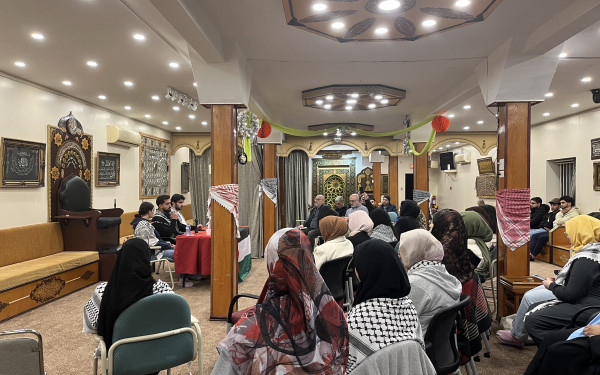
Maté was in Montreal for a panel discussion on Palestinian liberation organized by the Political Science Student Association of Concordia University (PSSA) and the independent advocacy group Solidarity for Palestinian Human Rights (SPHR) Concordia.
The Link sat down with Maté to discuss student activism in support of the Palestinian cause.
Many students and activists on campus are familiar with you from either the documentary Discordia or your activism in support of the Palestinian cause. From being a student to now being a journalist, how have your views on Palestine evolved?
The only evolution is that I think to a certain extent I still had, as a younger person who grew up Jewish in North America, some tribalism, some kind of elements of Jewish tribalism. That's been totally shaken out of me.
Even at Concordia, I look back on that time with some regret and embarrassment because, for example, when Netanyahu came, we protested and shut it down. At the time, I was conflicted because I was thinking, "Well, what about free speech? Do we want to be on the opposite side of free speech?" That was wrong, and of course, it was great to shut it down.
Seeing the evil that I believe Israel has become and the cynicism of its supporters, the censorship and intimidation that's deployed to silence people who speak up for basic Palestinian rights, it’s underscored that Israel truly is a project that's incompatible with basic human standards. I've always known that part, but I guess back then, when I was younger, I gave its supporters more grace than I think they deserve.
When you were at Concordia, it was around the time of the Second Intifada, and now we have the ongoing genocide in Gaza. Do you see any parallels between the activism that you were doing back then and what you see on other campuses now?
I hope to be a part of a continuum of decency that spans many generations. Many people came before my generation, and many people will come after yours, and you hope that you’re all part of a bigger project that leads to what Dr. Martin Luther King Jr. said about how the arc of history bends towards justice.
During the Second Intifada, I was inspired by going to Concordia, as SPHR was very organized and very brave. The Islamophobia after 9/11 was really strong, and it was scary.
It’s, of course, scary now to be a supporter of Palestine, especially if you’re Arab or Muslim. The consequences for speaking out are very stark: you can get deplatformed, deported and suspended from school.
When I saw all the campus protests against the genocide pop up, I was inspired by that, and I certainly felt a real connection to it, having been involved in activism during my time as a student.
You’re in Montreal for a panel that the PSSA and SPHR Concordia organized. What is the importance of linking the struggles in Gaza to Montreal's community through panels like this?
The foremost importance for me is to show Palestinians that they're not alone, and that they have people out there who refuse to accept what our governments are doing to them, and what they are complicit in.
It's important, at a time when there is so much censorship and cancellation, that we all come together and use the power of the masses, and also our moral argument that we're on the side of human decency, and that we refuse to let these crimes that are being committed against the people of Palestine go without challenge.
We were reminded of the censorship regime that we live under with this event, when the Canadian government denied entry to one of the speakers, Rima Hassan, an elected member of the European Parliament. She can't even come to Canada to speak about Palestine. If they're going to block an elected member of the European Parliament, they can do it to anybody.
Near the end of the Discordia documentary, there seems to be a place where you realize how much time you spent on campus and how, sometimes, it feels like campus politics becomes its own microcosm for geopolitical issues. What is the link between engaging in campus activism while still remembering the material harm being done abroad?
I remember grappling with this because part of the problem with being a campus activist is, at least in my case, there's drama with your opponents, the people you're against, and then internally, too, there's all this drama as well. It's so easy to get caught up in that.
Then, of course, people get suspended, or there's deplatforming campaigns and all of a sudden, all your time and energy is going into protecting yourself and dealing with these internal issues rather than trying to educate the public about what's going on in Gaza.
Of course, the censorship controversies that happen are a way of educating people because they show how desperate the Zionist lobby is to silence dissenting voices.
People have families that they have to support and that depend on them, or families who spend a lot of money to put them in school. You don't want to jeopardize that, and you want to be there for your family and not cause them stress if you get caught up in some manufactured case being persecuted for supporting Palestine.
It's tricky, but if you have the privilege of being able to be involved in the struggles, then the focus should always be on what is the best thing I can do for the people under occupation.
Do you have any future anxieties or hopes about student activism and its implications for what’s happening in Gaza?
Look what happened to the encampments. I know there was one here at McGill University, and there was a really harsh crackdown. It happened across North America at campuses where students who went out bravely put themselves on the line, slept in tents, faced suspension, persecution, and had their degrees revoked.
I happened to be in Los Angeles when the University of California, Los Angeles campus in Westwood was having a huge encampment. A few days after I visited, footage came out of Zionist mobs attacking people with projectiles, and there was even an explosive, and the police just watched. They just watched as peaceful and anti-genocide protesters—college kids—were being attacked.
Eventually, somebody was arrested, but overall, you just got the impression from that experience that there was impunity for violence against people who support Palestine. The crackdown was very effective and sent a huge chilling effect because it got to a point where not only are you risking your future as a student by supporting Palestine, but you could be risking your life if mob violence by Zionists is granted impunity.
I do believe that your generation, which grew up seeing on your phones a livestreamed genocide and the total complicity of our governments, drew a red line. That, to me, is a red line that remains etched in all of our consciousness forever, and that no amount of censorship, intimidation and propaganda will ever be able to reverse.
I'm hopeful that there's now a new moral awakening in your generation that wasn't there with mine and the ones before me, that will have a very positive impact on future generations.



_600_375_90_s_c1.jpg)