Tatreez workshops rewrite narratives around connection and belonging
The McGill University QPIRG event showcases the relationship between craft and resistance
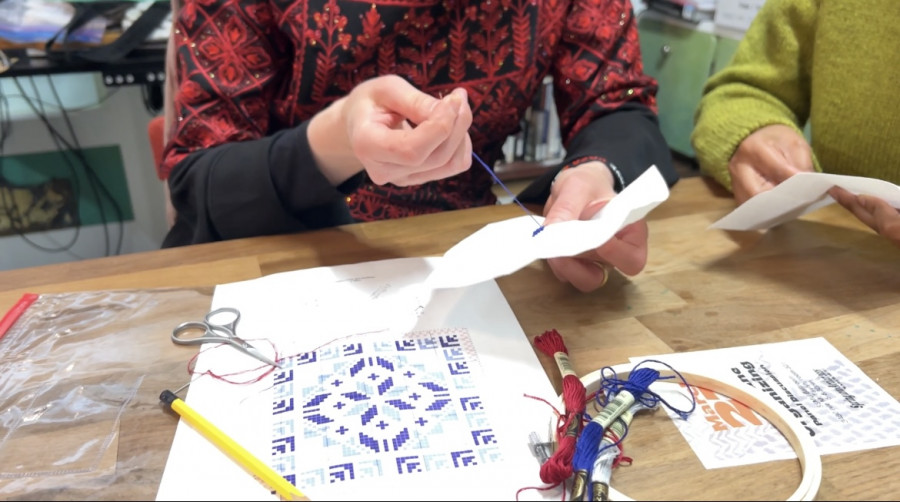
The McGill University Quebec Public Interest Research Group (QPIRG) held a tatreez workshop on March 26 as part of its Spring Into Action series.
Tatreez, which translates to embroidery in Arabic, is a traditional but evolving form of Palestinian embroidery that conveys origin, identity, marriage and economic status.
Palestinian artist Suzane Obeid, who facilitated the workshop, said that tatreez became a way to keep Palestinian culture alive.
“When we started the diaspora, it was used as a symbol of resistance, keeping our culture, teaching it from generation to generation,” Obeid said.
QPIRG is a non-profit that focuses on community building in Montreal while fighting for social and environmental justice, hosting workshops, panels and screenings. The event was held in QPIRG’s alternative library, which houses an extensive collection of books and zines focused on social and environmental justice.
Through workshops like this, QPIRG aims to connect cultural practice with broader social and political conversations.
Nelly Wat, QPIRG’s outreach and promotions coordinator, said these events help make those ideas more accessible.
“It's a great way, I think, to introduce people to new concepts, new ideas as well through something that's tangible,” Wat said.
Wajiya Amjad, a volunteer for QPIRG’s library and popular education committees, said this year’s theme centres on connection.
“The theme that we picked this year was common threads, kind of looking at the interconnectedness of struggles within borders and across borders,” Amjad said.
Obeid began the workshop by outlining the history of Palestine from the Ottoman Empire up until now.
“We shared these things that are kept close to someone’s heart and are very protected. It meant a lot to be able to come here.” — Anya Merzikian
She highlighted the 1948 Nakba, translating to catastrophe, during which Israel displaced at least 750,000 Palestinians from their homes and 15,000 were killed in a massacre. Obeid also recounted the 1967 ban on the Palestinian flag, which wasn’t allowed to be waved in the occupied territories.
Doing tatreez has become a way for Obeid to preserve her family heritage, identity and culture after being displaced.
“This is the only way that we can actually keep that identity present here and try to keep the connection with the land as much as possible,” she said.
Obeid described the act of embroidering as deeply personal.
"[It’s] a moment between you and the memories and the desire to actually go back and try to create things,” she said.
Following the workshop, Anya Merzikian, a McGill student, said she was grateful for the opportunity to discover another culture.
“It felt like we shared a moment of vulnerability," Merzikian said. "We shared these things that are kept close to someone's heart and are very protected. It meant a lot to be able to come here."
McGill has recently been accused of limiting free speech by four different union groups due to its decision to pull funding from QPIRG because of its support for pro-Palestine group, Students for Palestine's Honour and Resistance, known as SPHR.
At the federal level, in 2024, the wearing of the keffiyeh, a garment representing Palestinian heritage and culture, was banned for the legislative assembly inside the House of Commons.
For QPIRG, uplifting Palestinian culture is a step to fight against its erasure.
“I think an understanding of how small things, day-to-day or cultural things, are important in ensuring that people going through a genocide are not lost in history,” Amjad said.
Seeing the genocide unfold in Palestine made Obeid feel hopeless.
“We've reached a point where we felt that we were, you know, useless," she said. "We couldn't do much because, you know, it was just ongoing and ongoing and nothing was really being done seriously."
However, in times of mass displacement and erasure, Obeid believes that even small gestures can have a big impact in the fight for Palestinian liberation.
“We cannot just stand there and watch," she said.
Obeid said increased awareness since 2023 has been meaningful despite uncertainty about the future.
“A lot of people didn't even know before 2023. They didn't know about Palestine. They didn't know what was happening," she said. "I feel really, really honoured because there are people who care."



_600_375_90_s_c1.JPG)