Concordia Formula Racing unveils 2026 car
The team will test and improve the vehicle before competition begins in June
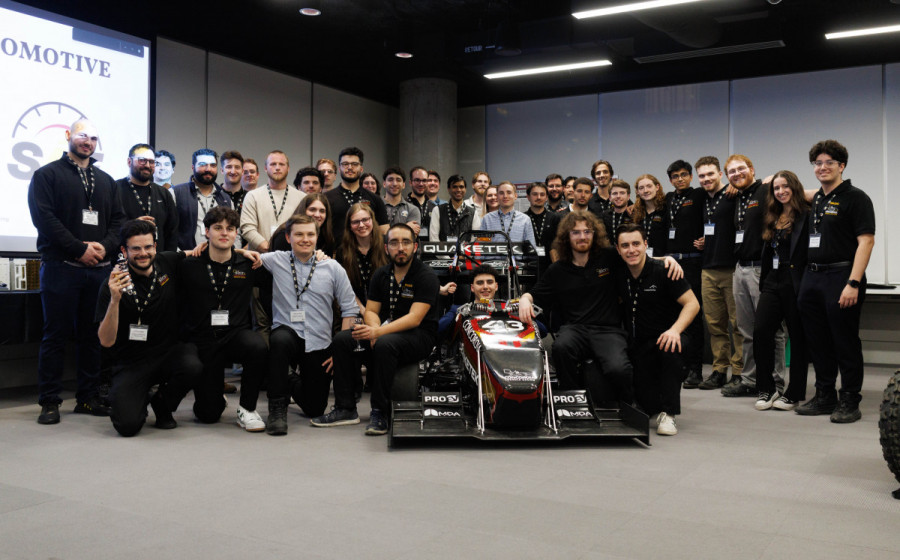
The Concordia Formula Racing team, a cohort of Concordia University’s Society of Automotive Engineers (SAE), unveiled its new car for the 2026 competition at the annual AutoX design showcase on April 2, an exhibition highlighting SAE’s success in 2025-26 while previewing future endeavours.
“AutoX is awesome because we really get to show the sponsors, alumni, and staff appreciation,” said Matteo De Luca, a third-year mechanical engineering student and the 2025-26 coordinator for Concordia Formula Racing.
“They've been with us, helping us throughout the year, so it's really awesome to show them this is what we've been working on,” De Luca added.
Concordia’s three teams—AeroDesign, Formula and BAJA—compile a collective of students who design, assemble and test custom-made vehicles. Once completed, they take them across the world to compete in SAE competitions against other universities.
This year, AutoX featured a slew of displays and models as team members, alumni and sponsors mingled among the exhibits. Both AeroDesign and BAJA featured the team’s vehicles as their centrepiece, but Formula kept their surprise hidden for the perfect moment.
Throughout the night, speeches from team members and organizers celebrated the student society's hard work. After hearing from AeroDesign and BAJA, De Luca announced the new car and revealed it to the room, eliciting a wave of applause for its design.
Joshua Lafleur served as Formula’s electrical technical director before moving into the electrical advisor role. He praised the team for its hard work and satisfaction with a job well done.
“This project is not any one person. It's everyone on the team,” Lafleur said. “And it really proves that you can do anything."
Formula’s new car features substantial upgrades over its predecessor. Andrew Freeman, the team’s technical director, explained the team’s largest development: a new battery pack for the 2026 car that better suits the application at hand.
“We lost about 20 kilos compared to last year,” Freeman said. “So in racing terms, that's a big deal.”
James Savelson, the team’s High Voltage co-lead, added that the 20 kilograms accounted for roughly 10 per cent of the previous vehicle’s mass.
“It is significant, and it's a lot of really cool technology packed into a very small space that we're excited to see what we can do with it,” Savelson said.
“This project is not any one person. It’s everyone on the team. And it really proves that you can do anything.” — Joshua Lafleur, electrical technical director, Concordia Formula Racing
The team also found other areas to reduce the car’s weight. Stefano Bianco, the Harness and Grounded Low Voltage lead, outlined the team’s rework and improvement of the car’s wiring, allowing the team to reduce the harness weight by another 3.5 kilograms.
“Once you know every wire, where they go and how everything is sorted, and everything is nice and happy, when you run the car, you're going to basically eliminate any reliability issues,” Bianco said.
These design elements underline the primary achievement of the Formula car’s unveiling. With months to go before the first competition, the team now has the chance to conduct tests and fix any mistakes before officially entering a race.
Lafleur applauded the team’s achievement of completing the car in time for AutoX, something it had never done before.
“Now that we've been able to accomplish delivering a product this early in the season, it really opens a lot of doors for pre-competition testing, validation and improvements,” Lafleur said.
Concordia endured a rough patch during the 2025 season, finishing 41st out of 80 teams at the Formula SAE Electric 2025 competition in Brooklyn, Michigan, but failing to attempt any of the drive-related events. De Luca commended the team for a quick, motivated turnaround after the previous year’s disappointment.
“We had a group of students that were super hungry and really not satisfied with that result, and began to work immediately, hopped on the horse right away and started going at it,” De Luca said.
As the night concluded, the teams gathered around their vehicles for a group photo, sharing in the success of their colleagues and classmates. Each team took its moment in the spotlight to celebrate the hard work of all involved.
For Freeman, the satisfaction of completion hinged on every individual detail.
“It's all really nice to see that everyone's hard work, even in the most minute detail, actually amounts to something that could be very important, even though most people would neglect it at first glance,” Freeman said.



4_600_375_90_s_c1.jpg)