Iranian Montrealers grapple with communication crackdown in Iran
Community members say responsibility to raise awareness falls on those abroad
_900_599_90.jpg)
With communications from inside Iran severely restricted and reports of deadly regime crackdowns continuing, members of Montreal’s Iranian community say the responsibility of speaking about the crisis increasingly falls on those living abroad.
Demonstrations across Iran have intensified in recent years, driven by widespread anger over political repression, economic hardship and strict social laws. Human rights organizations and activists report that authorities have responded with mass arrests, violent repression and internet shutdowns intended to limit the spread of information.
Earlier this month, the United States and Israel launched coordinated airstrikes across Iran, targeting military infrastructure and senior leadership.
In the initial wave of attacks, Ayatollah Ali Khamenei, Iran's supreme leader, was killed. In response, Iran led retaliatory missile attacks across the Persian Gulf region.
With the current military exchanges, there are growing fears of a regional war amid the restricted access within the state.
Pouria Nouri is the president of the Iranian Graduate Students’ Association of Concordia University and one of the organizers of Iranian demonstrations in Montreal. He said the situation inside Iran is often misunderstood internationally.
“What many people see outside Iran are fragments,” Nouri said. “But what is happening is systematic killing, mass imprisonment and fear being used as policy.”
According to Nouri, the scale and speed of the violence make it difficult for journalists and activists to document what is happening across the country.
“When this is framed as unrest or instability, it loses urgency,” he said.
For many Iranians living abroad, the crisis has become personal.
Morteza Tabatabaei, a Concordia photography student, said watching events unfold from outside Iran has created a painful sense of distance.
“The truth is it’s not a very new experience, but its intensity has increased,” Tabatabaei said. “There was always this sadness for me that I couldn’t be next to my fellow citizens.”
Tabatabaei said the people who have died during the protests in Iran should be remembered as ordinary individuals who lost their lives demanding the ability to live freely.
“A series of youth who just wanted to have a normal life,” Tabatabaei said. “They were shouting their human values and their freedom-seeking even though they knew their lives were in danger.”
Iran has seen repeated waves of popular uprisings over the past century, from the 1979 revolution that brought the current regime to power to more recent protest movements driven by demands for political reform and personal freedoms.
For Tabatabaei, today’s demonstrations are part of that longer pattern of resistance rather than a sudden or isolated moment.
“This movement of the Iranian people started long before foreign countries became part of the story,” Tabatabaei said. “It should be viewed more deeply and historically.”
For others in the Iranian diaspora, maintaining the cause’s visibility is essential.
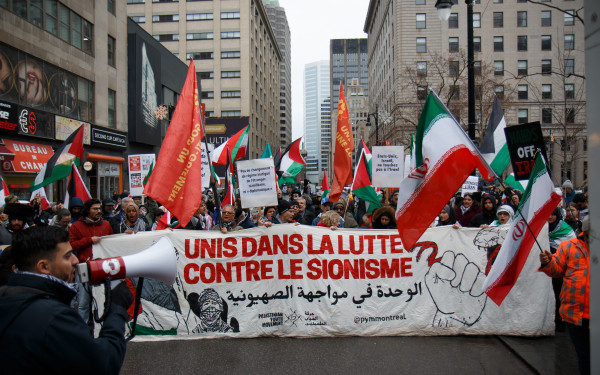
Kasra Mokhaddarati, a McGill University student who has participated in demonstrations in Montreal, said protests outside Iran play a crucial role in keeping international attention on the crisis.
“If this doesn’t happen regularly, people stop paying attention,” Mokhaddarati said. “The voice of the people in Iran has to reach outside.”
He added that following the news from Iran has taken a heavy psychological toll on him.
“You’re constantly checking the news, not sleeping properly, not knowing what’s real,” Mokhaddarati said. “And while we’re here, the people we know back home are living inside the tragedy.”
There are those whose families are still in Iran. One of them is Arsham Madadi, a security volunteer helping coordinate safety during Iranian demonstrations in Montreal. He said that the increasingly limited communication has made it difficult to reach loved ones in the country.
“The end of the Islamic Republic is our primary goal, and freedom for Iran is the only reason we, the people, fight,” Madadi said.
Although he said the current situation appears dark, Madadi expressed hope in the Iranian people's resilience and unity. Despite political differences among Iranians abroad, Madadi said solidarity remains strong as the crisis continues.
“As Iranians, we are proud of who we are. Despite our differences, we are united and beautiful, and we are becoming more empathetic and united every day,” Madadi said. “This is a source of pride for us to show the world the rich culture of our 2,500-year-old country.”
For Mokhaddarati, the most meaningful outcome would be that the sacrifices of those who have lost their lives lead to lasting change.
“The best thing that can happen,” Mokhaddarati said, “is that they went into the streets for the hope of a free country.”