The rise of student gig work
Montreal students discuss working conditions and income instability in today’s gig economy
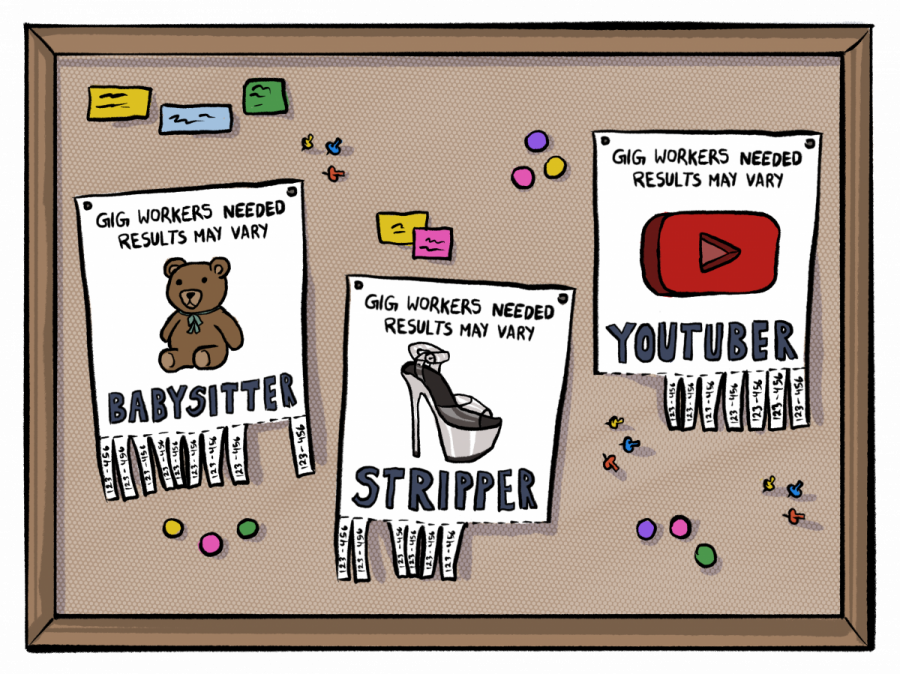
If you asked someone to name common university student jobs, sex worker, YouTuber and babysitter might not come to mind.
But in today’s gig economy, as more Canadians rely on freelance work and youth unemployment is on the rise, many students are finding new ways to make ends meet in Montreal.
Shawn Grenier is a political science student at Université du Québec à Montréal and creator of the YouTube channel The Canvas.
Their channel focuses on art history, but their recent content has leaned into political art history and antifascism. Recent topics include the Bad Bunny Super Bowl halftime show and historical antifascist self-portraits.
Grenier has been making videos for over seven years, but has only been able to earn a living for the past three to four years, mainly through ads, Patreon and contract work for larger media organizations.
Working full-time on YouTube gives Grenier the flexibility to attend university, partake in volunteer work and work without a boss.
“Since it’s not a regular [schedule], sometimes I have to decline because I have class. Or, there are a few times where I skip class in order to babysit for them all day because, well, I need the extra cash.” — Chloe Ennis, student and babysitter
Gabrielle Lalande, a full-time stripper and recent Concordia University graduate who was granted a pseudonym for safety reasons, also appreciates the flexibility that gig work offers, especially for students.
“I was able to fit random work schedules between my classes, allowing me to actually have enough money to live during my degree,” Lalande said. “Gig work is really nice when you don’t want to necessarily work a 9 to 5 or [if you] have other priorities in your life.”
Lalande has worked several gig jobs, including as a ranch hand and a maid. They argue that students are pushed into gig work because many jobs now require significant education or an “extensive resumé.”
However, they have said they have experienced many obstacles when it comes to job and financial security.
“Money is completely up and down, and it’s a gamble every time you go into work, especially in the context of the strip club, where you have to pay to be there,” they said.
For Lalande, the biggest downsides of being a gig worker at a strip club is mismatched expectations and unexpected costs, especially as shifts often run much after the Metro closes.
“We are classified like independent contractors but treated like employees,” they said. ”Despite not getting an hourly wage, we have to listen to the management’s rules about what time we show up, what clothes we wear, how nude we get, amongst a bunch of other rules.”
Lalande argues that classifying strippers as gig workers rather than employees is a way for owners or managers to exploit them and avoid providing benefits. They explained that gig workers do not get a wage, sick leave or workers’ benefits, adding that the lack of a safety net can be very dangerous for strippers, given the physical nature of the job.
“Normally, when you receive a wage, it’s kind of part of the deal,” they added. “But we don’t get guaranteed anything and still have to work.”
Chloe Ennis is a student in Concordia’s child studies program and a part-time babysitter. Since August 2025, she has worked on call every few weeks to provide childcare services for a Montreal family.
“I was looking to make some extra cash, and so I looked on Facebook on a bunch of different groups for parents looking for babysitters,” Ennis said.
Ennis said that working as a babysitter has helped her pay some of her bills while maintaining her status as a full-time student. Still, according to her, the gig’s lack of stability presents clear challenges.
“Money is completely up and down, and it’s a gamble every time you go into work, especially in the context of the strip club, where you have to pay to be there.” — Gabrielle Lalande, stripper and recent graduate
“Since it's not a regular [schedule], sometimes I have to decline because I have class,” Ennis said. “Or, there are a few times where I skip class in order to babysit for them all day because, well, I need the extra cash.”
She added that, because of inconsistent scheduling, gig work such as this is not ideal for students looking for quick cash.
“Someday I might be working for eight hours, and the next day would only be like three,” Ennis said. “Also, it can be hard to find a family that meets all your criteria in terms of salary and hours and schedules, especially with class.”
Grenier echoed the sentiment that gig work income is often inconsistent and unstable.
“I’m grateful for this job because I love it so much,” Grenier said. “But the income is very variable, and sometimes it’s very stressful because it’s so dependent on the algorithm.”
Grenier explained that YouTube payouts are based not only on view count. They also hinge on how much advertisers are willing to pay to reach people in the countries where the views originate.
Copyright claims can also be a major issue for YouTubers. The copyright holder of a piece of media, such as a song or film, can accuse a content creator of an alleged copyright violation and claim the entirety of a YouTube video’s income as their own.
In early February, Grenier received a copyright claim for a video that included short clips of a movie. Grenier attempted to appeal the claim, arguing that the video clips fell under transformative use. However, the final say was given to the copyright holder.
“I worked two weeks on [the video], and I’m not getting paid for it,” Grenier said.
Gig workers in service industries have attempted to create safety nets by organizing together.
In Montreal, the Sex Work Autonomous Committee (SWAC) recently announced an upcoming May 23 strike for workers in strip clubs and massage parlours.
SWAC organizers say they are striking to demand the abolition of pay-to-work fees; the institution of employee status for sex workers, which would allow access to unemployment insurance and coverage from the Commission des normes, de l'équité, de la santé et de la sécurité du travail; and an end to unsafe working conditions.
“The first step is to dispel the illusion that we are self-employed,” SWAC said in their announcement. “In reality, we have an employer, and they have a legal obligation to provide us with safe working conditions, just like in any other job.”
This article originally appeared in Volume 46, Issue 12, published March 31, 2026.



_600_375_90_s_c1.jpeg)