
Social (Cult)ure: The myth of self-improvement
A multi-million-dollar industry built on never being enough
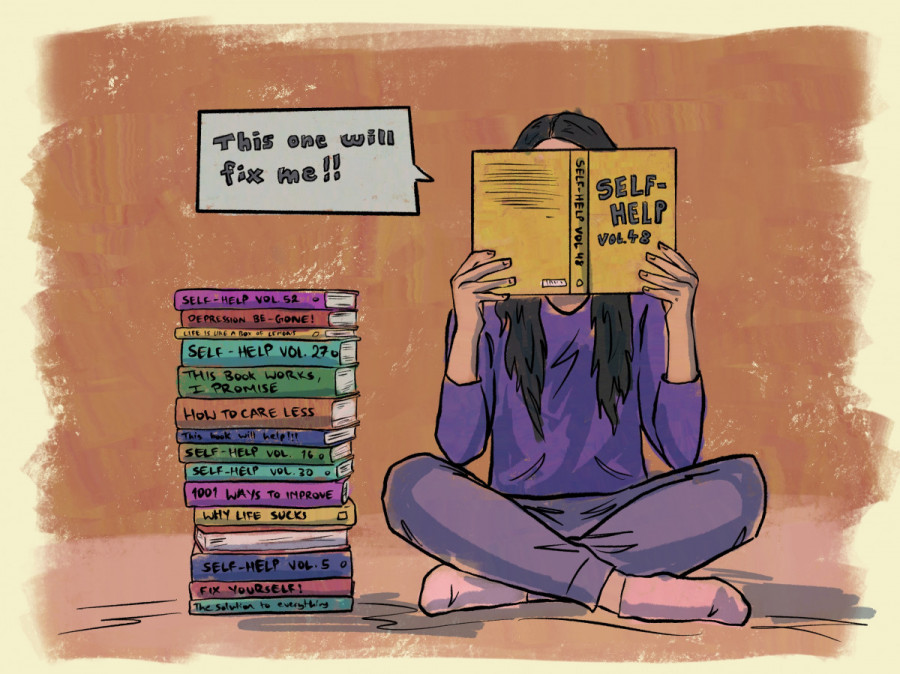
Few places in a bookstore feel as embarrassing as the self-help section.
One cannot be caught lingering there, casting furtive glances in between the shelves of Atomic Habits or Breaking the Habit of Being Yourself. There is something oddly private about seeking improvement, as though the desire to become better indicates an inherent failure within us.
The origins of the self-help book date back to ancient Egypt and Greece, where instructional texts circulated, giving wisdom on moral behaviour, self-control and how to live properly. At its core, the self-help genre was once a gesture of care that was meant to guide us for generations.
However, in recent years, self-help has transformed into a major industry that thrives on self-surveillance and profit maximization.
While there are a small number of authors offering thoughtful insights, their work is often drowned out by the multitude of recycled advice that floods the self-help market.
Many popular books regurgitate oversimplified advice that cannot be realistically applied, and the broader effect is significant, resulting in a hyper-individualistic culture that is indifferent to community. Simplistic lines like “manifest the reality you want” or “incorporate mindfulness into your life” have become widely popular across online spaces, slowly beginning to resemble an ideology rather than guidance.
In recent years, the self-help industry has proved to be especially skilled at pushing solutions to problems unbeknownst to us. Nowadays, we cycle through trends with remarkable speed: whether it’s the latest dietary fad, productivity system or exercise routine, each trend implies that there is something within us that requires immediate fixing.
Over time, a false sense of community begins to form around these routines and slogans, while success becomes narrowly equated with personal advancement, and collective responsibility continues to be neglected.
Today, the freedom to choose when to improve is nonexistent.
Instead, one is expected to actively seek new ways to reinvent oneself, which often results in feelings of low self-worth and inadequacy. In riding this train of perpetual improvement, one finds oneself trapped in a loop of self-surveillance. Life begins to resemble a panopticon, except the guard and the prisoner inhabit the same body.
Today, self-help functions as a cultural buzzword, not the meaningful practice it was originally intended to be. What began in the ancient world as practical guidance has evolved into a global industry that thrives on performativity and identity fragmentation. Existence, then, becomes a laborious task of self-surveillance. To move away from this cycle is perhaps the most helpful act one can offer oneself.
By allowing space for learning and embracing our failures, we can improve naturally rather than by force. And perhaps, in time, the self-help aisle at the bookstore won't feel so daunting anymore.






_600_375_90_s_c1.jpg)