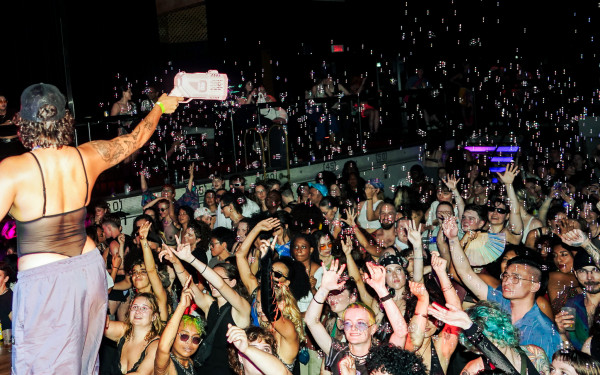
More than a salsa night
La Murga is reshaping how the genre is played, heard and experienced in Montreal
For years, Montreal’s salsa scene has existed in fragments.
Patrons rotate through venues outside the downtown core, in recurring circuits, with the same bands and the same songs. If you knew where to go, you could find it. If you didn’t, it wasn’t exactly looking for you either.
La Murga is trying to change that.
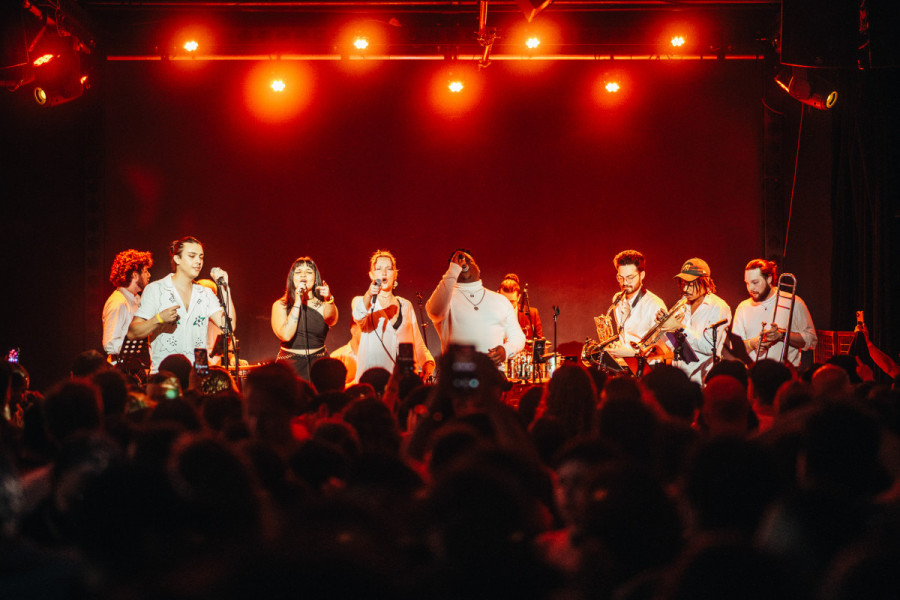
Founded in 2023 by Juan Felipe Quintero and Mateo Diaz, the Montreal-based collective brings together live salsa performance and vinyl DJ sets in a format that feels closer to how the music actually lives: social, accessible and built around movement.
Quintero describes arriving in Montreal and not finding a space that reflected the salsa culture he knew. He explains that while there were some events, the two felt disconnected from the city itself.
“It's not accessible for the people who are part of the Latin diaspora, that live in the city, that move within the city,” Quintero says. “It's not an urban thing, but salsa is an urban music.
That distinction, between salsa as an urban, social form and how it was being presented, became the starting point for the collective.
How can we make this a night that’s attractive to the Montreal crowd, to people that haven’t really been exposed or introduced to this genre? What about those who know and love it? — Mateo Diaz
Quintero, who spent his teenage years in Cali, Colombia, came to Montreal to study music at Concordia University. He eventually shifted from classical to jazz, and after a year of playing across different scenes, one absence stood out.
“I wanted to play salsa, because I've played everything here,” Quintero says.
Diaz describes a similar realization, though it came from distance rather than absence. After moving from Bogotá, Colombia, salsa became something he only recognized once it was no longer around him.
“You just had this void that you didn’t even know you had at the beginning,” Diaz says.
The two met through mutual connections and began building La Murga out of their shared feelings. Early events were informal and experimental, starting as jam sessions before evolving into more structured performances.
Diaz says the goal was to create something that could speak to multiple audiences at once.
“How can we make this a night that's attractive to the Montreal crowd, to people that haven't really been exposed or introduced to this genre? What about those who know and love it?” he says.
That tension of wanting familiarity and discovery defines the collective. Part of it comes down to format. A typical La Murga night moves between a live band and vinyl DJ sets, creating a continuous flow rather than separating performance from party.
Diaz explains that incorporating DJs also depends on responding to how people experience nightlife in the city.
“People are used to their events having a DJ now,” he says.
Diaz adds that the shift toward vinyl was intentional, rooted in the history of salsa as a club and collector-driven genre.
“Vinyl DJ sets of salsa were a huge thing,” he says. “We can also educate people on an older type of salsa.”
For Quintero, that structure isn’t just about the event’s programming but about holding space for different ways of listening. He frames it as a balance between those deeply invested in the genre and those encountering it for the first time.
“There’s a fine line,” Quintero says.
Instead of simplifying the music, the approach is to trust that complexity can still connect with attendees.
“If a crowd that has never heard salsa in their lives heard really musically challenging salsa [...] they’re going to be attached immediately,” Quintero says.
David Ryshpan, a pianist with La Murga who has been part of Montreal’s Latin music scene for nearly two decades, sees that mix play out in the crowd.
“You have the old school salsa heads, the music nerds and then this whole other contingent of young Latinx people,” Ryshpan says. “These are people who would never cross each other otherwise.”
Ryshpan compares that energy to an earlier version of Montreal’s music scene. He describes walking past venues where the music would spill out into the street, pulling people in without much effort.
“I feel like La Murga has that,” Ryshpan says. “Even if I go alone, I’m going to run into people.”
Quintero says he notices the same sense of continuity on stage.
“It feels like there’s people who are there always,” he says.
Inside the band, a similar exchange plays out through the ensemble’s intergenerational dynamic. At almost 23, Quintero leads a group that includes musicians older than him.
He explains that leading a salsa band requires a different kind of awareness, with more emphasis on structure and direction. Over time, that pressure has shifted into something more collaborative.
“When I’m failing to give a cue, someone else picks it up,” Quintero says.
That collaboration has become one of the most meaningful parts of the project for him.
“The biggest gift that it has given me is to build a little family of musicians,” Quintero says.
Behind the scenes, that same attention to structure carries into how the events are produced.
La Murga is fun and exhilarating, and for an outsider to the music like me, it welcomes you in with open arms. — Bryan Li
He adds that even without dancing, the atmosphere keeps him coming back.
“It’s an event where you want to bring your friends to, and it’s a great place to make new friends,” Li says.
As La Murga approaches its third year, the project is expanding while maintaining its core approach.
Diaz says the focus moving forward is to bring the music back into more open and accessible spaces, like how Salsa is authentically played and enjoyed.
“It can start in a café, it can start in the street, it can start in a house,” Diaz says. “It’s meant to gather people, to connect people and to make people feel like they belong”.
That direction is already shaping what they’re working toward.
Diaz mentioned the possibilities of hosting dance classes. Over the summer, the collective is planning a series of outdoor events and collaborations, alongside a fundraiser supporting ongoing crises in Cuba.
At the same time, Quintero is beginning to turn toward original material after building out a large repertoire with the band.
“I feel like now I have a much more clear path of where I want to go sonically with the project,” Quintero says.
What started as an attempt to recreate something from elsewhere is now settling into something shaped by Montreal itself. For now, especially with summer around the corner, it’s something you have to experience in the room.
The collective’s next show is set for April 29 at La Sala Rossa.
This article originally appeared in Volume 46, Issue 12, published March 31, 2026.