The Sum of Sound
Odie Harr’s ever-shifting collective turns their shows into something shared
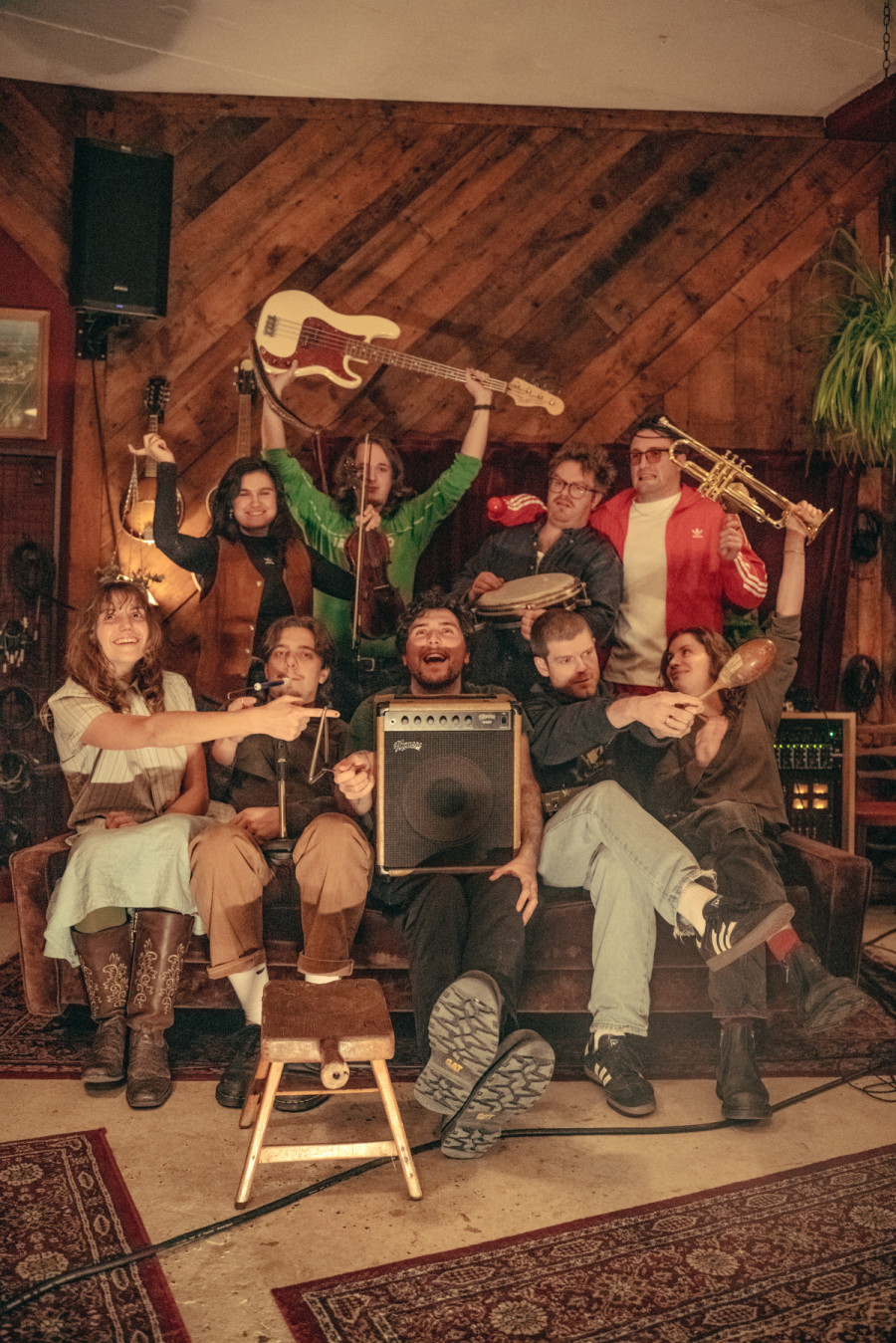
Nine-piece ensemble Odie Harr took the stage at Turbo Haüs on April 10 alongside Animal Boy, Birds of Prrrey and Fake Friends for the latter’s LP release, delivering a high-energy, sold-out show.
At first glance, you’re not sure where to look: a full stage, instruments layered across it, musicians shifting to make space for one another. Then they start playing.
There’s no slow build, no easing in. They jump straight into it, something guitarist and vocalist Shane Stewart had mentioned beforehand.
“It’s gonna be greasy, it’s gonna be exciting, it’s gonna be really hot in there,” Stewart said.
The set leans into that energy. Playing alongside heavier acts, the band shifted its usual balance, cutting slower songs in favour of something more immediate, more driving, with little to no pause between tracks.
Even with everything happening on stage, the sound holds together. Each instrument finds its place without competing for space.
Odie Harr builds itself not around a fixed lineup, but a shifting group of collaborators that expands and contracts depending on the show.
Core members often include Stewart on guitar and vocals, Callahan Ioannou on acoustic guitar, Marco Robertson on keys, Matt Grant on drums, Molly Snyder on trumpet, Antoine Morin on trombone, Talya Amira on harmonies and Jo Lashuk on accordion.
Though who appears on stage is always subject to change.
“It’s kind of grown,” Lashuk said. “We’ve gained a member every couple of months. It’s been exponential.”
Many of those connections trace back to open mic nights across the city, particularly those hosted at Bar Courcelle in Saint-Henri, where several members first met in 2022 and began playing together.
“When I used to watch them, it felt like you were part of it,” Shukla said. “Now being on stage, it’s the same energy, just from the other side.”
The project itself took shape following a one-off full-band cover of In the Aeroplane Over the Sea by Neutral Milk Hotel, performed at Turbo Haüs as a fundraiser for the Palestine Children’s Relief Fund.
The album, known for its layered instrumentation, including horns, accordion and a dense, collective sound, required a larger group to perform live.
What started as a single show quickly became something more permanent.
“As soon as we finished that show, it was such a beautiful vibe," Stewart said. "Everyone was singing along and having a good time [...] I was like, we need to keep this going."
That fluidity carries into the way the band makes music. While Stewart writes the foundation of each song, the group shapes the arrangements collectively, with parts shifting depending on who’s in the room.
“The songs are always slightly changing. Every time they play a show, there are parts that can change,” said bassist May Shukla. “The fluidity of the membership makes the songs more loose. It’s not like a symphonic score.”
Shukla, one of the band’s more recent additions, stepped into the role of bass player for the show after previously performing with the group roughly a year prior. For her, joining didn’t feel like entering something new, but something already in motion.
“It feels like you’re hanging out with friends when you go to rehearsal,” Shukla said.
That same dynamic carries across the group. Songs aren’t built through strict roles, but through a shared understanding of direction.
“We want to have the same vibe,” Lashuk said. “But we’re not going to write one paragraph per person.”
In practice, that means knowing when to step back. With so many instruments in play, restraint becomes part of the sound.
“It’s about what serves the song more,” Morin said. “Not overplaying.”
As soon as the first note hit, the dynamic shifted. The room tightened, bodies packed close to the stage as the band, dressed in matching Adidas tracksuits, leaned into the performance. People tap their chests in rhythm. Others sway, dance or smile at friends and familiar faces in the crowd.
“When I used to watch them, it felt like you were part of it,” Shukla said. “Now being on stage, it’s the same energy, just from the other side.”
On stage, musicians glance at one another mid-song, laughing, staying in sync without needing to say anything. Hair that started carefully styled loosens as the set goes on, curls falling out of place, flyaways catching the light.
The energy builds without feeling out of control.
“It’s more like sharing an experience,” Morin added. “Not being like, ‘I play music, I gotta be serious for the crowd.’”
That sense of collectivity extends beyond the stage. For Stewart, seeing how audiences respond to a project helps make it meaningful, not just as listeners, but as participants.
“It kind of feels like a block party,” he said.
For a band that isn’t built to be easily packaged or scaled, that kind of response becomes the measure of success.
“A nine-person band isn’t very marketable,” Stewart said. “So if people vibe with this, that’s awesome. Every time we get on stage and play, we’ve made it.”
With their debut album Passing Show coming out in May, the band continues to build on that same foundation, one shaped less by fixed roles and more by collaboration, trust and presence.
For now, there’s no fixed trajectory beyond what’s already happening.
“Have a good time, hang out,” Lashuk said. “That’s the main goal.”