Concordia’s Society of Automotive Engineers is speeding to success
Student engineers race against time to complete several technical challenges
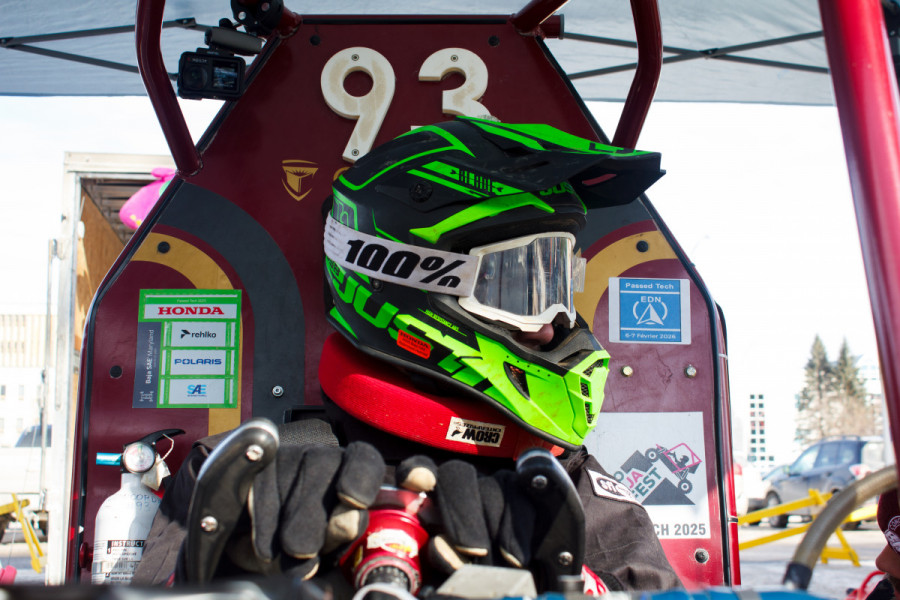
Inside “The Cage,” found in Concordia University’s Henry F. Hall Building, a group of determined student engineers race against more than just time.
These young innovators are preparing for international engineering competitions, where the difference between first and last place can come down to a singular bolt.
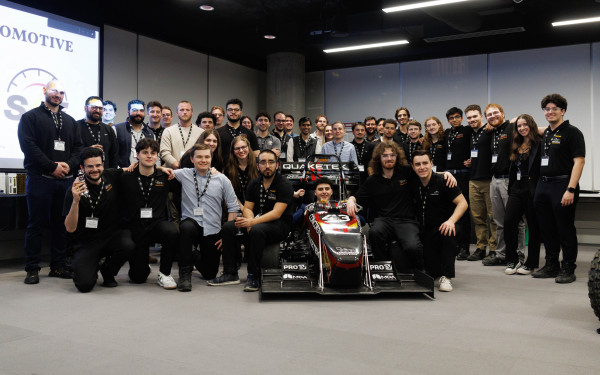
Students part of Concordia’s Society of Automotive Engineers (SAE) design and build vehicles to compete against hundreds of universities worldwide. The team competes in a variety of disciplines, like the Formula Electric competition and Baja off-road racing, and encourages students to work like an engineering firm rather than a school club.
The club is open to anyone and they’re always looking for students who have an interest in building cars. Sergio Baroud, a student engineer involved with the SAE, explained how simple it was to become a member of the team.
“My first year, I was at Frosh and I saw the model of the car at a fair, I just started asking questions and I was interested. I went to the info section and got in,” he said.
Concordia’s team is part of the global network under SAE International, which is in charge of the Collegiate Design Series, an assortment of competitions that challenge students to design, build and test sophisticated machinery.
These competitions differ greatly from traditional academic projects. Teams must manage their budgets, meet timely deadlines and defend technical decisions before expert judges.
This student-run team is managed entirely by a group of skilled individuals who work collaboratively under many pillars. From mechanical to software engineers, there is a department for everyone.
The Concordia team has existed for more than 40 years, improving its vehicles year after year. This continuity has allowed students to learn and evolve from past generations, taking lessons from the wins and losses of previous years to adapt their approaches to each competition.
Nehna Patel, the Concordia SAE VP external and the Baja racing team's business lead, noted that their preparations continue even after the event ends.
“When we come back, we actually disassemble the car to make sure everything is OK or to analyze what went wrong,” Patel said. “There’s a lot of making sure things are going correctly and changing things so they don’t happen again.”
Through the years, this institutional knowledge has turned into one of Concordia’s team’s most valuable competitive advantages.
Under the Collegiate Design Series, the competition requirements stretch far beyond simply racing. All teams must submit detailed reports containing their designs and complete cost analysis. They must also pass technical inspections before they're given the green light to hit the track.
“We’re always looking to better our car, no matter what.” — Nehna Patel, Concordia SAE VP external and Baja racing team’s business lead
These events test speed, endurance, efficiency and durability. Teams must ensure that their vehicles can withstand any challenges thrown at them, as a design that cannot be technically justified for their strong performance may lose points.
Preparations are completed months before the competition season to ensure that the vehicle will reach peak performance. During the design portion of the preparation, teams gather to work on design concepts, create models and perform various simulations. Every decision made must balance the weight, the cost and the manufacturability.
Once the designs have been completed, it is time to start manufacturing.
Students start assembling the systems and machine parts and running tests. It is common, expected even, to run into mechanical failures, with participants needing to run diagnostics to figure out what went wrong and how to improve the design before running the next test.
Students commit a lot of their time to the SAE. They often find themselves juggling their coursework with finding enough time to spend at the workshop. As a result, leadership groups are created to help keep the work on track.
Beyond formal coordination, the team relies on practical systems, including maintaining a clean and orderly workshop.
“One of the main things we try to do is keep our space as clean as possible, because during assembly things get messy and we have a habit of dive-bombing to get the car made,” said Sam Hashemi Asl, Concordia’s Baja racing team captain.
On a technical level, members achieve skills that are only attainable through direct experience rather than by sitting through a lecture.
Baroud discussed the importance of using learned concepts in real-world situations.
“Studying alone does not give you that experience that you need to get into the work field,” Baroud said. “This helps to get really hands-on and be able to integrate yourself into the field.”
Through their work, students learn the principles of mechanical design, programming, electrical integration and aerodynamics, among others.
When it comes to transferable skills, students learn to manage budgets, integrate logistics and present technical adjustments, all while managing the pressure of competition. These experiences help put students in real-world engineering scenarios, where projects may experience unplanned issues.
Patel remarked how the group’s attention to detail goes a long way in the success of the team.
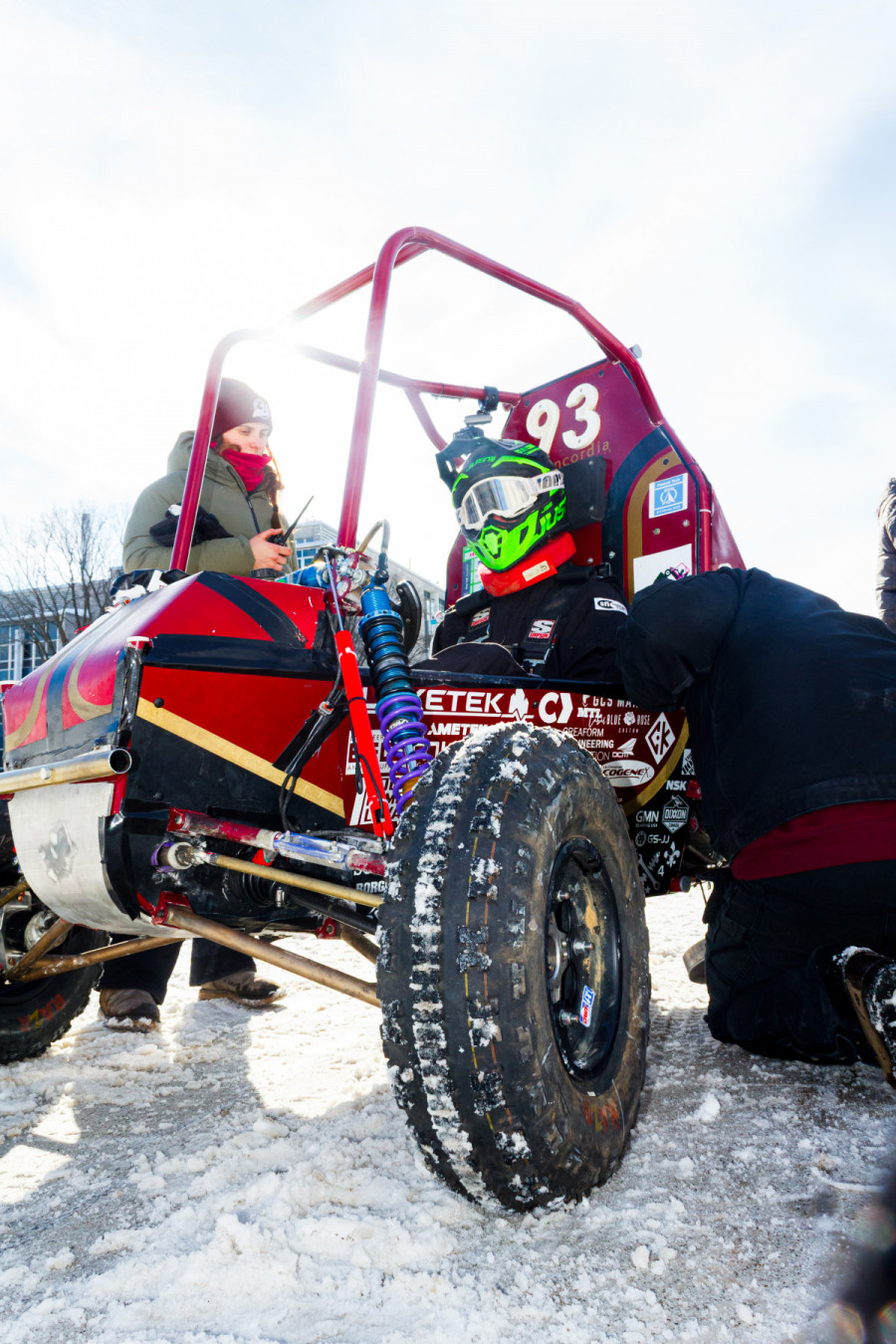
“We’re actively marking things down and making sure that parts we take off the car are put in their own place so later we can either use them or change them to make them better,” she said.
Asl agreed, emphasizing the importance of organization.
“You learn quickly that if you don’t stay organized, you lose time, and in competition, time is everything,” Asl said.
Despite all the planning, unexpected setbacks still occur. Funding grows tight, mechanical parts fail and time always runs out quicker than expected.
However, the members make it a point to treat every issue, including mechanical failures, as a learning opportunity rather than a loss. Through recording every detail and step in the conception and building of the vehicle, students can find the root of the problem and fix it as quickly as possible.
For Concordia’s team, the greatest focus is data collection.
“Historically, a lot of our data has been qualitative, like a driver saying the car feels bumpy over a jump,” Patel explained. “Now we’re trying to bring back our data acquisition systems so we can get quantitative numbers on how the car performs.”
As competition season is currently in full swing, all members of Concordia’s SAE continue to test and redefine their designs, in hopes of entering their best project yet.
At the last annual Épreuve du Nord winter competition hosted by the Université de Laval, the team managed to place fifth overall across six different dynamic events. These included placing fourth in the two-hour endurance race, as well as second in the design presentation, displaying how their electrical systems survive winter conditions.
For students like Asl and Patel, all results push them to bolster their end objective.
“We’re always looking to better our car, no matter what,” Patel said.
At the end of the day, the SAE isn’t just building vehicles; they’re building engineers.
This article originally appeared in Volume 46, Issue 10, published February 24, 2026.



4_600_375_90_s_c1.jpg)