Cinema Politica screens Edward Said documentary
Edward Said: Between Worlds makes its way to Concordia University, followed by a question-and-answer with the producer
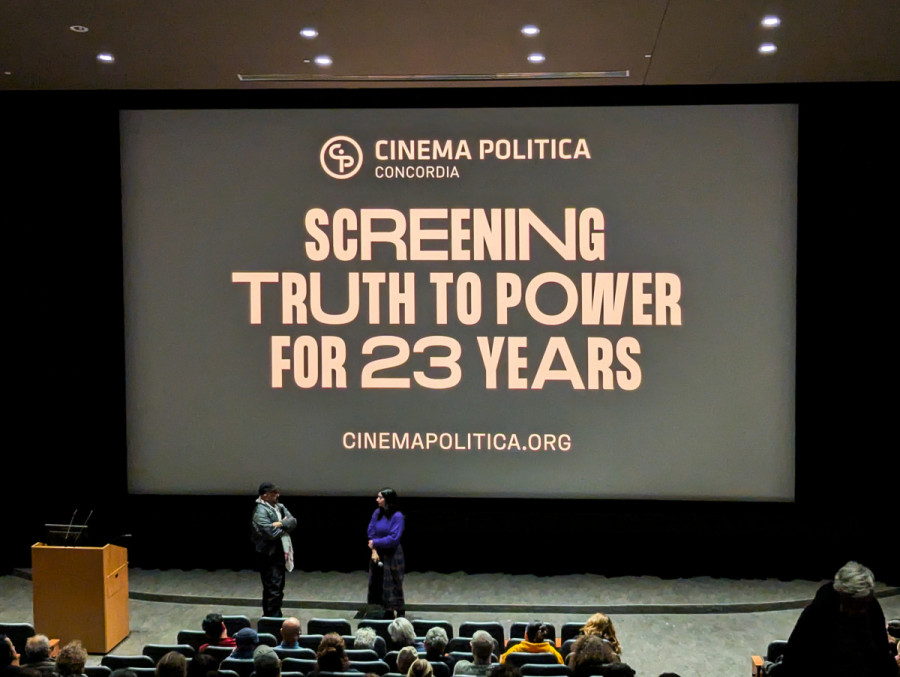
Cinema Politica held a screening of the documentary Edward Said: Between Worlds at the Sir George Williams Alumni Auditorium on Oct. 26. The screening was followed by a discussion and question-and-answer with the producer and was moderated by Concordia University professor Yassin Alsalman.
The film premiered at the Toronto International Film Festival last month and has also appeared at the Toronto Palestine Film Festival. It was selected for the Spotlight Gala section of the 2026 New York Film Festival.
The film uses previously unseen, family-owned archival footage documenting moments from the life of Edward Said, a former American-Palestinian professor at Columbia University and author of several influential books, including Orientalism, Covering Islam, The Question of Palestine, and his memoir, Out of Place.
The film follows Said from his birth in Jerusalem and his time spent in Cairo after displacement during the 1948 Nakba, to his death in New York in 2003 after battling leukemia for 10 years. It is a story of resilience, growth and his long-lasting influence on Western perceptions of the Arab world and Palestinian liberation.
Producer Sarah Mowaswes worked alongside Danish-American director Maiken Baird, who knew Said personally when she was younger and was able to offer a unique insight. As a Palestinian-American herself, Mowaswes said that making the film with the current situation in Palestine was frustrating yet healing.
“It was this grounding moment of, 'We know what’s happening in Gaza and Palestine is very real, [and that] the genocide is very active.' Even though [the film] doesn’t end with talking about Gaza or Palestine in the present day, that was always a part of the process of the filmmaking for us,” Mowaswes said during the post-film discussion.
The film serves as both a biography of Said’s life events as well as an overview of the historical events that took place in Palestine during his lifetime.
There’s so much anger and impotence because our political necessities are not being met [...] and there are also so many other things as well going on in our own local context of austerity and withdrawal of rights for so many people. We’re angry. I’m angry. — Lola Rodriguez, student, Concordia University
“All of these moments in Palestinian history were so specific to his life,” Mowaswes said, “and were reasons why he either came into the movement or became more popular in the movement. It was impossible to detach them from one another.”
Mowaswes said the team parsed about 400 hours of footage and 200 hours of audio over a year, and then spent an additional year editing and compiling the documentary.
The process also involved collaborating with the family, whom Mowaswes cited to answer the audience's question about what Said would think about today’s situation.
“It’s impossible to know what Edward would have thought, but I think he would be very angry,” Mowaswes said.
But Mowaswes said that according to Najla Said, Edward Said’s daughter, he also would have “maintained hope.”
“He would have felt really inspired by all the student movements [and that] there were so many people who were talking about Palestine,” Mowaswes concluded.
The theatre was almost full, with 380 people in attendance.
“[The film was a] very beautiful story of growth and dedication to an actual lived experience of a struggle,” Lola Rodriguez, a Concordia student, said.
Rodriguez said that since Said’s death, the issues discussed in the film have remained frustratingly consistent while simultaneously changing drastically.
“There’s so much anger and impotence because our political necessities are not being met [...] and there are also so many other things as well going on in our own local context of austerity and withdrawal of rights for so many people. We’re angry,” Rodriguez affirmed. “I’m angry.”
Another Concordia student, Dara Drova, echoed Rodriguez’s sentiment.
“It was beautiful seeing the feeling of the resilience of Palestinians coming through just in moments of them living their lives,” Drova said.
Drova added that she has family members she is disappointed in who should watch this documentary.
"Over time, they flip-flop back and forth on how they view things depending on what news article they’ve seen that day, and I think [the film] just gives so much meaningful context,” Drova said.
Cinema Politica is a nonprofit media arts organization that highlights independent political films and documentaries. Learn more about their events, including their fall program with weekly film screenings, on its website or Instagram.