Strength, perseverance and resilience in a women’s cycling world
The ongoing challenges of gender disparities in women’s cycling
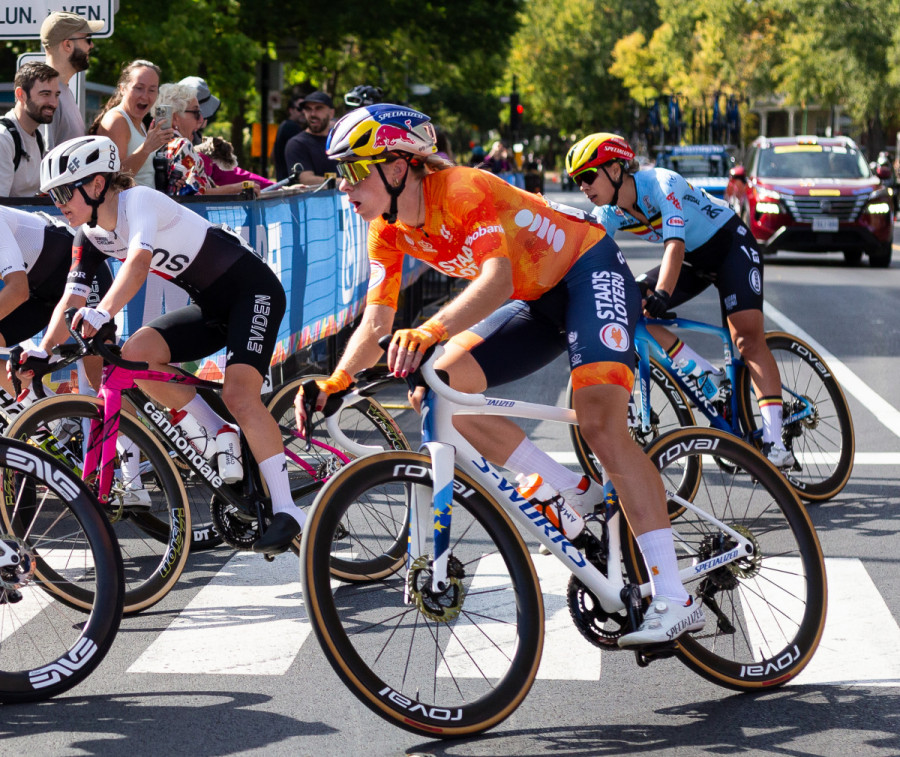
The Union Cycliste Internationale (UCI) World Championships in Montreal this September gave fans the opportunity to watch the world's top female cyclists in action. Among the supporters, many wore clothes supporting women’s cycling and held signs demanding for a women’s Grands Prix Cyclistes next year in Montreal.
The Grands Prix Cyclistes, annual cycling races held in Montreal and Quebec, are exclusive to the elite men category, but before this event was founded, the Women’s Cycling World Cup of Montreal was held from 1991 to 2009. The event was cancelled in 2010 due to a lack of funding, the same year the Grands Prix Cyclistes was created.
Although Quebec has seen increased interest in women’s sports in recent years, disparities persist between the genders.
Twenty-two-year-old Mathilde Charron, who has competed with the Vélo Cartel racing cycling team for four years, said men race in every age category in cycling. Meanwhile, women race in the same competition, whether they belong to the junior, senior or masters age groups.
“For masters women, it’s a huge disadvantage,” Charron said.
She added that it makes it much less appealing for older riders to compete against younger athletes, and that unlike the men, the possibility of riding exclusively with their age group isn't available to them.
Rose Blecon, also 22, has ridden with cycling clubs for some time but hadn’t found one that completely resonated with her. In May 2026, she launched the Montreal Women Cycling Club (MWCC), a women-only and queer-friendly club.
“I wanted to create a space where women could feel like they belong, no matter their level, and where the goal would be to share this passion and to surpass ourselves,” Blecon said. “It’s a male-dominated sport, and as a woman, you feel it. In big groups or in pelotons, we’re often very few.”
Indira Pintin, who has been cycling for 25 years, echoed Blecon's comment.
“We need groups where everyone can find their rhythm, ask questions and learn without feeling out of place,” Pintin said.
Along with these issues, there are also fewer opportunities for women to race. For the first time since the creation of the Mardis Cyclistes de Lachine, women had their own women-exclusive race this year. But while the men’s race is composed of 31 laps, the women’s is only 15.
Charron said her male peers have shown solidarity with women in cycling who are facing these disparities. However, she also believes that implementing changes in the race schedules would increase exposure and visibility, since the men’s race usually takes place last in the event schedule.
“As a young Latina in Quebec, I didn’t have many female role models in the sport around me. I wanted to ride, but didn’t always feel confident enough to go further. The more we see women in cycling, all ages, all origins, from all levels, the more we can say, ‘I belong here too.’” — Indira Pintin, cyclist
“When the system has been the same for so long, if we don’t talk about it, people don’t necessarily see what has to change,” Charron said.
Charron hopes to show the world that women can put on a good show.
“We’re not as fast as the men; that’s inevitable,” Charron said. “But the race is not less interesting; it’s just different.”
Blecon said people are beginning to recognize the importance of giving women's sports a platform, given their popularity.
“The fact that there were so many people to watch the women’s race at the world championships also shows that there’s an audience for it,” Blecon said.
Charron sees the strength and resilience women display in cycling and believes watching them race in real time makes a huge difference in getting girls and women into the sport.
“Seeing the pros in front of you in action is very impressive,” Charron said. “I’m sure it would motivate more people to get into the sport if there was more representation.”
Pintin didn't expect to feel so inspired while watching the women’s race.
“I felt very grateful to be there, to live this collective emotion. I went home energized and convinced that I was even stronger: there is so much potential for girls and women in cycling,” Pintin said.
She said female representation in sports is vital because it was lacking in her childhood.
“As a young Latina in Quebec, I didn’t have many female role models in the sport around me. I wanted to ride, but didn’t always feel confident enough to go further,” Pintin, who took up cycling in the 90s, said. “The more we see women in cycling, all ages, all origins, from all levels, the more we can say, ‘I belong here too.’”
Although Blecon has struggled to find sponsorship for her club, she also noted that cycling brands like Liv and Peppermint have oriented their businesses toward women. She feels like the brands could benefit from sponsoring women’s sport-related events and initiatives.
“Brands don’t seem to realize how invested the women communities can be,” Blecon said.
But as much as they hope it will happen, Charron and Blecon both feel like a Grand Prix Cycliste for elite women won’t be achievable in 2027 for logistical and financial reasons. However, they hope it will become a reality soon.
After all, as Pintin noted, “it takes a whole cyclist village” to spread the interest in the sport.
This article originally appeared in Volume 47, Issue 4, published October 27, 2026.