
Storytelling through dance
Students from the Gilbert Dance Academy perform at Cabaret Lion d’Or
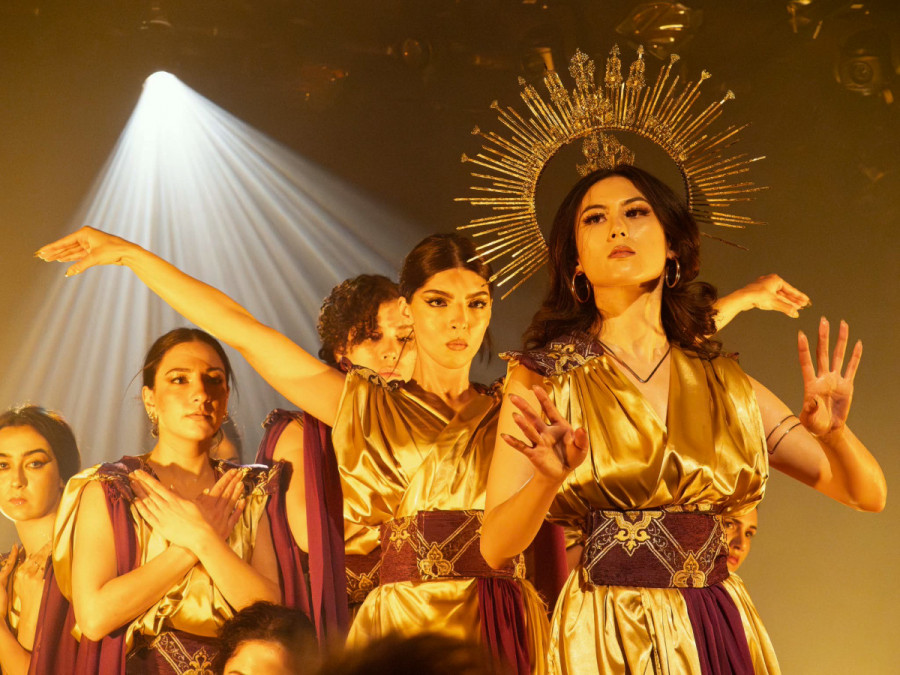
Gilbert Dance Academy students put on a dance and theatre show called l’Orient, mon amour at Cabaret Lion d’Or on Sunday, Oct. 18.
The academy holds an annual show focusing on different themes. This year, dance instructor Gilbert Mhanna wrote a love letter to his home region.
Mhanna prefers the term Oriental dance because it is the direct translation of the Arabic term “Raqs Sharqi.” He noted that when French colonizers came to places like Lebanon, they called it belly-dancing, but Mhanna does not think this term is accurate.
“The colonizers decided on that term in reference to what they saw out of these dancers, and how they treated them [...],” Mhanna said. “They can buy them, they can buy these dancers, they can buy a one-night stand with them, so they decided to name them like that.”
Small round tables draped in red fabric were set up throughout the dimly lit room and began filling in earnest from 1:30 p.m. onward.
Mhanna mingled with the audience and greeted them around 2:30 p.m., then began the show, which featured plenty of audience participation. At the beginning, Mhanna asked several attendees to tell a story, introducing the storytelling theme that would run throughout the production.
As a woman and a dancer, I hope that every woman watching me on stage sees a little bit of herself in me and realizes that she, too, belongs up there if that’s her dream. — Farah EL-Bizri, dancer, Gilbert Dance Academy
Later on, Mhanna brought a single man and a single woman from the audience onstage to read a poem to each other.
Cherif Troudi went to see the show with a few of his friends.
“It’s very beautiful, the synchronization, the dancing,” Troudi said of the first half. “I really loved how they expressed that through movement.”
The cast included Alik Aharoutian, Dina Lobo, Donia Shiri and Emma Pizem, among others.
Special guest Nikotine Beirut, a Lebanese-Canadian singer-songwriter and cabaret artist, also appeared in the show.
Alongside writing the script, Mhanna directed and choreographed the show. He also played the narrator, who reads a love letter to the region's rich culture and history, as Mhanna described.
Mhanna moved from Lebanon to Canada to pursue his artistic dreams. He teaches Oriental and contemporary dance at the academy, which inspired him to write this show based on his personal experiences growing up and the dance styles he teaches.
The whole show is based on the framing device of the love letter. At the end of the show, the audience learns the letter is blank, and the show itself is the letter the storyteller has been writing all along.
Mhanna began teaching dance in Lebanon, where he taught pop and jazz street-style dancing. He did not really start teaching his current dance style until after he immigrated.
“I decided that I want to actually get more into that because I felt that Arabic music was talking to me, especially when I immigrated, and I felt this nostalgia [and] homesickness,” Mhanna said.
L’Orient, mon amour discusses themes of colonization and how stories are formed and told. The story spans many decades and explores different places, from the ancient world of Mesopotamia to Southwest Asia in the 1950s and 1960s.
Farah EL-Bizri, who has been involved with the academy for two years, was in last year’s production and took to the stage again for l’Orient, mon amour.
She was initially concerned that language barriers would make it hard to convey the show’s message, as it switched fluidly between English, Arabic and French. However, she found that audiences were still able to connect emotionally, even if they did not understand everything being said or sung.
“What touched me the most was realizing that emotions don’t need translation,” El-Bizri said.
El-Bizri highlighted some of the difficulties the performers had in finding accessible places to practice. She said that artists need spaces to grow and to bring their ideas to light.
She hopes people will be able to see themselves in the story represented onstage.
“As a woman and a dancer, I hope that every woman watching me on stage sees a little bit of herself in me and realizes that she, too, belongs up there if that’s her dream,” El-Bizri said.