Going all the way with Cinéma L’Amour
An oral account of one of the last remaining pornographic theatres in the country
Few businesses symbolize Montreal’s culture more than bagel shops, smoked meat restaurants and… a porn theatre.
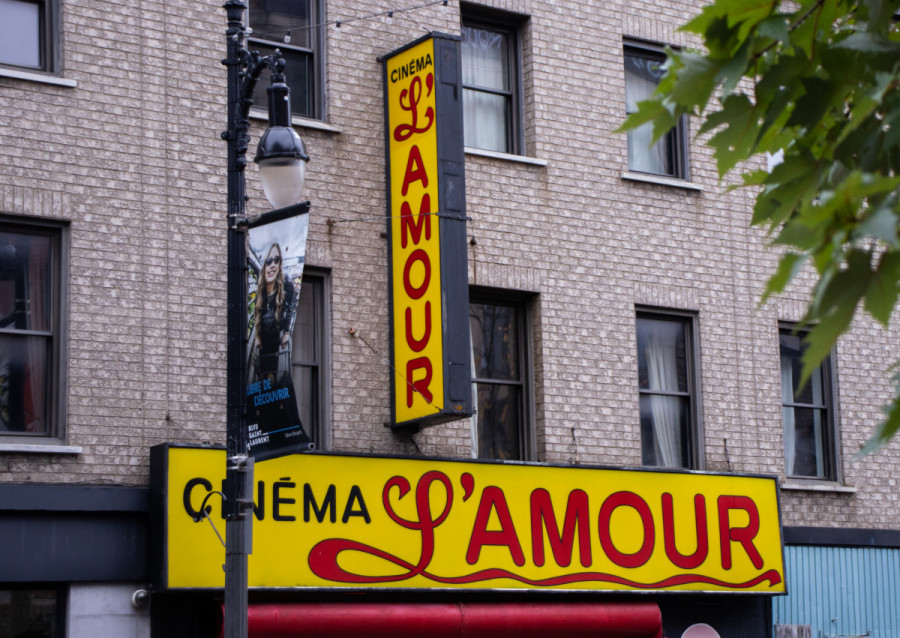
This reputation is thanks to the Koltai family, who have been running Cinéma L’Amour on Saint-Laurent Boulevard for over four decades.
Now considered one of the last pornographic movie theatres in the country, the establishment has weathered evolving trends in nightlife, pornography and sexuality while retaining its place as a fixture of Montreal and gaining recognition worldwide.
The first Cinéma L’Amour dates back to the 1970s, when Ivan Koltai and his wife built a theatre in Hull, Quebec. Located near the Ontario border, where pornography laws were stricter, the theatre attracted a constant rotation of clients, selling out every screening for a decade.
“People in the 1970s, they would come to see a movie, and they’d dress up like they’re going for dinner to watch the 7 o’clock or 9 o’clock showing,” Steve Koltai, son of the founder and current proprietor of the theatre, said.
In 1981, Ivan purchased the theatre in the Plateau and turned it into what the public knows today. Built in 1914 and renamed and repurposed over the years, the theatre retains its original structure, ornamentation and architecture.
It’s hard to tell exactly what to expect when passing by an establishment with a glowing “Adult XXX” sign and vintage nude posters in the front window. People often mistake the theatre for everything from a strip joint to a gentleman’s club.
I feel like kinks, and being a person who’s sexually liberated can feel shameful, isolating; sometimes it can be scary to experiment. And I think having a safe space to try things, a space where you’re greeted warmly at the door, is important. — Seona Lewis, cashier, Cinéma L’Amour
So what really goes on in a pornographic theatre? Steve explained that it’s less about what’s playing on the big screen and more about the physical space. For that same reason, the theatre only picks two films to rotate each week.
“We’re not purchasing any new movies. If you want a particular movie, you can go look at it on your phone,” Steve said. “We’re not about seeing movies; we’re about social interaction, we’re about fulfilling fantasies.”
Steve also stated that he doesn’t necessarily worry about the increased accessibility to pornography today, because that’s not what most people are coming in for.
“They’re in to hang out with their buddies, to hang out with my staff, to have fun with clients, to mingle, to watch, to be a voyeur, to be an exhibitionist,” Steve said.
In its 45 years of business, Cinéma L’Amour has evolved from being a place you go to catch the latest release to a space where people can engage in sexual activity and explore different fetishes. The clientele has also changed. Now, the theatre attracts a younger crowd.
“We have zero tolerance for prostitution,” Steve said. “That being said, there’s lots of sexual activity; that’s what it’s about. It’s about being very open-minded, being liberated [and] letting people do what they want. Everything is permitted as long as it’s done with respect and slight discretion.”
Steve takes pride in the inclusivity that the theatre promotes.
He also said that although people are becoming more open-minded, a stigma remains around the movie theatre.
“A lot of them [the clients] are really amused, like it’s a very unusual thing,” Cinéma L’Amour cashier Seona Lewis said. “A lot of people find it surprising and novel in a way.”
Throughout her day, Lewis interacts with many different people, from clients to curious onlookers and tourists who pass by.
“I think it would be easy to stereotype the type of person that comes here, but a lot of them are really nice people looking for a specific sense of community,” Lewis said. “They’re people who have a bunch of different lives, do different jobs and just need a space to come and unwind.”
Fabio Accioli, the establishment's general nighttime manager, said he was initially hesitant about working at the theatre, but he's warmed up to it.
“There’s a bunch of regulars that come four or five times a week, so we all know each other by name,” Accioli said. “We all hang out in the lobby; it’s more of a friendly space that we created. So when I go into work, it’s not really work; it’s more chatting and socializing.”
As the theatre has gained traction worldwide, Steve said it's now seen as an emblematic landmark of Montreal. This shift can be attributed in part to the rising popularity of its merchandise.
“When I first started working there, Steve was explaining the merchandise to me, and I’m rolling my eyes because I’m like, ‘Who the hell is going to come and buy a porn cinema merchandise?’” Accioli said. “But in the end, that’s what’s keeping us going a lot. We cannot keep it in stock.”
Today, the business ships merchandise worldwide, which Steve now cited as one of the theatre's main sources of revenue.
He said he’s proud that the business has become part of Montreal’s tourism scene.
Steve admitted that one of the main reasons the theatre can stay in business is that his family owns the building, where upstairs units are rented out.
“Will it last another 10 years? I don’t know. I’m not going to last another 10 years,” Steve said. “Maybe at some point we’ll give it to someone else that wants to do it. Let someone else live the legacy and figure it out.”
As pornography consumption continues to move online, Cinéma L’Amour stands out as a place where people are encouraged to explore their sexual fantasies in a safe environment.
“I feel like kinks, and being a person who’s sexually liberated can feel shameful, isolating; sometimes it can be scary to experiment,” Lewis said. “And I think having a safe space to try things, a space where you’re greeted warmly at the door, is important.”
And while it may not be as family-friendly as St-Viateur Bagel or Schwartz’s Deli, the theatre has carved out a particularly unique place in Montreal’s cultural landscape.
“Maybe what goes on in the theatre is not [to] everyone’s liking; maybe sometimes the crowd’s too old, or there’re too many men,” Steve said. “I love my city, and I love that people love the city and I want them to leave Montreal with a good feeling.”
This article originally appeared in Volume 47, Issue 4, published October 27, 2026.