
Tabling in defiance of mezzanine ban
Concordia University student associations and clubs tabled in an act of protest
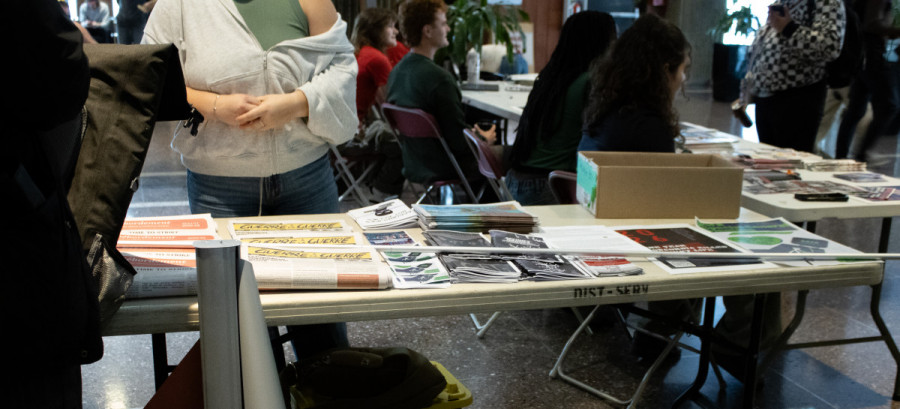
Concordia University student clubs and associations tabled at the mezzanine in the Henry F. Hall Building on Oct. 1 to protest the administration’s decision to ban the space from being used for tabling and bookings.
At 11:00 a.m., Concordia Student Union (CSU) executives, CSU councillors and students pushed aside chairs and tables in the centre of the mezzanine to set up a small tabling area. They brought folding chairs and tables, and various student clubs and associations set up their stations.
The African Student Association of Concordia, Black Student Career Development, the Concordia Ski & Snowball Club, CSU Campaigns, the Arts and Science Federation of Associations (ASFA), the Fine Arts Student Alliance, Concordia Game Development, the North African Student Association, the Pan African Student Association, the Political Science Student Association (PSSA) and the Shia Muslim Student Association were all present.
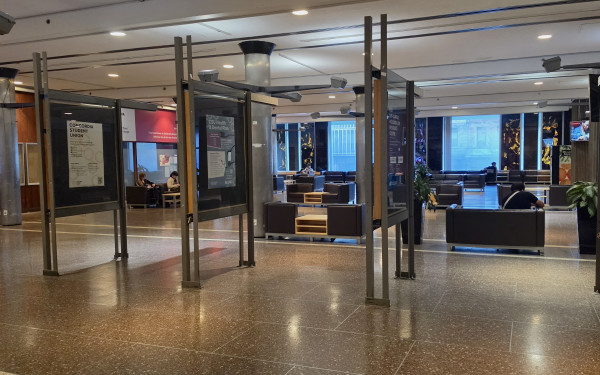
This comes as the Concordia administration unilaterally decided in August to close the space for bookings and tabling, without the input of the CSU, over concerns of foot traffic and congestion.
For members of student associations, the defiant tabling served as a way to raise awareness of the mezzanine's importance to students.
Joshua Louis, the president of the PSSA and a CSU councillor, said the mezzanine was such an important place to inform students about their association.
“Last mandate, when the Hall mezzanine was available, we would table to inform students of a financial aid program that we were working on or events where we would invite diplomats to discuss with them future job opportunities,” Louis said.
Other groups wanted to address Concordia's foot-traffic concerns with successful tabling.
Lili Daviault-Campbell, ASFA's internal coordinator, believes the university’s justification for the ban was unfounded.
“I don't think being able to pass between four columns is really going to change people's ability to get through here,” Daviault-Campbell said. "It's a massive wide open space, and there's staircases on either side; it's absolutely ridiculous."
She added that the space is important for ASFA because it represents 33 member associations that need to table for their events, and ASFA uses it to announce elections and hold in-person voting.
Students also painted banners with statements such as “Whose Mezz? Our Mezz,” and “We are the university” on the mezzanine floor.
The tabling ended at 1:30 p.m., and all the furniture was returned to its original place.
After the event, CSU internal affairs coordinator Lina Elbakaye and external affairs and mobilization coordinator Saraluz Barton-Gomez spoke on the impact of the tabling.
They believe the event was a success because of the number of students who came up to the clubs and associations.
“There were a lot of people, flyers had to keep being printed, a lot of information was being passed out to students [and] pretty much all of the tables were being used,” Barton-Gomez said.
They also highlighted the event’s success in addressing the foot-traffic issue the administration cited for the mezzanine ban after supportive security from Concordia’s Campus Safety and Prevention Services (CSPS) approached them at the start of the tabling.
“You can definitely see that people were able to pass to go to the escalators,” Elbakaye said. “And [security] even kept on saying, ‘Oh well, First Stop is allowed to table, but students are not allowed to table.’ And First Stop is literally right next to the escalator; that's not foot traffic for you”
Barton-Gomez reiterated that the university’s ban had no evidence to back it up.
“At the end of the day, we were given no concrete proof that foot traffic was an actual issue. And by doing this, we're kind of giving concrete proof that foot traffic is not an issue,” Barton-Gomez said.
She also brought up how unifying it was to have so many different clubs come together for one cause.
“It was honestly nice to see students coming together for something they care about because I feel like that's something that's maybe been lacking a little at Concordia,” Barton-Gomez said. “We need to come together in these joint mobilizations because the one thing that we do have in common is that we're all students and we all have things that we care about within that realm.”



_600_375_90_s_c1.jpg)
__600_375_s_c1.png)