
Artemis II takes over Place-des-Arts
The crew of astronauts sat down in Montreal to discuss their mission and the future of space exploration
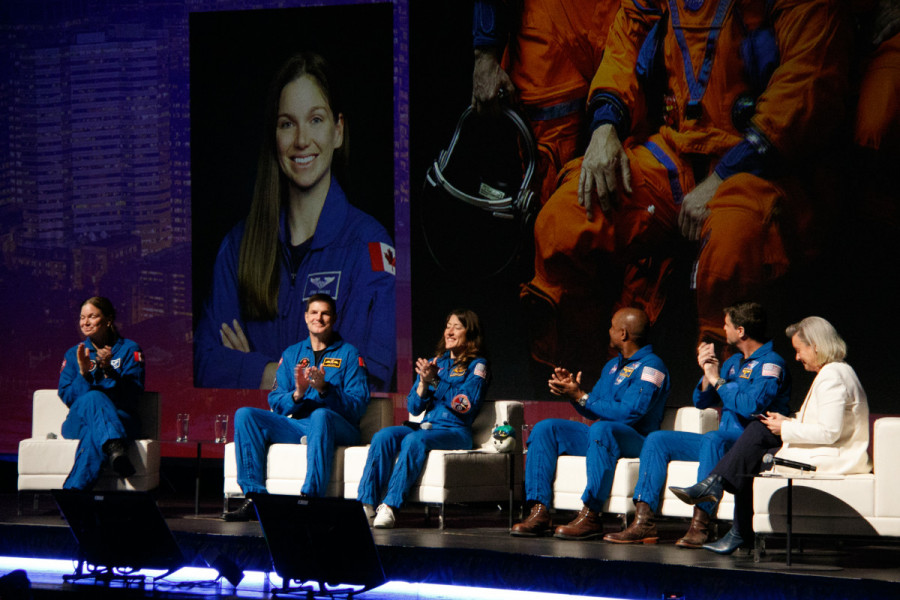
Thousands of people filled the seats of Salle Wilfrid-Pelletier at Place-des-Arts for a panel featuring the astronauts of the Artemis II mission on Friday, May 15. Hosted by the Chamber of Commerce of Metropolitan Montreal (CCMM), the discussion marked the final stop on the group’s Canada tour, which featured a meeting with Prime Minister Mark Carney.
The crew of the Orion capsule—Canadian Space Agency astronaut Jeremy Hansen and NASA astronauts Victor Glover, Christina Koch and Reid Wiseman—joined CCMM president and CEO Isabelle Dessureault onstage for the discussion. Fellow Canadian Jenni Gibbons, the crew’s Earth-based voice link and crew backup to Hansen, also sat on the panel.
The crew achieved several milestones, including the first person of colour (Glover), the first woman (Koch) and the first non-American (Hansen) to travel to the moon. It also marked the first time humans left lower Earth orbit since the Apollo 17 mission, and surpassed Apollo 13’s record for the furthest distance humans had ever ventured away from Earth.
Hansen welcomed the crowd in French, drawing a round of applause for the London, Ont. native. Gibbons further energized the attendants with a cry of “Go Habs Go,” rousing chants of “Olé” from the gathered spectators.
While the crew members recognized the historical importance of their expedition, they couldn’t hide their awe and appreciation for the moments they shared. Wiseman, the mission’s commander, reflected on the view from the capsule as it passed through the galaxy.
“You see it like we're on the stage and it’s a theatre performance and you see where the stars are in the galaxy, you see a depth to it,” Wiseman said. “And you're not watching it from your point of view, you're looking at it from in the galaxy. And that was extraordinary.”
Hansen recounted the capsule’s short communications blackout when Orion passed behind the moon. While the team had studied photos of the moon’s surface in training, the images paled in comparison to the true experience.
“It's extraordinary to see that with your own eyes and just to really comprehend that, that you don't see from images that are stitched together,” Hansen said. “We didn't see a mosaic of images. We saw the moon.”
Artemis II represented the latest stage of the Artemis program, the first missions to the moon for scientific study since the Apollo program. NASA plans to send the first manned mission of the program to the lunar surface by 2028, a milestone that it hopes to repeat annually.
Gibbons clarified Artemis II’s role as a testing ground for future missions, noting that aspects like remote medical kits, food and water supplies and an optical communications array were flight crew objectives.
“This mission is a stepping stone, but at its heart, it was a test mission,” Gibbons said. “So many of the technologies that this crew and the ground team were able to prove out and develop for this mission will be used for future missions.”
Wiseman used the opportunity to acknowledge the work ahead, rallying support for innovation continuation and investment in the space sector.
“I was talking at the Canadian Space Agency yesterday, and I asked Canada to be ready,” Wiseman said. “Because we have a tremendous amount of work ahead, and it is your brains and the place you live that have taught you exactly how you need to function on the moon.”
Concordia University remained a point of interest throughout the event, notably when Dessureault acknowledged businessman and astronaut Mark Pathy’s historic $15 million donation to launch the Mark Pathy Space Institute at the Gina Cody School of Engineering.
Concordia president Graham Carr, who attended the event with Pathy, reflected on the role the donation would play in the development of the university as a hub for innovation in the space sector.
“I think for current students or for future students, the symbol of that gift [makes it] clear that countries want to invest in this area for the future,” Carr said. “It's got to be incredibly motivating.”
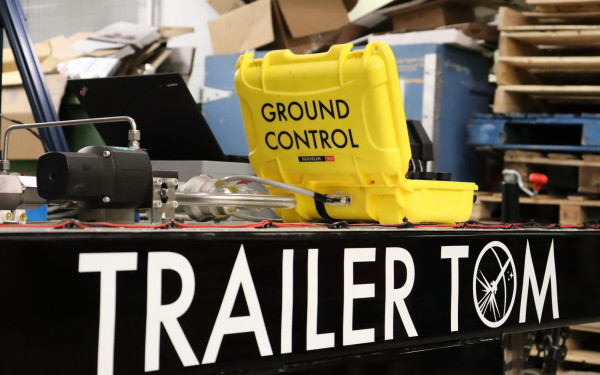
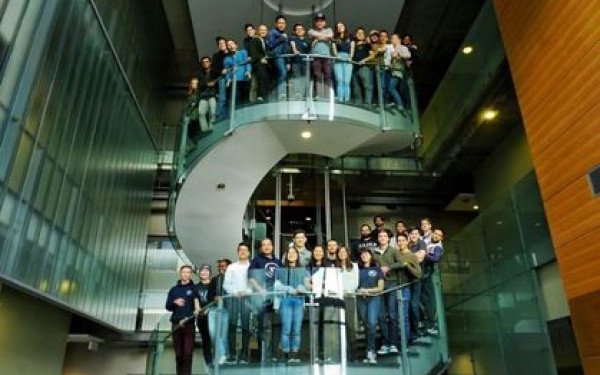
A cohort of students from Space Concordia also attended the event and met with Carr and Pathy at the event’s conclusion. Helia Borran, co-project manager for Space Concordia’s Solid Rocketry division, celebrated the panel as an acknowledgement of the need for investment in the development of the university’s space program.
“Seeing that even people in history, professional astronauts, are really focusing on developing talent, you see that we are actually doing something important that makes us very proud to be doing this,” Borran said.
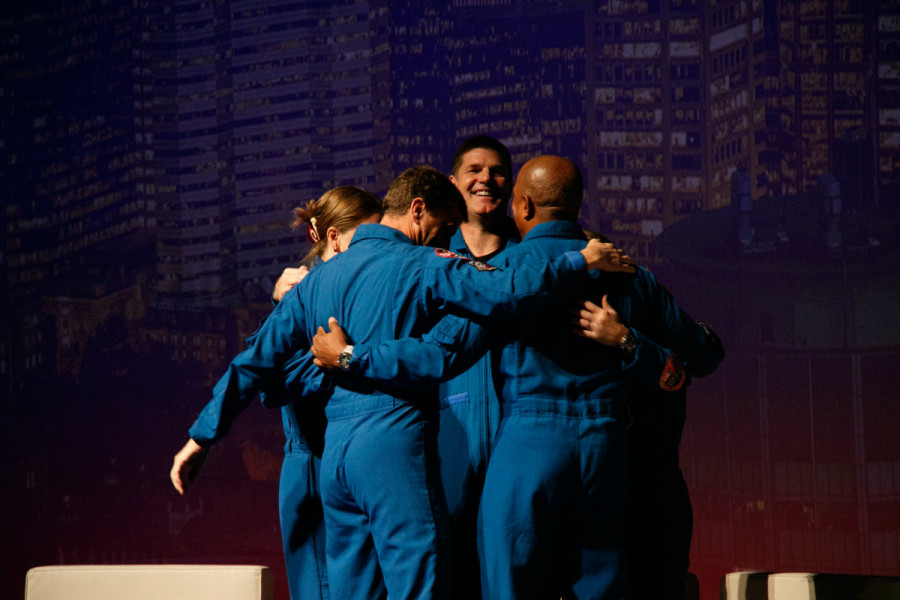
Throughout the discussion, the crew’s camaraderie shone through, cracking jokes and adding tidbits to each other’s stories. Hansen emphasized the importance of having a tight-knit group, adding that the crew worked extensively with its behavioural health team to improve communication and teamwork.
“What we learned was we know, and no matter what happens, whatever hurdle we run into, we know at the center of that is a desire to be a strong team,” Hansen said. “And truly underneath all that, we do love each other. And so when we don't feel it inside, we try to get back to it as soon as we can.”
As the panel drew to a close, Glover called on the attendants aged 25 and under to raise their hands. In his final remarks, he called on the audience to focus on investing in the future of space exploration.
Borran expressed her appreciation for the recognition of youth programs like Space Concordia, which prioritizes the advancement of its members in pursuit of future projects.
“One of our main focuses, besides our project, is talent development. We're trying to teach people the skills necessary to go far and beyond, to reach the moon,” Borran said. “So this day means a lot for a lot of us.”
Carr discussed his excitement about the university’s growth and development in the space sector, calling back to his conversations with Space Concordia after the event.
“I said to them, ‘I wish I were a lot younger right now,’” Carr said. “Because if you were remotely interested in outer space, space exploration, space engineering, health in space, this is the moment and this is the place.”



_600_375_90_s_c1.jpg)