
The pain and stigma of concussion culture
The serious discussion about the long-term risks of head injuries in sports
Content warning: Suicide, substance abuse and brain disease.
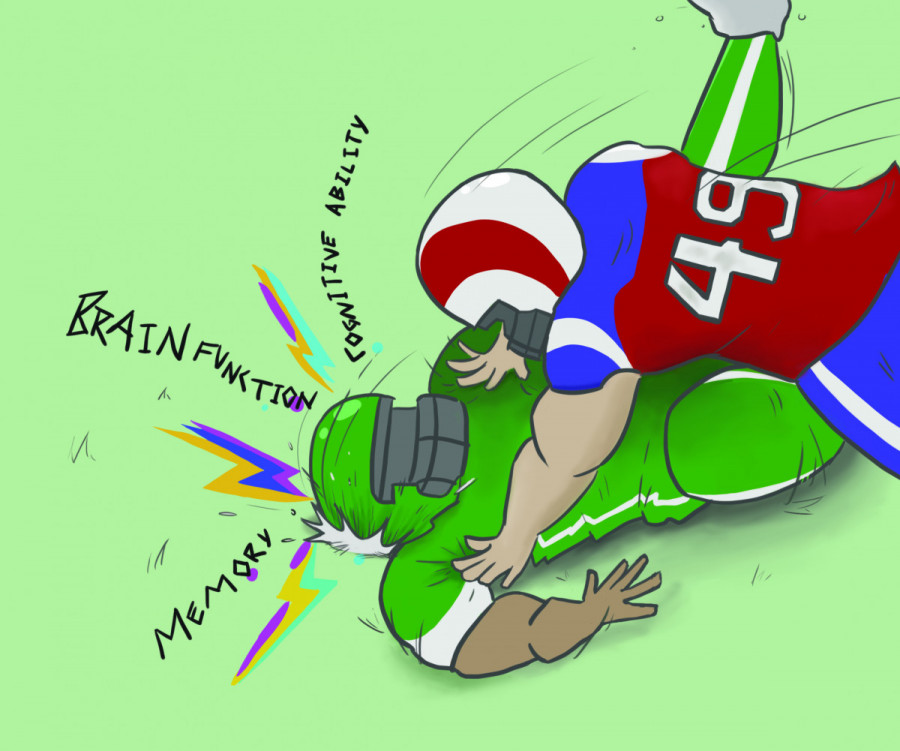
By now, most sports fans are aware of the danger and prevalence of concussions in professional sports. In fact, when fans see a big hit in the NHL or NFL, or watch a skier take a bad fall, their first thoughts jump to potential head injuries.
Concussions are a type of mild traumatic brain injury caused by a blow to the head, typically from a fall or, in the case of contact sports, a collision involving the head. Symptoms include headaches, nausea, vomiting, fatigue, blurred vision, confusion, dizziness and amnesia surrounding the event.
Athletes may feel compelled to play through head injuries for a variety of reasons, one of which can be pressure from coaching staff. But there are also issues with concussion detection, as Victoria D’Amours, a former competitive figure skater, can attest.
“If you break your ankle, your ankle’s going to be swollen and blue. There is no denying that there is some sort of injury," D'Amours said. "But with a concussion, it's not symptoms that you can see."
It’s worth remembering that the prevalence of head injuries within sports discourse is relatively recent.
Concussions only became widely discussed in the early 2010s when the NFL saw a combination of lawsuits and former players committing suicide. Dr. Bennet Omalu was the first person to observe chronic traumatic encephalopathy (CTE) posthumously in NFL players who had committed suicide in 2002.
By 2012, after the suicides of multiple former players with autopsies showing they suffered from CTE, the NFL was facing a unified lawsuit of 80 concussion-related suits representing over 2,000 NFL players.
The players accused the league of negligence and failure to notify its players of the relationship between concussions and long-term brain injuries.
The league ultimately agreed to a US$765 million settlement. In 2016, a senior NFL official acknowledged the link between football and degenerative brain disorders, marking the first time the NFL had acknowledged it.
While it marked a major development, it seems disturbing that it took multiple NFL players committing suicide and having their brains studied for the NFL to acknowledge that smashing heads for a living may lead to permanent brain damage.
The discussion with head injuries in sports, however, is less about the concussions themselves and more about the long-term complications, mainly CTE.
CTE is a degenerative brain disease caused by repeated injuries to the head, which leads to the death of nerve cells in the brain. There is no known cure and no definite diagnostic test aside from posthumous diagnosis.
“One thing athletes do, in every aspect of our life, is if we don’t talk about it, it doesn’t exist. Concussions are kind of the same thing where there’s a stigma about it, being that if I ignore it or don’t really face the truth, then it’s not true, it’s not real.” — Èvelyn Parry, goalkeeper, Concordia University women’s soccer team
CTE’s symptoms include cognitive changes like memory loss and trouble thinking, behavioural changes such as impulsive and aggressive behaviour, mood changes including depression, emotional instability, suicidal thoughts and substance abuse, and movement symptoms like parkinsonism, balance and movement issues, and motor neuron disease.
In 2017, a study published in the Journal of the American Medical Association examined the brains of 111 deceased NFL players and found that 110 of them had CTE.
By 2022, the NFL and NFL Players Association finally agreed to update their concussion protocols, and by 2024, the NFL made changes to kickoffs to reduce full-speed collisions and allowed players to wear guardian caps.
However, data shows this is the equivalent of taking painkillers to "fix" a broken leg.
As researchers working at Boston University’s CTE Center have found, the disease stems from repeated head injuries. Thus, while the big hits are most certainly brutal, true prevention should aim to limit cumulative head injuries over a career.
NFL players are certainly not the only ones at risk here. Combat sports, especially boxing, correlate significantly with CTE development later in life due to repeated injuries to the head.
Another study, concerned with English soccer players, found that concussions make up 7 per cent of all injuries in women’s international soccer, 5 per cent in women’s domestic, 3 per cent in men’s international, and 2 per cent in men’s domestic.
The NHL has an extensive concussion protocol as well, and broadened its Rule 48 (Illegal Check to the Head) in the 2011-12 season to "encompass all hits to the head."
These problems are further complicated when acknowledging the pressures athletes face to "suck it up." An especially egregious example concerns former New York Giants head coach Brian Daboll, who interrupted quarterback Jaxson Dart's concussion protocols to ask if he was OK to keep playing.
Èvelyn Parry, a goalkeeper for the Concordia University women’s soccer team, has suffered two concussions in her career. She pointed out the stigma surrounding concussions in athlete culture and the response to head injuries.
“One thing athletes do, in every aspect of our life, is if we don't talk about it, it doesn't exist,” Parry said. “Concussions are kind of the same thing where there's a stigma about it, being that if I ignore it or don't really face the truth, then it's not true, it's not real.”
A recent poll found that 19.5 per cent of NFL players admitted to hiding concussion symptoms from a doctor while playing in the NFL, and 26 per cent of them had done so at lower levels of football.
This gets scarier when we take into account that CTE is also associated with getting a second head injury before the first one was treated.
After her second concussion, Parry started to notice the way the injuries affected her play. Three months after the incident, the team practiced the same drill where Parry had suffered the injury.
“My body genuinely had a reaction to it,” Parry said. “I don't want to point to a trauma response, but a bit like that. And I had realized that I'd been kind of holding back because of that fear of that injury happening again.”
D’Amours explained that this issue can also be prevalent at the youth level.
“There might be a tendency not to believe the kids, because there are symptoms that anyone could have for a variety of reasons,” D’Amours said.
“There is a life after sports, and while that was really important for me at the time, the life that you’re going to live once your sport is over is hopefully longer than the time you spent with your sport.” — Victoria D’Amours, former competitive figure skater
However, sometimes it's the athletes who push themselves into playing through injury. When asked for some advice D’Amours wished she could have given herself, or advice for athletes dealing with concussions, she put the importance of competitive sports into perspective.
“When you’re a growing athlete, all you care about is your sport,” D’Amours said. "But there is a life after sports, and while that was really important for me at the time, the life that you’re going to live once your sport is over is hopefully longer than the time you spent with your sport.”
D'Amours does not think that this means scaring young athletes by overstating the risks.
"I think we need to target our effort into recognizing the signs and ensuring that the proper protocols are put in place, and that people are directed towards the right resources,” D'Amours said.
Unfortunately, it's not just contact and helmet sports that can put non-pro athletes at risk.
Adrien Chaput, former flag footballer for Marianopolis College, can attest to this. Chaput has experienced multiple head injuries playing both flag football and basketball, neither of which is typically seen as a heavy contact sport.
The numerous head injuries, including a couple of concussions, Chaput said, have had a lasting impact on his life, such as persistent dizziness and low-quality sleep.
Chaput also explained that just six months after his first concussion, he experienced what he thought was a small head injury, but “his symptoms returned in full force.” Later, he was diagnosed with post-concussion symptoms, which occur when concussion symptoms last longer than they normally do.
Chaput continues to struggle with these symptoms to this day.
“It limits my participation and ability to learn at the same level in sports and school," he said.
He also expressed frustrations with physicians’ attitudes towards concussions as a non-professional athlete.
“They kind of just brush it off, because there is nothing they can do,” Chaput said.
D’Amours’ experiences as a figure skater concur with Chaput’s.
“In reality, you can get a concussion just from falling on your butt,” D'Amours said.
While awareness around concussions has increased in recent years, athletes and experts still feel that proper protocols need to be more strictly followed once head injuries occur to ensure safety.
With files from Samuel Kayll.
This article originally appeared in Volume 46, Issue 12, published March 31, 2026.




.DSC_1175_600_375_90_s_c1.jpg)