The U Sports-NCAA dilemma
Concordia athletes share their experiences in the U.S. and Canada
.DSC_1175_900_600_90.jpg)
To find success in university sports, follow the money—right to the NCAA.
The National Collegiate Athletic Association (NCAA), the governing body for university sports in the U.S., represents the pinnacle for amateur athletes looking for a place to continue their education in tandem with their sport. With 92 national team championships (compared to Canadian U Sports’ 21), the NCAA carries a certain prestige simply through its name value.
But what happens when the curtains fall away, and the inner workings are revealed? How do Canadian athletes make an informed decision when faced with an organizational juggernaut and a small-time spot closer to home?
Èvelyn Parry, a second-year goalkeeper for the Concordia University women's soccer team, had a one-track mind towards the NCAA after high school. She played in Spain during Grade 12 to set herself up for a chance at U.S. competition, eventually committing to play at the University of Kentucky-Lexington.
“For most people, the NCAA is glorified as the best, the No. 1,” Parry said. “So often when we think about university, that's our No. 1.”
Canadian athletes have flocked to the U.S. in higher numbers in search of high-level competition.
Men’s basketball alone features 297 Canadian players across Division I, II, III and the National Association of Intercollegiate Athletics. A 2023 study revealed 4,408 Canadian athletes competed in sports across D-I and D-II in 2022-23, a number that likely increased over the past three years.
The arrival of name, image and likeness contracts, which allow college athletes in the U.S. to earn money by controlling their image, has only widened the chasm between the NCAA and U Sports athletes.
In the U.S., student-athletes no longer need to turn pro to earn life-changing money. A successful stint in university can pay out as much as an entry-level professional contract.
Kinifoh Coulibaly, a defender for the Concordia women’s soccer team, committed to play for Jacksonville University after a successful tenure with FC Laval. She returned to Canada to be close to home, but acknowledges the gap between the money and funding in the NCAA and U Sports.
“I think we should start including more funding in our sports, actually, because I feel like the U.S. has a big hand on that because of the money,” Coulibaly said. “They have a big hand in taking Canadian athletes, and they have the funding to come get our players.”
Despite her idealized view of the NCAA, Parry quickly ran into obstacles in Lexington.
She was part of a large recruiting class, and her coach had never seen her play in person. A concussion she suffered in pre-season only complicated matters, exposing Parry to the businesslike characteristics of Division I sports.
“I quickly learned that injuries, physical or mental injuries, when life gets in the way, the way the U.S. does it is they move onto the next [player]," Parry said. "The train is moving, and you're either on it or you're not, but the train is still going to go. It's a harsh truth, honestly.”
For Parry, things outside athletics didn’t get easier. She felt unchallenged by her academic workload and unaligned with Lexington’s culture, eventually deciding to enter the transfer portal and explore options in both the U.S. and Canada.
“You could be in a super nice castle, villa, and if it's a prison, it's still a prison,” Parry said. “So that's how I visualize it. Yes, all the prestige was great, but I didn’t feel at home. I felt locked in.”
U Sports provides financial aid in the form of athletic financial scholarships, which vary by university and athletic department. While these awards often cap out at $4,500 per student per year, this amount can technically cover an athlete’s student fees and tuition. However, they often go hand in hand with other academic scholarships and bursaries.
So how can Canadian universities convince young athletes to stay close to home?
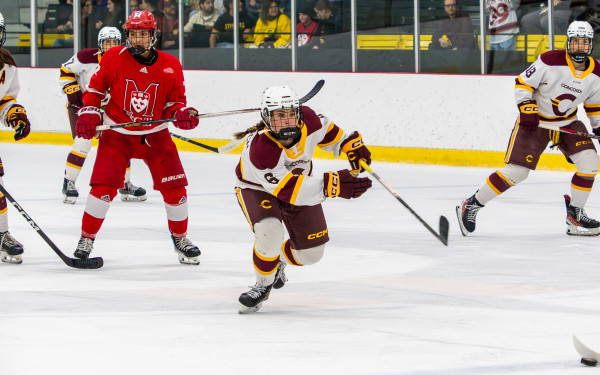
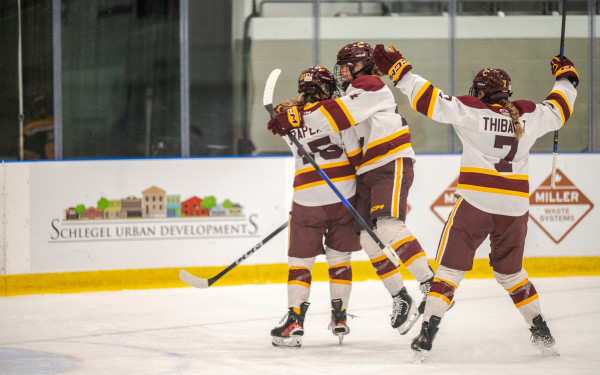
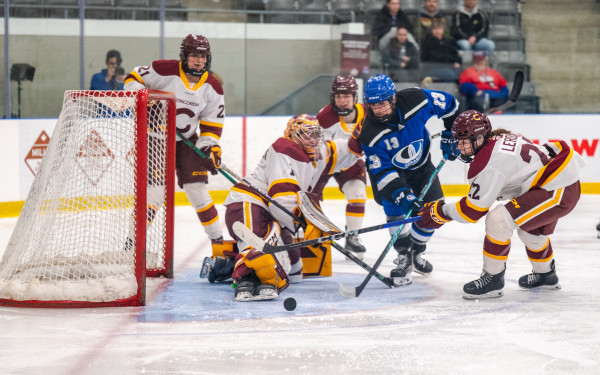
For one, the passion never changes, regardless of the country. Belle Mende, a goaltender for the Concordia women’s hockey team, experienced this when she signed on as a graduate transfer from Cornell University.
“I love these girls. I played with some of the best players at Cornell, and [my Stingers teammates] love the game just as much as them,” Mende said of her time at Concordia.
“I quickly learned that injuries, physical or mental injuries, when life gets in the way, the way the U.S. does it is they move onto the next [player]. The train is moving, and you’re either on it or you’re not, but the train is still going to go. It’s a harsh truth, honestly.” — Èvelyn Parry, goalkeeper, Concordia University women’s soccer team
Coulibaly advised young athletes to attentively consider every aspect of their athletic and academic careers before deciding. She reflected on her own experiences and the pull of a career in the U.S., where her career was funded by a country that places a premium on athletic development.
“I just went and was on a full scholarship, so I was like, ‘You know what? I will go. It's a full scholarship,’” she said. “But really take your time before making your decision.”
Mende valued playing time over everything else when she decided to transfer. After not playing during her junior and senior years at Cornell University, she found her shot at Concordia.
“Take into consideration the other aspects, but go to the place that gives you the right vibe,” Mende said. “I didn’t care about any of the big rinks or the merch or any of that, I just wanted to play hockey.”
For Parry, it’s all about maintaining a holistic worldview. She emphasized the importance of considering plans after university and even the culture of their potential new home.
“I would try to talk to players who are currently on the team to see what the dynamic is like, because the two teams, Kentucky versus Concordia, [have] two very different philosophies,” Parry said.
It sounds simple: find the place that fits the best. And while the U.S.’s funding power and professional pipeline seem glitzy on the outside, Canadian athletes shouldn’t discount the credibility and stability of a school closer to home.
“The States, they're a powerhouse in soccer right now. So it works, and I'm not bringing that down. They win, and I respect that," Parry said. "But in Canada, it's more about going through that team cohesion and creating the personal experience of soccer.”
This article originally appeared in Volume 46, Issue 8, published January 27, 2026.