
Cycling through a tough winter
Higher Bixi rates and snowy roads challenge Montreal cyclists
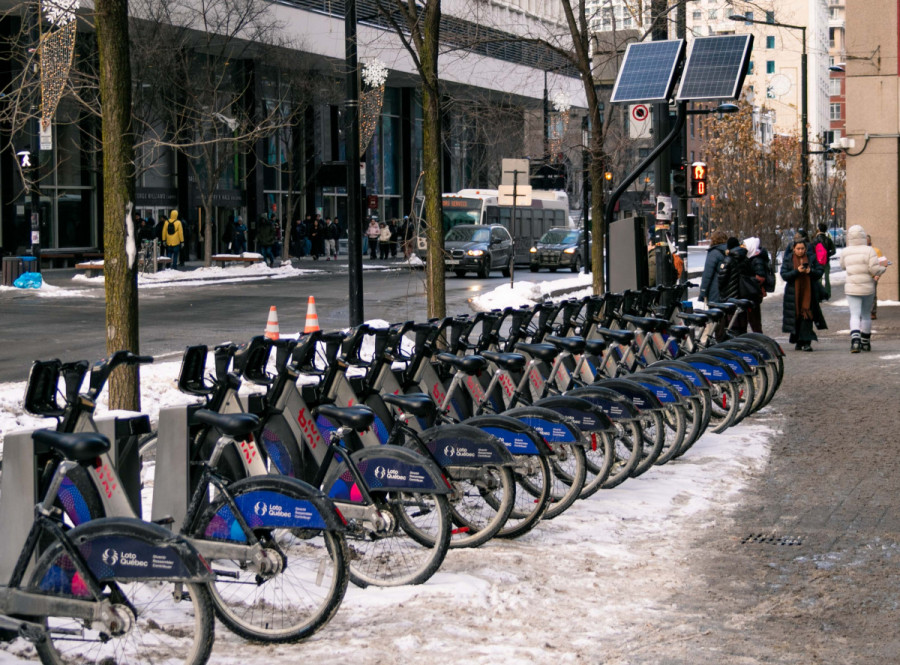
Montreal’s Bixi users will have to fork out more cash starting Feb. 16, when the island’s public bicycle rental system will officially raise its rates.
A season pass, from April to November, will now cost $115, up from last year’s $112. Monthly passes, now $24, are up from $23. The unlocking fee will also be raised from $1.50 to $1.60, costing 21 cents per minute, compared to the former 20 cents per minute.
The increase follows the release of the City of Montreal's annual budget for the upcoming year. The budget revealed that funding for the Bixi service has been reduced, down from $10.9 million in 2025 to $5.5 million this year.
Among Bixi’s occasional users is Julien Gagnon-Ouellette, coordinator of the bike workshop Grande Roue with Loisirs Communautaires Saint-Michael.
“The $5 million that was cut was for development, and this development allows for many things, such as a better service for bringing Bixis back to different stations,” Gagnon-Ouellette said.
“It’s literally an essential service in Montreal, [...] a city that is known to be bikeable.” — Bixi user Emily Nguyen
Interim opposition leader and Projet Montréal member Ericka Alneus spoke on the cut in a Montreal Gazette article, saying “areas in the east end of the city that have been hoping for Bixi to come won’t get [that service].”
“Creating innovation is dear to my heart, and that requires money,” Gagnon-Ouellette said, describing how he believes things like Bixi bike trailers may become rarer without the support of the city.
He added that there could be a gradual deterioration of service, whether in the number of bikes per station, the condition of available bikes, including electric bikes, or the proximity of stations in outlying areas.
Electric bikes make cycling an accessible option for people who live in remote locations. In an interview with CTV News in 2024, Vélo Québec spokesperson Magali Bebronne said that 36 per cent of Quebecers live within 5 kilometres of their work or study location, and that this figure only rises in smaller municipalities.
“The more we move away from the [city] centres the more we need electric bikes,” Gagnon-Ouellette said. “Plus, the teams who move the bikes are expensive.”
Regarding higher Bixi rates, Bixi user Emily Nguyen called the news disappointing, but also said that it could be worse as it’s “only $3 more.”
Nguyen uses Bixi almost every day, in every season except winter. She lives in a central area and relies on biking or walking to get around.
“It’s literally an essential service in Montreal,” Nguyen said, “a city that is known to be bikeable."
Snowy roads make for tough cycling
Price inflation isn’t the only obstacle that Montreal cyclists face. In a snowy city, bike riders face unique challenges.
The winter brings reduced visibility, making it harder for drivers to see cyclists on the road.
Gagnon-Ouellette has been a winter cyclist for 12 years and says bike lanes are the safest places for cyclists, especially during the winter.
In areas without segregated bike lanes, cyclists are at risk, particularly on one-way streets when a car is trying to pass closely.
“The biggest risk is that a motorist hits a cyclist," Gagnon-Ouellette said. “Then, the most dangerous thing is that a motorist hits a cyclist who has just fallen.”
This problem is exacerbated by snowbanks, which reduce cyclists' space in bike lanes, forcing drivers to pass very close to them.
“By bike, on two wheels on the snow, there are more zigzags, and so we need more lateral space,” Gagnon-Ouellette said.
The more bike lanes, the better
The new mayor of Montreal, Soraya Martinez Ferrada, campaigned on a promise to audit and remove unsafe bike lanes. This promise spoke to citizens angry over what they believe is the removal of parking spaces without their consultation.
The new budget shows Martinez Ferrada’s administration will maintain bike paths promised by the Plante administration. However, some projects, like the plan to build protected bike lanes on Hochelaga St., have been delayed.
Additionally, in December 2025, Outrement residents protested the winter closure of a bike lane on Lajoie Ave., saying it leaves cyclists more exposed.
Hugo Bourgoin, spokesperson for the City of Montreal, told The Link that all bike lanes are properly cleared of snow during snow-clearing operations.
“The bicycle lanes, which are part of the four-season network, 740 kilometres on a total network of 1,083 kilometres, are cleared of snow according to the same level of priority as the roadway,” Bourgoin said. “It is, however, possible that the wind, for example, puts snow on the lane following the passage of our teams.”
He added that Montrealers can report such situations to the city’s 311 number.
What needs to be done?
Bourgoin added that the Réseau express vélo (REV) project is also a priority for the city. Known as the "backbone" of Montreal's bike lane network, the REV connects the bike lanes running through the city’s boroughs.
Improvements to public transportation can also help support cyclists according to Gagnon-Ouellette.
The avid cyclist suggests allowing bikes on public transportation at all hours. Currently, bikes are not authorized on Metros and buses on weekdays between 7:00 a.m. and 9:30 a.m., from 3:30 p.m. to 6:00 p.m., and at all times on weekends and public holidays.
He also suggests extending public transportation networks in the city. This, he said, gives cyclists a good plan B on days that may end up being too difficult to bike.
This article originally appeared in Volume 46, Issue 9, published February 10, 2026.




_600_375_90_s_c1.jpg)