
Modern adaptation of Antigone reflects today’s political authoritarian atmosphere
The McGill Classics Play’s rendition drew parallels to the current Trump administration
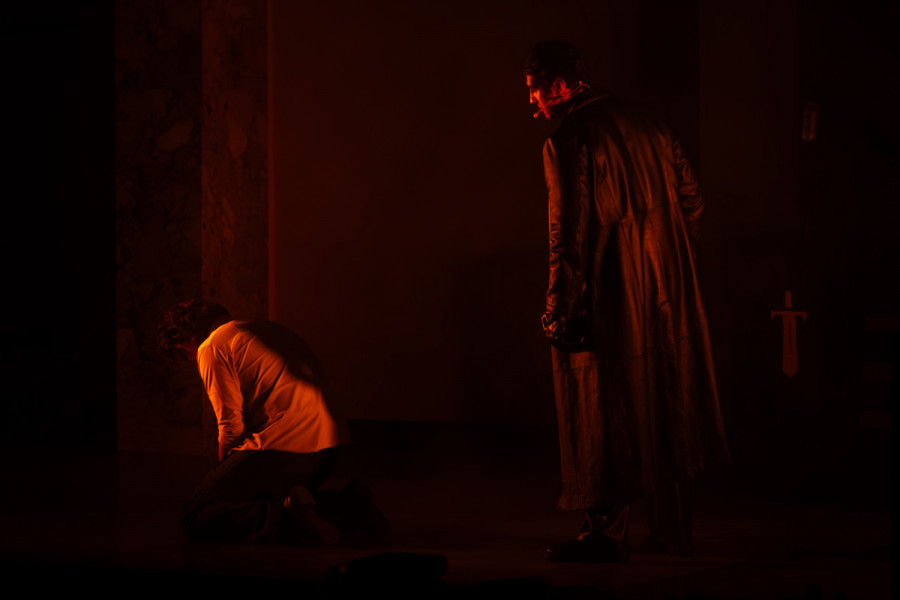
The McGill Classics Play presented a modern adaptation of Sophocles' Antigone from Feb. 4 to Feb. 7, leaving the cast, crew and audience members to reflect on how the Greek classic resonates with today's political climate.
Set in the 1930s, the adaptation focused on the rise of authoritarianism and posed questions about how people respond when confronted with fascism. With military costumes, bold makeup and dark lighting, the show captured the audience’s undivided attention as it evoked a tyrannical atmosphere through emotionally raw performances.
Co-playwright and director Madelyn Mackintosh said she drew inspiration from the first year of the U.S. President Donald Trump’s second administration, a parallel which resonated with the audience.
Audience member John Valeria said he found the play resonated with the current political climate in the U.S., highlighting specifically the people in Minneapolis fighting back against ICE (U.S. Immigration and Customs Enforcement).
“I think that's what the play was about, Antigone takes a stand, but at great cost to herself and to those she cares about,” Valeria said.
Antigone tells the story of the rise of a new king, Kreon, who gains control of the city of Thebes following a bloody battle. A woman, Antigone, returns to wartorn Thebes and finds her brother dead and labelled as a traitor by the state.
Antigone defies Kreon’s decree and gives her brother a proper burial, setting in motion a chain of events that leads to her suicide. Her sister Ismene is left to pick up the pieces, by telling Antigone’s true story in light of Kreon’s altered version of events.
Co-playwright Caroline Little explained why they aimed to emulate pre-World War II German Weimar Republic when writing, highlighting how authoritarianism can take hold.
“I think it’s especially poignant because it is a time when politics was rapidly progressing and rapidly growing further to the left,” Little said. “Then, obviously, there was a very sharp decline and turn to the right. I think we're seeing that right now.”
Little and Mackintosh significantly altered sections of the original text to reflect the current political atmosphere in North America.
Unlike in the original story, Kreon does not repent for his cruelty; instead, he justifies his actions by clinging to power. Mackintosh tied this directly to the behaviour of the American president.
“Whenever Trump has lost something, he's gotten worse,” Mackintosh said. “When he lost the 2020 election, he doubled down more.”
Another major change was the decision to increase Ismene’s character. In the original, after she tries to convince Antigone not to give their brother a proper burial, Ismene disappears from the original text and is assumed to have survived.
In contrast, her role was expanded in this rendition after Antigone took her life, as Ismene finally started facing the cruelty under Kreon’s regime.
Penny Hruby, an actor and president of the McGill Classics Students’ Association, found herself sympathizing more with Ismene than Antigone when confronting authoritarian cruelty, even while portraying a gunner soldier in the show.
“[Ismene] recognizes that what Kreon is doing is wrong but doesn't dare to fight back,” Hruby said. “Realistically, if I were faced with this, I think I probably would react much more similarly to Ismene.”
Mackintosh said that when an ICE agent murdered Renee Good in January 2026, the cast and crew had just resumed their first rehearsals following the winter break. This inspired Mackintosh to portray Ismene as someone who could whistleblow the hidden truths of those who tell lies.
“If the people with the power try to lie to you, and even if you do not have the same amount of power, part of being as courageous as you can is telling the truth to the depth of your ability,” Mackintosh said.
Actor and Concordia University student Brendan Lindsay, the comic relief of the play, portrayed the sentry soldier and described his character as self-interested. Lindsay said the bold makeup with a lot of eyeliner helped him act out the selfishness of someone who obeys systemic evil, a trait he linked to authoritarian support in the U.S.
“I think in more conservative political movements there is more self-interest because there's more upfront gains to being in a right-leaning political movement,” Lindsay said. “I don't think that I could have played a member of the Theban Guard without having a sense of self-importance.”





Frédérique_Ménard-Aubin-8588_(1)_(1)_1_600_375_90_s_c1.jpg)
