Archival cinema brings Palestine’s past into the present at Zamalek
A Tokyo Reels Collection screening transformed Zamalek’s kitchen into a space for memory, resistance and collective viewing
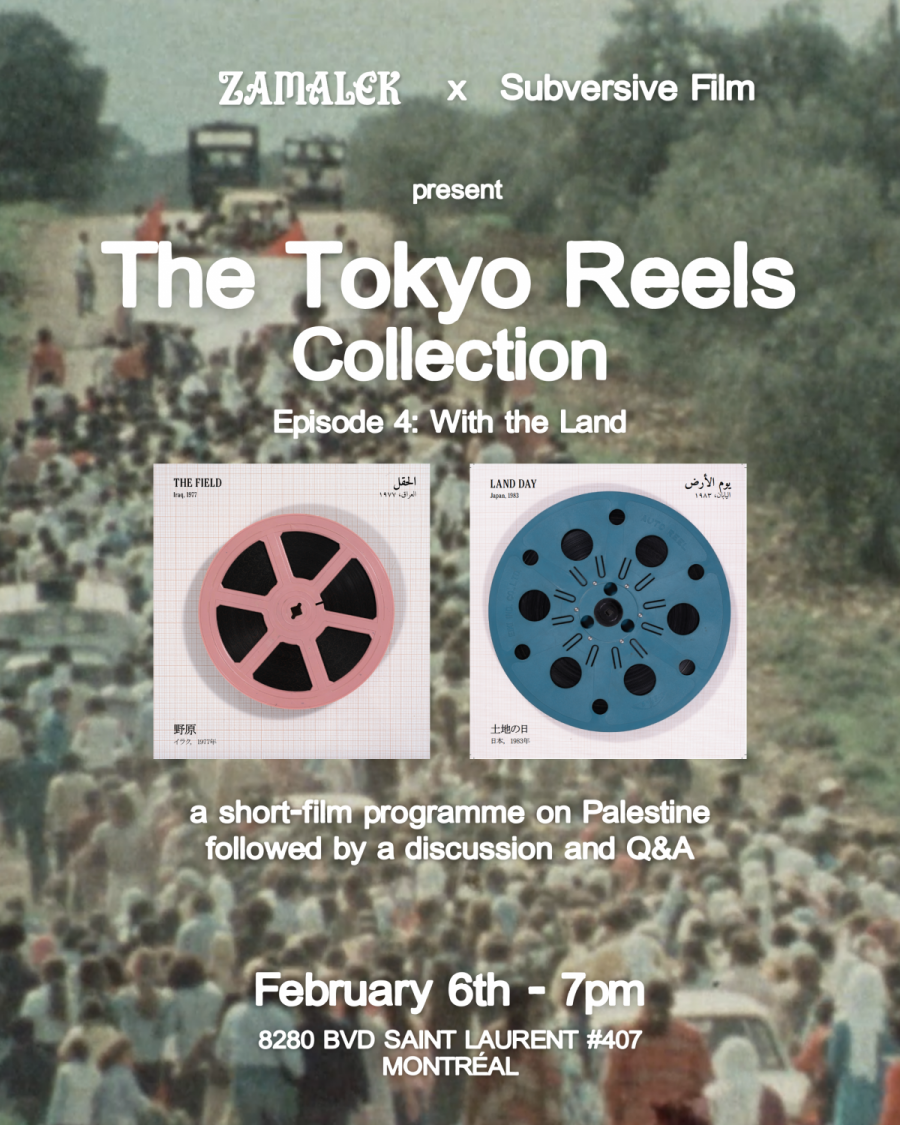
Dozens of community members gathered on Feb. 6 for a film screening from the Tokyo Reels Collection hosted by Zamalek.
Part of an ongoing series, this event marks the fourth installment of a project dedicated to sharing archival footage uncovered in Japan in 2017.
The materials were later entrusted to Subversive Film to restore them as films documenting key moments in Palestinian history throughout the 1970s and 1980s.
At the latest screening, attendees had the opportunity to see the film Land Day (Ghaleb Shaath, Japan, 1983), preceded by the short fiction film “The Field” (Sabih Al-Zoohiri, Iraq, 1977).
The screening took place in Zamalek’s original kitchen, now repurposed for community gatherings and social initiatives.
The informal setting felt fitting: kitchens are often where conversations linger. One could see reassuring hands placed on others’ arms at the sight of heavy scenes, and warm smiles from people recognizing each other from past screenings.
Bashar Odeh, one of Zamalek’s owners, a Montreal-based artisanal beverage brand, said the communal setting is central to how the screenings are meant to be experienced.
“I don’t think that you will have that experience if you watch these films at home alone or in your bed,” Odeh said.
He added that hosting events like this reflects the values behind Zamalek.
“We are a business that tries to do something other than just be a business that makes profit; we want to make a difference and have an impact,” Odeh added. “These are the types of events that can create that [collective experience]”.
Fadi AbuNe’meh, a member of the Subversive Film collective, is one of the key organizers for this cinema projection. His work is one of passion, restoration, and advocacy.
“I was born in Palestine,” says AbuNe’meh, explaining his personal connection to the films.
Reflecting on his experience teaching in Palestine, he said education has long been central to cultural survival.
“I remember it was a mission of mine that even a sixteen-year-old knows that at that period, in the 70s and 80s, we had a revolutionary ability in filmmaking.”
AbuNe’meh also highlighted the importance of translation and international solidarity in presenting the films. The screening featured four languages: spoken Arabic testimonies, Japanese subtitles and dubbing embedded in the original films, and English and French subtitles added by Subversive Film for Montreal audiences.
“The only way forward is for the people struggling around the world to be together,” AbuNe’meh said. “Your role, when you export your own struggle, is to speak with other people in their own languages too.”
For AbuNe’meh, the power of cinema lies not only in aesthetics, but in its ability to carry history.
“There is nothing like the moving image to fully transfer you somewhere,” he said. “These are living documents of that period that happen to be moving images.”
A discussion followed the screening, in which the public was invited to participate in the exchange, and members asked thought-provoking questions about the unique processes in the restoration of the films, the interesting approach to translation and the cultural significance of this work.
Some attendees had a strong personal motivation to attend the projection. Local photographer Mohannad Mansour said the archive resonated with his own family history.
“My parents are Nakba survivors,” Mansour said. “Last week they showed some [films] from Ein El Hilweh, which is the refugee camp my dad grew up in, and I literally saw a shot [in which] I am pretty sure is my family […] It’s very nostalgic for me, but it’s also very informative.”