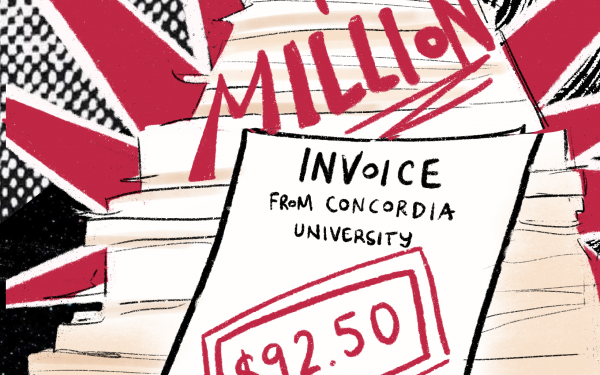
Quebec upholds tuition hikes as Concordia braces for deeper budget cuts
Students, universities warn higher fees increase financial pressures and lower enrolment

The Quebec government is maintaining the tuition hikes for out-of-province students attending English-language universities, confirming that the increased fees will remain in place following the province’s revised funding framework.
The decision preserves a roughly 33 per cent increase that raised the minimum tuition for out-of-province Canadian students studying in English to about $12,000 annually, up from $9,000 in Winter 2024.
“When I was applying to come here, it was my first choice, but because of the tuition hikes, it made me reconsider everything,” said Kalia Graham, a second-year psychology student at Concordia University, originally from Whitehorse, Yukon. “I almost didn’t end up coming.”
The tuition hike was first announced in October 2023 as part of a broader overhaul of Quebec’s university funding system targeting English-language institutions.
English universities initially challenged the increase in court. However, the province has since updated its rationale, arguing that the increase prevents Quebec taxpayers from subsidizing the education of non-resident students.
“I had to really discuss budgeting with my family and plan it out to see how it would look,” Graham said.
Graham added that two of her friends who had also planned to attend university in Montreal ultimately chose not to because of the tuition increases.
These provincial policy changes have also had institutional consequences. Concordia and McGill University previously argued in court that the tuition overhaul harmed their competitiveness and contributed to declining out-of-province applications, forcing budget adjustments and service reductions.
According to remarks delivered during recent Concordia Senate discussions on Feb. 6, the government has now formally entrenched the higher fee, arguing that it is “not fair for the taxpayers of Quebec to be subsidizing the cost of educating students from elsewhere.”
“There comes a point where you get used to the fact that people consider you to be the easy scapegoat.” — Thang Tran, international student
Senate discussions also noted that students studying in French-language programs continue to pay the lower rate, meaning the financial impact disproportionately affects English-language institutions.
Ryan Assaker, finance coordinator for the Concordia Student Union, said the consequences are already visible on campus.
“We’ve seen trends here where the free food programs that we have are having bigger lines," Assaker said, pointing to increased demand for student services. "The housing [services], or all of our service departments, are also ranking up.”
Financial strain is also reflected in campus reductions, Assaker said, including cuts to limited-term appointment teaching positions—short-term instructors hired to teach specific courses—as well as reduced shuttle-bus service between campuses.
Assaker added that declining international enrolment could have long-term effects on programming and staffing.
“The incentive isn’t there anymore," he said. "It’s costing too much."
For students already enrolled, the issue is not only future costs but also uncertainty about how policies apply.
Senate discussions have highlighted concerns that some out-of-province students who switch programs risk losing their original tuition status, potentially facing the higher rate even if they began their studies before the policy took effect.
Adam Semergian, academic coordinator for the Arts and Science Federation of Associations, said student groups are already hearing concerns about enrolment decisions.
“We’ve heard from current students that their family members [...] are not planning to come to Concordia now because of the tuition hike,” Semergian said. “It’s 33 per cent now, but what about in the future?”
Despite the higher costs, some students say they remain committed to continuing their studies in Montreal while navigating financial pressures.
Graham said her budgeting now depends on summer work, grants and loans, adding that she typically works multiple jobs during the summer months to cover expenses.
International students face similar challenges. Thang Tran, a first-year computer science student from Vietnam, said he has grown accustomed to the idea of higher fees but still feels the policy's financial and political implications.
“There comes a point where you get used to the fact that people consider you to be the easy scapegoat,” Tran said.
He added that as a non-citizen, he feels he has limited power to fight back against decisions affecting tuition.
The latest decision primarily confirms the 33 per cent tuition increase for out-of-province Canadian students; it does not affect international students.
However, this comes at a time when international students are already affected by earlier reforms that raised minimum tuition levels for English universities in Quebec.
In the meantime, university officials say they will continue raising concerns with the province.
In a written statement, Concordia deputy spokesperson Julie Fortier said the institution is “of course disappointed by the decision but not surprised,” adding that the university plans to discuss with Higher Education Minister Martine Biron how the policy harms the competitiveness of Quebec universities and contributes to declining applications.
Fortier noted the university continues to offer financial awards to help offset the higher tuition for out-of-province students.
For students like Graham, entrance scholarships and student-run services have helped ease the transition, although financial planning remains a constant concern.
For Tran, the issue ultimately comes down to the limited control many international students feel they have over policies that directly shape their education.
“There isn’t much I can do. I can’t really engage with democracy in a way that citizens can,” Tran said. “All I can do is tell my friends, 'Well, if you don’t like it, you should vote.'”
With files from Moon Jinseok
This article originally appeared in Volume 46, Issue 9, published February 10, 2026.



_600_375_90_s_c1.jpeg)