
The perfect storm of ‘catastrophic’ potholes
The city says it’s struggling to fix potholes, plough snow and salt sidewalks
The first month of the year in Montreal was marked by unploughed streets, frozen sidewalks and potholes large enough to give the new mayor, Soraya Martinez Ferrada, two flat tires.
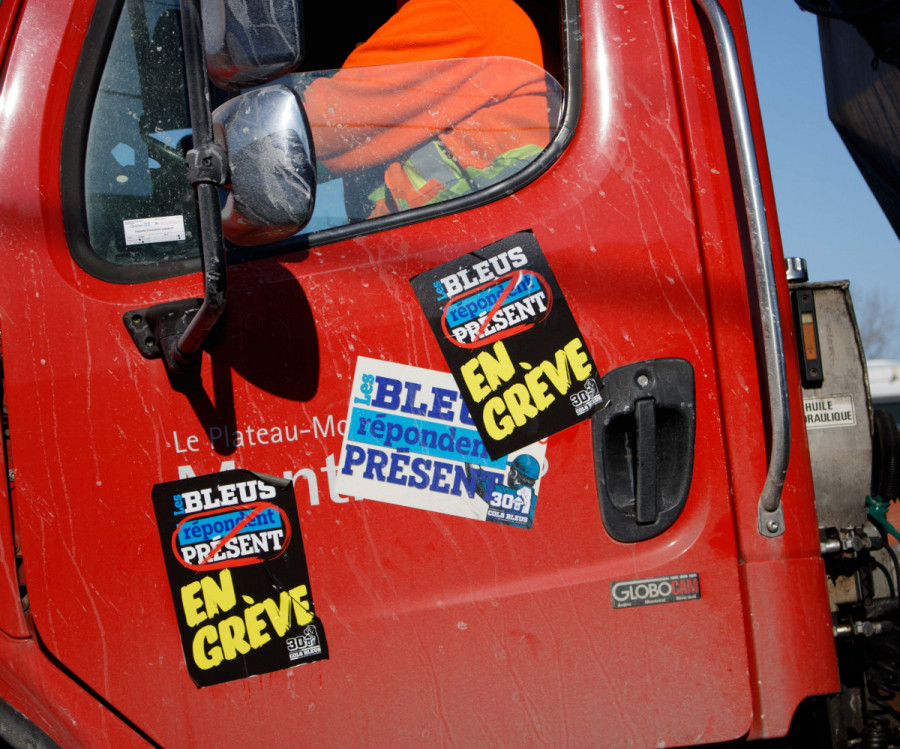
Meanwhile, Montreal's blue-collar workers went on strike on Feb. 4, and nearly a fourth of the specialized vehicles required for these services have broken down. The new administration is now pivoting to patch the holes.
Anjou’s borough mayor, Luis Miranda, said that it is no coincidence everything seems to be deteriorating at the same time, because all these operations are connected. According to him, at the moment, 23 per cent of the equipment used for these services in Montreal is in poor condition.
“We needed to catch up to all that yesterday,” Miranda added.
Miranda points to the Rosemont–La-Petite-Patrie borough, where he said six of the 12 sidewalk ploughers were missing.
“This is something that we are going to need to look into, because it isn’t normal to be short on equipment,” he said.
The state of the equipment, combined with the weather, created the perfect storm.
Miranda said this situation has been a long time coming, as a product of negligence.
“We invested a lot in bike paths,” he said. “We worked on streets that were not necessarily the priority because we were making bike paths.”
He believes the attention those streets got should have gone to streets that really needed work, like Notre-Dame St., the culprit that busted the mayor’s tires.
_900_600_90.jpg)
The city’s plan
When it comes to snow ploughing, not much can be done apart from bracing for impact.
Miranda pushed the idea of cooperation between boroughs. In his case, the Saint-Laurent borough lent him a snow blower last week to get the job done during the snowstorms.
“We need to make sure that we share what we need to do, make sure that everyone can have equipment to work with," Miranda said. "That is all we can do this year."
When it comes to the potholes, Miranda—alongside Ville-Marie city councillor Claude Pinard and Saint-Laurent borough mayor Alan DeSousa—announced on Feb. 5 that they will hand out $471,000 in 10 over-the-counter contracts to three companies tasked with manually sealing potholes for the next eight days, calling it a “blitz.”
The manual sealers are going to work hand in hand with the city’s four mechanical sealers.
An added that an additional $2.5 million will be given to boroughs specifically to seal potholes throughout the year.
The amount of money given is correlated with the number of complaints boroughs have received, the most affected being Villeray–Saint-Michel–Parc-Extension, Rosemont–La-Petite-Patrie, Mercier–Hochelaga-Maisonneuve, Ville-Marie, Saint-Laurent and Côte-des-Neiges–Notre-Dame-de-Grâce.
“It really is one of the worst winters we have seen since 2018,” Pinard said.
A three-year contract for mechanical sealing of potholes in Montreal came to an end on Dec. 31. Pinard said the city launched a call for tenders to renew this contract, but that there were no candidates that conformed to the criteria.
The new contracts, alongside the investment, will enable the city to help the boroughs, Pinard said, as the maintenance of pavements, both arterial and local roads, is the responsibility of Montreal’s 19 boroughs.
With no contracts and terrible weather for roads, the city finds itself in an "emergency" situation, according to Pinard. He called the roads “catastrophic" and an “issue of public security.”
The new investment will help prepare the city and the boroughs to face the next episodes of freezing, though most of the work done with this investment is only temporary, as permanent repairs can only be done in the spring.
DeSousa added that this issue not only impacts drivers, but also cyclists and pedestrians.
“It is not in Montreal that we want to see you practice your slalom like Mikaël Kingsbury,” he said.
_900_600_90.jpg)
Opposition calls it ‘amateurism’
Just outside the Maisonneuve conference room where the announcement took place, opposition borough mayor of Verdun, Céline-Audrey Beauregard, threw doubt on the weather argument.
“These are winters that are now the norm, with more and more thawing,” she said, adding that the newly elected Ensemble Montréal party had more than enough time to analyze the situation.
“It was irresponsible to push the problem because it was already preventable,” Beauregard said.
She asked if it required the mayor to be affected by the situation for the municipal government to take action.
“What I heard earlier scares me,” said Villeray–Saint-Michel–Parc-Extension city councillor Sylvain Ouellet, next to Beauregard. “The amateurism of this administration is quite problematic.”
Ouellet said the 10 contracts seem to be “blank cheques,” alleging there are no attempts from the administration to check how many potholes would be fixed in those eight days.
According to him, the real way to fix potholes is to invest in the renovation of the streets that need it, even if it can only be done in the summer and is more expensive.
Pointing to Montreal’s 2026 budget, he claimed that the administration is cutting the number of roads scheduled to be renovated this year.
“The boroughs will have more money, fine, it is going to be nice,” Ouellet said. “But it won’t change the quality of the pavement.”
He also cast doubt on the legality of the over-the-counter contracts, saying that it could be considered contract splitting, a practice that involves splitting a larger sum contract into multiple smaller contracts to avoid the regular procedure. If a contract amount is over $133,800, it must be a public call for tenders.
In this case, the city of Montreal split the $471,000 into 10 contracts for three companies, avoiding the need to publish those contracts publicly.

Blue-collared cloud
The blue-collar workers of Montreal work the city’s machinery, like the snowploughs, the sealing machines and the salt distributors.
Their union, the Canadian Union of Public Employees 301 (CUPE301), launched its first strike in 15 years on Feb. 4 after rejecting the city’s proposed 11 per cent salary increase over five years, which they argue is low considering the rising cost of living.
The union represents 6,200 workers in the city, who have been without a collective agreement since December 2024, according to a press release. After over 20 meetings, even some with the new administration, the union remains disappointed with the results.
“What is happening at the negotiating table is not serious,” said CUPE301 president Jean-Pierre Lauzon in a statement. “We are being presented with a financial framework that
would ensure the impoverishment of blue-collar workers. I can confirm one thing: we will not negotiate our own impoverishment."
The union declared that this strike is the beginning of what could become a clear and intentional escalation through their means of pressure, and that more actions can be taken if the city refuses to recognize the role of blue-collar workers.
“We have an excellent relationship with the blue-collar workers,” Pinard said at the announcement. “They had to do what they needed to do.”
On the other hand, Ouellet worries that this new deal might tarnish their relationship with the blue-collar workers because those contracts perform “exactly the same task” that the workers would do.
“We are in the middle of a negotiation with the blues,” Ouellet said. “The strategy done right now seems improvised, with consequences that could be serious for Montreal.”
This article originally appeared in Volume 46, Issue 9, published February 10, 2026.





_600_375_90_s_c1.jpg)