A fight on two fronts
Migrant advocacy groups protest federal and provincial government anti-immigration measures
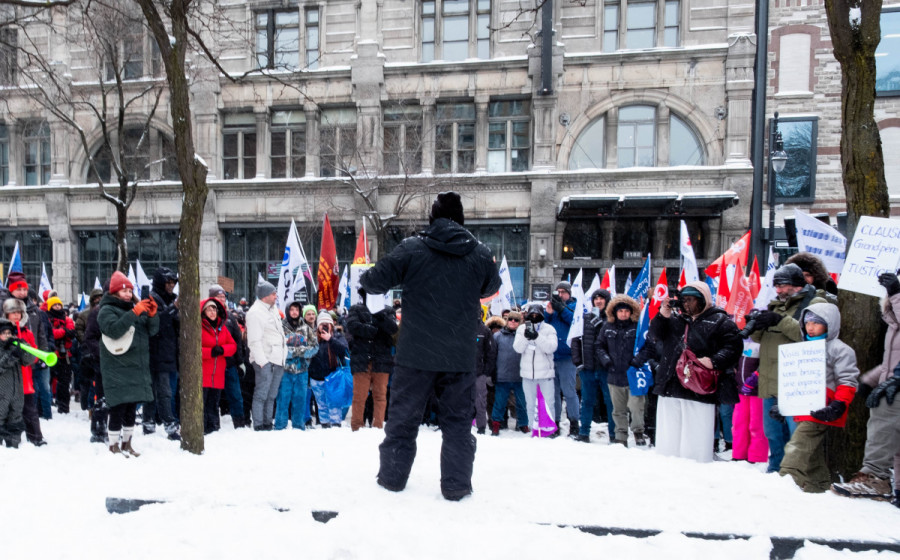
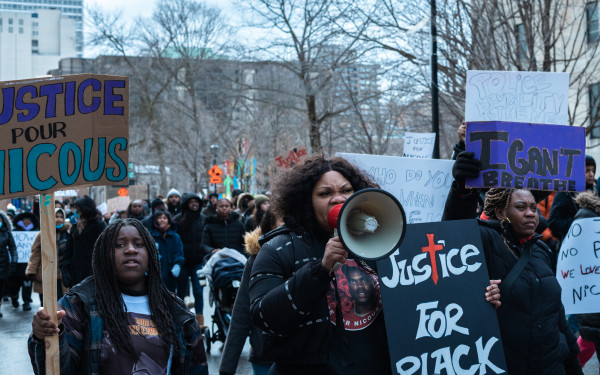
Hundreds of demonstrators took to the streets of Montreal on Feb. 7 to denounce the treatment of immigrants in Canada and Quebec.
Protestors gathered in front of the Canada Border Services Agency (CBSA) building at 12:30 p.m., braving the snow and the cold. The event was organized by Solidarity Across Borders, a migrant justice network based in Montreal since 2003.
Shi Tao Zhang, a member of the network, denounced Canada’s immigration enforcement policies.
“They separate children from families,” Zhang said. “They detain children with their families at the Laval immigration detention centre.”
According to data from Action réfugiés Montréal, at least 182 children were separated from one of their parents and were detained at the Laval Immigration Holding Centre in 2018.
A 2017 document titled "National Directive for the Detention or Housing of Minors" emphasizes that CBSA must not separate families.
Solidarity Across Borders also opposes the passage of Bill C-12. The bill would further restrict the Safe Third Country Agreement, an agreement between the U.S. and Canada that requires asylum seekers to seek refuge in the first country they reach. Bill C-12 would seek to “deter people from using the asylum system to bypass regular immigration rules (including the Safe Third Country Agreement).”
The bill also states that asylum claims made by people who enter Canada along the U.S. land border between ports of entry and who make their claim after 14 days would not be referred to the Immigration and Refugee Board of Canada, which is responsible for decisions on immigration and refugee matters.
“Which means that virtually no one who's coming from the United States will ever be able to claim asylum in Canada,” Zhang said.
After the march, a number of immigrants gave speeches sharing their experiences living in Quebec. The event ended with a choir singing unifying songs in English, French and Spanish.
Later in the day, at 2 p.m., hundreds of people gathered in front of the offices of the Ministry of Immigration, Francisation and Integration in Montreal to protest the elimination of the Quebec Experience Program (PEQ) by the CAQ government last November.
The PEQ was a pathway for immigrants to obtain a Quebec selection certificate, which would help them apply for permanent residency. International students and foreign workers were required to provide proof of their advanced French level or show that they have worked in certain sectors in the province for at least two years.
Bruna Ongaratti, a Brazilian immigrant who came to Montreal in 2023 with her husband, said she understood the requirements to apply for the PEQ and wanted to work to get them.
“When we chose to come to Montreal, we always knew we had to learn French, and we had to work two years, and then we can apply to the PEQ,” Ongaratti said.
She said that both she and her husband were about to apply in September 2025, but then the program closed.
“Now, we don’t have [the motivation] to stay here in Quebec,” she said. “We learn French, we work, we have a good life here, we have good salaries, we have everything—but the government doesn’t want me anymore.”
In its place, a new Skilled Worker Selection Program (PSTQ) will take the PEQ’s place. There are worries that the province is prioritizing applicants from outside of Montreal and Laval, according to CBC reporting.
Montreal Mayor Soraya Martinez Ferrada has called for the establishment of a grandfather clause for those who had a temporary immigration permit when the program was abolished.
Guillaume Cliche-Rivard is a member of the National Assembly for Québec Solidaire. He took direct aim at Immigration Minister Jean-François Roberge.
“Jean-François Roberge did something that I didn’t think he would be able to,” Cliche-Rivard said. “He nominated himself as the worst immigration minister in recent Quebec history.”
For people like Ongaratti, who is also a parent, the future is uncertain.
“I made a promise for my daughter because Quebec made a promise for me,” she said. “And now, I cannot keep this promise.”



_Mamadou_Konate_(Centre)___Amelia_Orellana_(R)_brown_hair__600_375_90_s_c1.JPG)
_600_375_90_s_c1.jpg)