
We’re onto you, Musk
The rocketmen gaze starward with no regard for the fragility of Earth
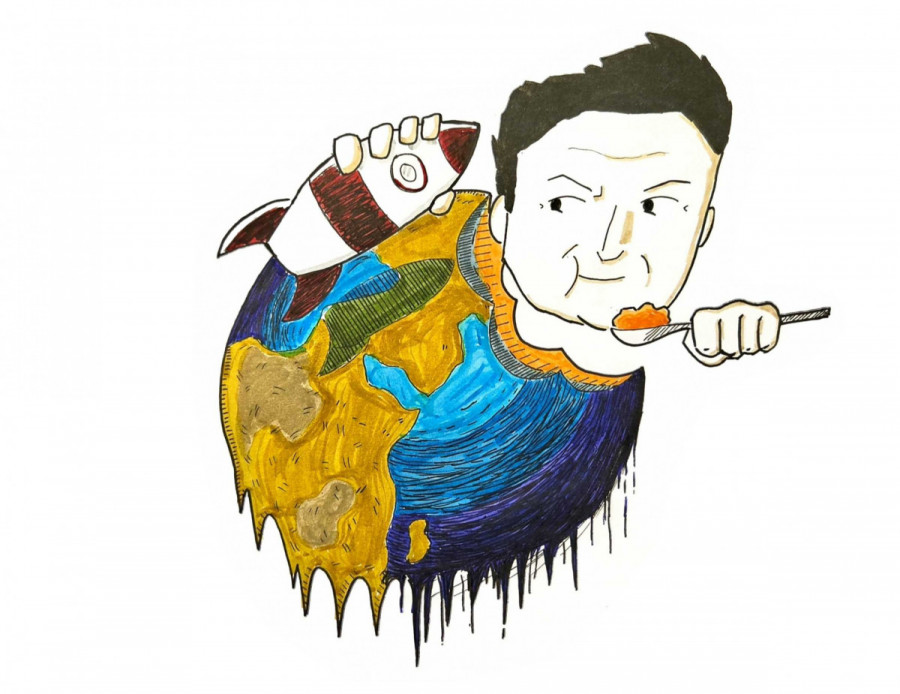
Ever since humans first went to space, the money, time and energy poured into space exploration have exploded, with countries and companies alike fighting to achieve the big “firsts.”
The original space race was a Cold War competition between the United States and the Soviet Union from the mid-1950s to the mid-1970s to achieve superior space exploration. Now we’re seeing a modern version of this race, driven by billionaires rushing to profit off the great unknown.
But private space exploration does not deserve the hype that the space-obsessed tech bros give it.
Spearheaded by Elon Musk’s SpaceX and Jeff Bezos’ Blue Origin, private aerospace companies are competing in a faux-macho big dick competition. The space race is a planned distraction from Earth's problems and the crowning jewel of capitalism’s flawed obsession with growth.
Capitalism itself is a massive comfort blanket, designed to help us never confront the mortality that awaits us all. Terror management theory tells us that, when mortality becomes “salient,” instead of addressing the underlying fear, we turn for comfort to the things which make us feel good. However, capitalism not only fails to recognize where the balance lies and what the tipping point is, but has no idea how to stop when it pushes too far.
Fuelled by intense rivalries and a pervasive fear of death, these “rocket men’s” ambitions include developing space tourism and a permanent human settlement on the Moon and even Mars. That is the worst use of our resources when our planet needs so much attention right now—especially amid the climate crisis, which threatens humanity’s future.
There is no second Earth, despite what Elon Musk might want you to believe. The inescapable online narrative of space as humanity’s “Plan B” only downplays the urgency of solving the climate crisis here on Earth. Not to mention, the push into space accelerates climate change on our planet and has new environmental impacts for humanity to contend with.
The environmental impacts from rocket emissions occur directly in the most sensitive layers of the atmosphere, where soot, alumina and nitrogen oxides are released. Space debris is accumulating at an exponential rate, creating orbital congestion. Ground-level launches produce localized exhaust and propellant contamination, habitat and wildlife disruption and launchpad damage during anomalies. The billionaire’s cosmic joyride is leaving a pretty big mess here on Earth.
For all its glamour, the obsession with the “final frontier” is, at best, an amusement and, at worst, a fatal distraction from the urgent task of rebuilding a society ravaged by social injustice, climate change and a loss of faith in the future.
The very act of reaching for the stars reminds us of the fragility of our planet. Humanity should pay more attention to what’s happening here and now on Earth. Learning how to live well on this fragile planet is far more important than dreaming about a new one.
This article originally appeared in Volume 47, Issue 6, published November 24, 2026.