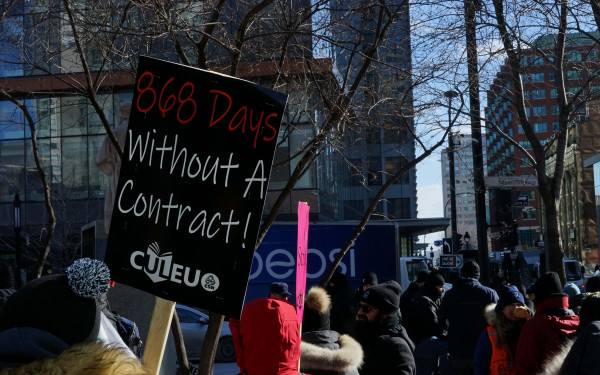
Montrealers protest Bill C-39
The rally was part of a nationwide day of action opposing the Building Canada Strong Act

Montreal residents gathered outside Industry Minister Mélanie Joly’s constituency office on Nov. 12 to protest against Bill C-39, the Building Canada Strong Act.
The rally was one of three mobilizations in the city, part of a nationwide day of action led by the Canadian chapter of 350.org, a global grassroots climate movement.
The federal government introduced Bill C-39 in September, arguing that the legislation would attract investment in major infrastructure and resource projects that support jobs and economic growth.
Among its provisions, the omnibus bill seeks to expedite and compress the federal review process for major projects, such as pipelines, to a one-year timeline after proponents submit the required information and studies. Critics argue this doesn’t allow enough time to study the environmental impacts of proposed projects.
Indigenous groups, including Chiefs of Ontario, have rejected the bill, contending it overrides their treaty and constitutionally protected rights, sidelines the government’s duty to consult and obtain free, prior and informed consent and doesn’t provide adequate time to decide on projects that would affect their lands and waters.
The protest in front of Minister Joly’s office was organized by various groups, including Common Horizon, Équiterre, Mères au front, Greenpeace and Seniors for Climate Action Now.
Hailey Asquin, a representative of Common Horizon, criticized the bill and the “corporate agenda” of Mark Carney and Mélanie Joly.
“We don’t see ourselves, regular working people, in their priorities. Everything they do seems to be to make wealthy shareholders and CEOs richer,” Asquin told the crowd.
She said the government should shift its priorities.
“Instead of investing time and resources in future-destroying industries, what if we instead invested in future-building industries?” Asquin asked.
In an interview with The Link, Asquin said bypassing environmental protections would cause significant ecological damage, particularly in rural and Indigenous communities, and criticized the government’s framing of these protections as red tape.
“All of these laws have lives attached to them. They were created because people were poisoned, entire ecosystems were damaged,” Asquin said.
She added that the government should instead invest resources in good green jobs for young people looking for meaningful work to address the climate crisis.
In her speech, Ashley Torres from Mères au front said she was worried about the bill’s environmental impacts on future generations.
“Bill C-39 is presented as a measure to strengthen the Canadian economy. But in reality, it will increase the environmental debt of our children,” Torres said.
She said the legislation would only help fossil fuel companies that continue to make record profits.
“Our children deserve better than this bill, which jeopardizes our ability to live in this world. This is not the legacy I want to leave to my daughters,” Torres said.
Bill C-39 establishes “regions of national interest” such as energy corridors and industrial regions for current or future developments. Once listed as a region of national interest, projects could be pre-approved. Additionally, if a project is considered to be in the public interest, “enabling activities” such as site clearing can begin before an impact assessment is complete.
These provisions follow the government’s creation of projects of national interest, which automatically grants all federal approvals at once under Bill C-5, which became law in 2025. In October, Prime Minister Mark Carney designated the proposed West Coast Oil Pipeline as the first project of national interest, which the David Suzuki Foundation called “a national liability.”
Speaking to The Link, Torres called these regions of national interest “sacrifice zones.”
“We are scared that [Bill C-39] can accelerate these types of projects here in Quebec when we are not interested [in them]. We have said no to so many of these projects in Quebec,” Torres said.
On Nov. 10, Climate Action Network International named Carney among other leaders of wealthy countries receiving its satirical “fossil of the day” award for their absence at COP31, the United Nations Climate Change Conference.
Torres said she wasn’t surprised about this announcement.
“Canada has shown us time and time again that they are not climate leaders because climate leaders don’t build pipelines,” Torres said.
Other provisions in the bill include allowing companies to offset harmful impacts on fish and fish habitat by paying a fee to an environmental damages fund, as well as making the Canada Energy Regulator the sole assessor of pipelines, instead of the Impact Assessment Agency of Canada, which critics say would weaken necessary review processes.
In his speech, Marc-André Viau from Équiterre said that although two-thirds of Canadians want to maintain or strengthen environmental protections, Minister Joly and the government are going in the opposite direction.
“We are no longer in a trade war or protecting our economy,” Viau said. “We are simply in a deregulation phase, doing what industries have always demanded: making profits and letting others deal with the consequences.”
Bill C-39 has also received widespread criticism from labour advocates, as the proposed legislation attempts to change Section 107 of the Canada Labour Code, which would give the government the power to unilaterally end a strike if it adversely affects national interests, as seen in Section 334 of the proposed bill.
Bertrand Guibord from the Conseil central du Montréal métropolitain, a regional labour council, said the proposed legislation threatens workers’ rights.
“Canadians have a right to a healthy environment and working conditions that respect their fundamental rights, including freedom of association, collective bargaining and the right to strike,” Guibord said.
Dave Jules-Amilcar, an engineering student at Collège Ahuntsic, said it was important to show up to the rally because laws such as Bill C-39 will affect young people’s futures.
He added that politicians are not concerned about the interests of youth and working-class people.
“I know that they are not working for us. I know that they are the representatives of bigger corporations and people with a lot of money, which is not most of the people,” Jules-Amilcar said.
As of Nov. 15, Bill C-39 is under review by a House of Commons committee and is under a pre-study by a special Senate committee.