Refugee advocates renew calls for Canada to withdraw from U.S. border agreement
Federal Court hears constitutional challenge against the Safe Third Country Agreement
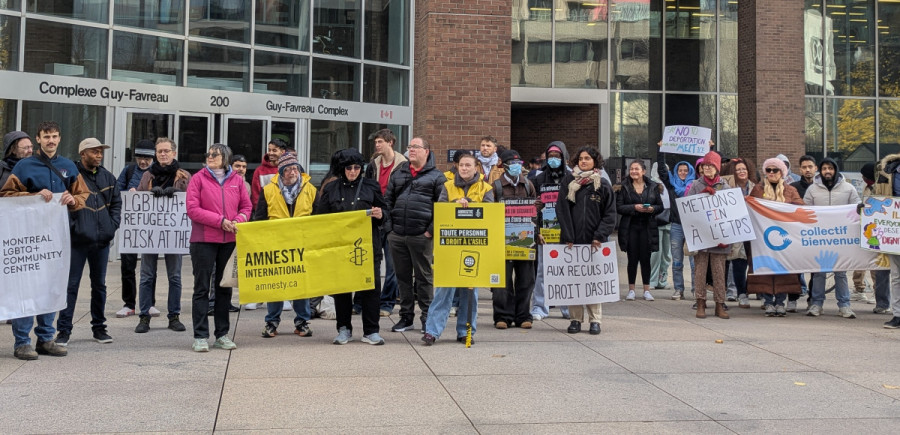
Refugee advocates held a rally in downtown Montreal on Nov. 9 to renew their demands for Canada to withdraw from the Safe Third Country Agreement (STCA).
The rally coincided with the start of a four-day Federal Court hearing in Toronto on a constitutional challenge to the STCA. The applicants argue that the agreement violates refugees' equality rights under Section 15 of the Canadian Charter of Rights and Freedoms.
The agreement, which took effect in 2004, requires most people seeking refugee protection to file an asylum claim in the first country they enter, either Canada or the United States.
However, since its establishment over two decades ago, refugee advocates have argued against the notion that the U.S. is a safe country for refugees.
“We want to emphasize that [the United States] is not a safe place for refugees or people without status,” Lauren Lallemand, the co-executive director of the Canadian Council for Refugees (CCR), said to The Link.
She added that the STCA is unconstitutional and demanded Canada withdraw from it.
The CCR launched a constitutional challenge against the STCA in 2017, along with Amnesty International Canada and the Canadian Council of Churches, after a similar challenge was struck down a decade earlier on technical grounds.
In 2023, the Supreme Court of Canada ruled that the agreement did not violate Section 7 of the Charter, which guarantees the right to liberty and security of the person.
However, the Supreme Court sent back constitutional questions to the Federal Court about whether the border agreement violated Section 15 of the Charter, which guarantees equality rights.
The court challenge focuses on this section, as advocates are arguing that the U.S. discriminates against and violates the equality rights of children, women and 2SLGBTQI+ people.
Reporting by The Marshall Project estimates that the Trump administration has detained 8,755 children during its second term. Women fleeing gender-based violence are also at risk, as the U.S. does not consider gender as one of the grounds for refugee protection.
In October 2026, Reuters reported that the Trump administration deported dozens of 2SLGBTQI+ refugees to countries where they would be subject to persecution and criminalization for their sexual orientation.
Melissa Claisse, the director of development and impact at The Welcome Collective, an organization supporting refugee claimants in Montreal, highlighted the fears of refugees across the border.
“The atmosphere, climate and fascist politics of the Trump administration are forcing people to live in hiding [and] in terror, to hope that they can make their way to Canada to maybe have a small chance at safety,” Claisse said in her speech.
In an interview with The Link, Claisse said the STCA forces people to take dangerous routes through forests and mountains to avoid interception by Canadian and American border officers.
“Every day we see the ways that the border is ripping families apart and denying people access to safety,” Claisse said.
Research conducted by academics at the University of Lethbridge, University of Arizona, Rice University and University of Regina found that 15 people died at the Canada-U.S. border between 2020 and 2023.
Alina Murad, the director of federal government relations at The Refugee Centre in Montreal, said that detention conditions in the U.S. mean Canada’s participation in the STCA violates the principle of non-refoulement, which stipulates that individuals should not be returned to situations where they would be at risk of harm.
Human Rights Watch, an international non-governmental organization that investigates human rights abuses, reported that at least 52 people have died in immigration detention since the beginning of U.S. President Donald Trump’s second term.
“The treatment of [refugees] within this system is treating them as though they are criminals. No one should be treated this way,” Murad said.
She also added that there is nothing criminal about seeking asylum.
In her speech, Nadine Louis, the executive director of Action Réfugiés Montréal, said that through the STCA, Canada is participating in an “indirect” chain of refoulement when individuals are turned back at the border.
“Canada cannot wash its hands [of responsibility] by assuming that the United States will handle the necessary protection efforts on its behalf,” Louis said.
The Migration Policy Institute estimates that the U.S. deported 980,000 people between January 2025 and July 2026. The Trump administration has also sent more than 25,000 individuals to third countries that are not their own and where they have no connections.
The legal challenge at the Federal Court will continue on Nov. 12, with the final day of hearings scheduled for Dec. 16.