Indigo, interrupted
Sharmistha Kar’s art practice traces labour, land and colonial history through indigo
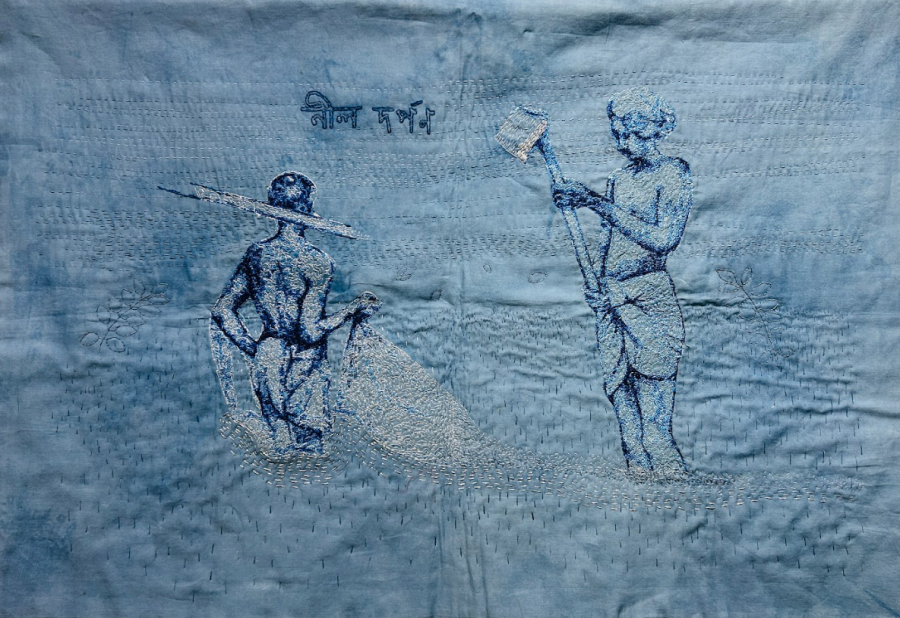
Sharmistha Kar’s textile practice brings handwork and machine processes into the same frame, with each stage demanding time, attention and labour.
Kar is an artist and PhD candidate in art education at Concordia University whose work centres on indigo and its colonial histories. Rather than approaching indigo as a neutral or decorative dye, her practice examines how extractive labour systems have shaped the material and how it can be worked with differently today.
“There are huge differences in gesture, in my hand, in space, in land,” Kar said, describing how different every project can feel. “Even growing the plant needs so much effort and attention.”
That awareness of effort does not come from a single site of making, but from moving between different conditions, such as tending indigo herself, working in lab environments, and researching indigo’s violent history under colonial rule in India. For Kar, moving between these spaces brings the realities of labour into focus.
“They forced farmers to cultivate,” she said.
Indigo production under British colonial rule relied on coercion and violence, culminating in the Indigo Revolt of 1859. Kar does not narrate that history in full; instead, it surfaces in her art.
“I wanted those emotions to be shown in a larger size,” Kar said. “The grief, the control, the power.”
Kar draws many of these figures from archival photographs, which she redraws by hand before translating them into embroidery. Pencil marks give way to stitched lines, digital files to fabric surfaces.
Hands, eyes and tents recur throughout Kar’s work, each signalling a different relationship to indigo.
The eye, she explained, reflects the gaze, the tendency to admire indigo for its colour while remaining detached from the conditions that produced it. Tent imagery gestures toward labour and displacement, referencing temporary housing for workers and the instability tied to extractive economies.
“When you read indigo’s history, there is written evidence that the people who handled and processed it were affected physically. The smell reacted with the respiratory system, and it even affected reproduction.” — Sharmistha Kar
Hands in Kar’s work point to care, repetition and physical effort. They reflect the time spent tending plants, drawing from archival photographs, stitching and embroidering. Even as her practice moves between handwork and digital processes, Kar resists the idea that labour disappears when machines are involved.
Gesturing toward the cursor on her screen, Kar drew the connection between digital and physical labour.
“That is also [a] hand,” she said. “Even our cursor has a hand, and it’s also a human hour that I’m giving.”
That attentiveness to labour carries into how Kar works alongside others.
She has worked alongside artist Anindita Chakraborty, whose own practice intersects with textiles, memory and material research. Chakraborty describes their collaborations as unfolding slowly, guided by shared attention rather than efficiency or outcome.
“For us, collaboration is slow and attentive,” Chakraborty said. “It creates space to learn from one another and to stay engaged with the creative process.”
Textiles, Chakraborty added, offer room for conversation and experimentation, recalling moments where understanding emerges through repetition and proximity.
“When we work together, conversations naturally unfold,” Chakraborty said. “Or sometimes it’s the silent gestures that guide us.”
That slowness mirrors the values Kar returns to in her own practice: labour that accumulates, care that cannot be rushed and attention that resists extraction.
Kar’s research has also taken her beyond India, allowing her to learn from other indigo-growing contexts, including Japanese indigo practices and farms in Kamouraska, Quebec. Each environment demands different forms of care. Japanese indigo can tolerate colder climates, while Indian indigo depends heavily on heat, sun and water.
“You have to be with the plant,” Kar said. “You have to give it water, look after it.”
That sustained tending requires time, patience and physical endurance. These demands sit in direct tension with indigo’s colonial past, when labourers were forced to produce the dye at scale under dangerous conditions.
Working with indigo in laboratory settings further complicated that relationship. Before dyeing, Kar was required to complete extensive safety training.
“I had to go through so many safety trainings before I made my first dye,” she said.
That level of protection stood in stark contrast to the historical conditions of indigo labour. Kar spoke about the emotional weight of handling the material while thinking about those who came before her.
“There was a huge emotional contrast for me,” she said. “When you read indigo’s history, there is written evidence that the people who handled and processed it were affected physically. The smell reacted with the respiratory system, and it even affected reproduction.”
Questions of visibility and accountability also emerged through Kar’s broader engagement with craft materials. She recalled a colleague who had been gifted an indigo dye kit but hesitated to use it because it contained no information about its origins.
“There was no information about who cultivated it, who processed it, or how those colours came into the box,” Kar said.
That absence pushed Kar to think more deeply about craft ecology in her studies, the systems of labour, land and movement that make materials possible but often remain unseen.
Others who have worked closely with Kar describe her practice as one grounded in sustained, hands-on engagement with material.
Geneviève Moisan, a fellow PhD student in Kar’s cohort, began working with Kar through shared supervision and later supported the material and technical aspects of her indigo research.
Moisan assisted Kar in working through different indigo dye kits, testing timings and maintaining the vats.
“We had a lot of fun testing different timings for the dyes and taking care of the vats together,” Moisan said. “My role was to support the work and her exploration of such a magical dye.”
For Moisan, working directly with indigo was central to understanding the research itself.
“I think it is important in a research-creation setting to work with the actual material components of one’s research,” Moisan said, “to better understand the difficulties, struggles, but also the marvelling at such beautiful processes and why they have kept humans reaching for blues for centuries all over the world.”
Kar’s own experiences of these processes, such as movement and migration, inform her thinking about labour and place. Growing up, she moved frequently with her parents, watching how work structured everyday life.
“Coming from India and living on a different land makes me more conscious and sensitive to my physical presence,” Kar said.
Kar’s PhD work brings these threads together through postcolonial theory, craft and art education. For her, education does not sit apart from making but emerges through sustained engagement with materials and their histories.
“Our approach now is just as important,” Kar said.
Despite the weight of indigo’s history, Kar’s practice remains rooted in the present tense of making. Through repeated gestures, sustained attention and time spent with the material, her work creates space to sit with that history without removing its weight.
She described this approach through 'Rafu,' a Farsi term meaning to mend.
“Talking about it is part of healing,” Kar said. “Working with indigo, for me, is a sense of repair.”
With files from Hannah Vogan.
This article originally appeared in Volume 46, Issue 10, published February 24, 2026.