Uniting from al-Maghreb to ash-Shām to celebrate Palestinian culture
The Palestinian Cultural Club hosts North Africa United for Palestine
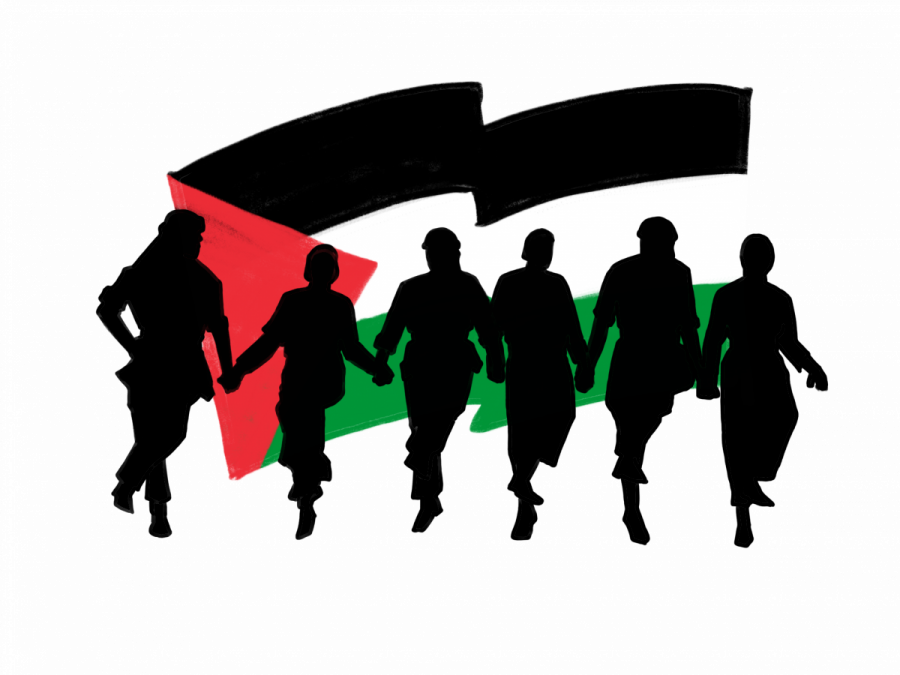
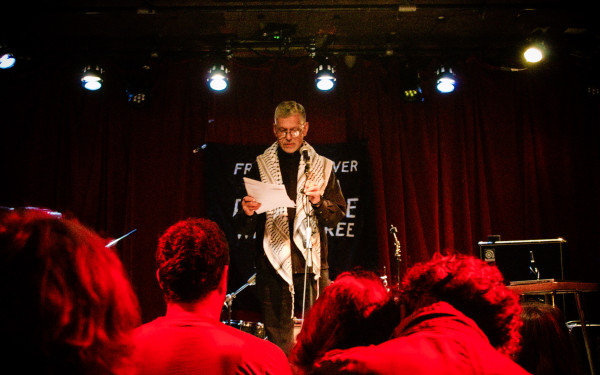
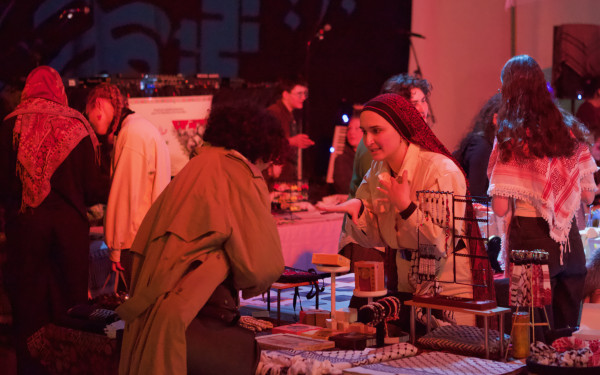
On Nov. 22, Concordia University’s Palestinian Cultural Club (PCC) held the North Africa United for Palestine fundraising gala. The event featured Arabic music, a packed dance floor with the occasional dabke circle, Moroccan food from sponsors and homemade dishes.
The event was a collaboration between several clubs from McGill University and Université de Montréal, such as the Algerian Students’ Association, Moroccan Students’ Association, Tunisian Student Society and the Comité des étudiants maghrébins de l’UdeM. The proceeds from the event, which was nearly sold out, will go directly to support the activities of Islamic Relief Canada and Doctors Without Borders in Palestine.
The atmosphere throughout the night was warm, lively and celebratory. Attendees wore traditional clothing, including flowing, colourful kaftans with delicate embroidery, long-sleeved thobes and jebbas and velvet karakou jackets. The event aimed to provide students with a social setting and a break from academic life, while also raising funds for humanitarian aid.
Yusuf Mohammed, a volunteer for the PCC, highlighted the importance of cultural events in support of Palestine. He said that when people first think of Palestinians, they think of victimhood and violence. However, according to him, this focus leads to the neglect of other aspects of Palestinian culture that are being erased, such as dance and music.
“[This event serves] as a reminder that our existence is not only political, but it’s also a very, very rich cultural existence,” Mohammed said.
Mohammed explained that it was often difficult to explain the Palestinian struggle, but that this was never the case when talking to other Arabs. The struggle of the Palestinian people, he said, is an issue that brings people of all backgrounds and cultures together because it is a human issue.
“Uniting different nationalities can serve as a reminder that we’ve always been more the same than we are different,” Mohammed said.
Concordia undergraduate student Nazir Sinan highlighted how the event challenged the orientalist viewpoint that homogenizes the diversity of North African culture. As a Syrian-Palestinian, Sinan said the event brought that diversity to the forefront and highlighted the pluralism of Arab cultures.
“I kept having goosebumps when listening to the zaghrouta (ululation) because the one in Syria is very much with the tongue, while the Algerian one is very much with the throat,” Sinan said. “To me, that’s beautiful, and it’s also a sound of resistance […] It’s sort of imprinted in my mind as this anti-colonial sound that triumphed over the French”
Growing up in the suburbs of Quebec, Sinan said he often felt he was the only one who cared about keeping Palestine in the conversation.
“Seeing a name like ‘United for Palestine’ is a call to those who do feel alone, who are fighting for Palestine—[it says] come here because you’re not alone,” he said.
He said he felt as if North Africa was passing the torch to Palestine in terms of fighting colonial administrations.
“It [felt like] the embodiment of the famous proverb [that] we’re not free until we’re all free,” Sinan said.
PCC vice president Laila Al Sharqawi, who is of Moroccan and Palestinian descent, spoke about the importance of events that bring people together for a shared cause.
“I wanted to showcase that the government is not the people, and the people are rooting for Falasteen (Palestine),” Al Sharqawi said.
She noted that the atmosphere at the gala was fun and full of laughter.
“Anybody is welcome to our events,” Al Sharqawi said. “You don’t have to be Arab or Muslim […] Just come, have fun, meet people.”
The Palestinian Cultural Club plans to host future events, including a poetry night and a potential Palestinian wedding. Updates can be found on their Instagram, @pcc_conu.
This article originally appeared in Volume 47, Issue 6, published November 24, 2026.