Documentary film ‘NAZA’ examines the banality of evil behind the horrific Gaza genocide
The film consists of 24 Israeli soldiers and intelligence officers interviewed about the atrocities they have committed.

The 2026 British documentary NAZA, created by investigative journalist Yuval Abraham and filmmaker Rachel Szor, bills itself as “a window into systems of mass killing.”
The film consists of interviews with 24 Israeli intelligence officers and soldiers, filmed over the course of three years from the rooftops of Tel Aviv.
Each interviewee is shown only as a dark silhouette to protect their anonymity. This choice also turns them into a blank canvas for the audience to project onto. It demonstrates what can happen when ordinary people say nothing in the face of injustice, participate in gradually escalating and extraordinarily horrific acts of evil and ultimately become a complicit instrument of mass atrocity.
The film’s title comes from the Hebrew ‘Nezek Agavi,’ a term used by the Israeli military to refer to civilian casualties. In an early scene, an intelligence officer described how the military refers to civilian casualties not as “15 women and children” or “15 people” but simply “15 NAZA.” NAZA is repeatedly discussed throughout the film as a “necessary loss” considered when the military decides whether or not to strike a building.
One former intelligence officer notes that the targeted benchmark for a strike is to aim for “20 NAZA” per each alleged “Hamas operative” killed. Senior Israeli military officials have claimed that there are 30,000 to 40,000 operatives left in Gaza as of October 2026. If the Israel Occupation Forces applied that ratio to every alleged operative, it would translate to a hypothetical civilian death toll of 600,000 to 800,000 people, equivalent to 30 to 40 per cent of Gaza’s estimated population of two million.
Some officers report being responsible for strikes that killed up to 500 civilians to strike a single alleged operative. The film’s interviewees explain how formulas, calculations and algorithms decide whether to strike a building. Many of them sketch out diagrams in a notebook.
This dehumanization, the replacement of humanity with technical jargon and numerical calculations, is behind the genocide in Gaza. The taking of hundreds of human lives occurs with algorithmic formulas and the press of a button in a room many kilometres away.
One intelligence officer states that his job is to “deal with the technicals,” not question the “moral or ethical aspects” of what is being done. This response is eerily similar to the famous “I was just following orders” defence provided by the Nazi military officials tried for the Holocaust in the Nuremberg trials.
One cannot help but think about Jewish historian-philosopher Hannah Arendt’s concept of ‘the banality of evil’ from her 1963 book Eichmann in Jerusalem (covering the trial of Nazi official Adolf Eichmann). Extraordinarily evil acts are often committed by bland, ordinary people who do not critically question what they are doing.
One intelligence officer says he often hears people in their final moments via hacked cellphones prior to launching a strike. He describes ordinary sounds such as prayer, a television in the background or a baby crying. When asked how he could still choose to bomb a home with a baby crying in it, he hesitates. He then responds that that is simply the mission: total destruction.
Many interviewees say their only focus is completing their objective. One states that he was always taught to think of what he was doing as akin to a video game, rather than the mass killing of real-world people.
These moments seemingly suggest that those involved in the genocide treat these atrocities as a bureaucratic task for them to complete.
Between series of interviews, we see Israelis going about their daily lives. Through apartment windows, we see someone clean their kitchen, and another fold a blanket on their couch. One woman runs on a treadmill. These scenes are reminiscent of the 2023 historical drama film The Zone of Interest, which examines the ordinary life of an Auschwitz commandant and his family in their home next to the Auschwitz concentration camp.
Much like The Zone of Interest, NAZA constantly seeks to remind us that these horrific atrocities were committed by ordinary individuals with ordinary lives who simply chose not to question what they were doing and continuously chose to be complicit in these acts.
A large portion of the runtime is dedicated to a detailed examination of the Israeli military’s targeting database Lavender, which uses AI to choose target individuals to bomb from a list of tens of thousands of Palestinian men living in Gaza. The system makes these choices by predicting an individual’s involvement with Hamas based on text messages, phone contacts and other data the military collects.
An intelligence officer claims that about 15 per cent of the thousands of people killed by Lavender are not involved with Hamas.
Many Israeli strikes invoke the ‘Where’s Daddy’ strategy, in which targeted individuals are bombed upon returning to their family home at night. Despite nearly guaranteeing the deaths of innocent people and children, the military chooses this strategy as it is believed to have the highest success rate.
One interviewee noted that Lavender often destroys entire buildings with everyone inside “for targets so junior that we don’t even know who they are [without using AI].”
One woman says the military demolishes homes by the hundreds “before legitimacy is lost” in the eyes of the international community, seeking to prevent families from returning. She notes that the bombing is so destructive that entire communities have been destroyed, providing the appearance that “civilization never even existed there.”
In one of the final scenes, an interviewee states that he grew up wondering how the Nazis were psychologically capable of committing the Holocaust and recounts his experience visiting former concentration camps. Following his involvement in the mass killings in Gaza, he says he finally understands how the Holocaust was able to happen, and wonders if he is any better than the Nazis.
After the final interview, the film cuts to a montage of cell phone footage of the Gaza genocide. After an hour of examining the banality of the genocide’s evil and the dehumanization that allows it to function, the audience is confronted with the human side of the destruction. We see homes destroyed, fires engulfing the streets and the devastating human toll, with bodies of the dead and injured amid the destruction.
One video depicts a man searching for his two dead children amongst severed body parts in the rubble that was once their home. We hear his cries of despair as he realizes his children have been killed.
This is the reality of Israel’s actions in Gaza. There is no war, only a genocide. This is not a conflict; it is mass slaughter.
The film ends by noting that the genocide of civilians in Gaza is still ongoing. The credits begin. Whereas most films pair end credits with music, NAZA’s play in complete silence.
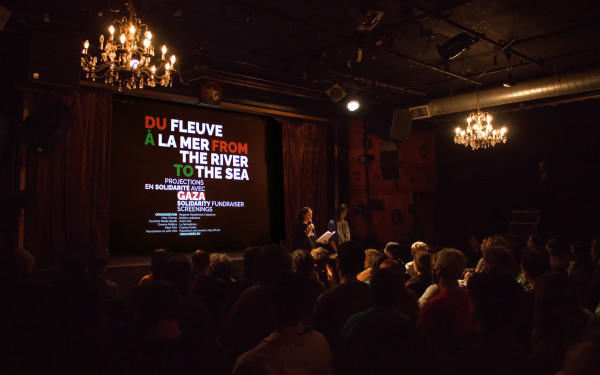
By the end of one Montreal showing, the entire sold-out theatre was deafeningly silent, even as the lights turned on. There was nothing to clap for, and no words could adequately capture the weight of what the audience had just witnessed.
NAZA is undeniable documentation of the banality of evil behind a horrific genocide that is currently ongoing: a genocide that takes more lives with every passing day; a genocide we must work to stop.
The film will be free to stream on The Guardian’s website beginning in late November.