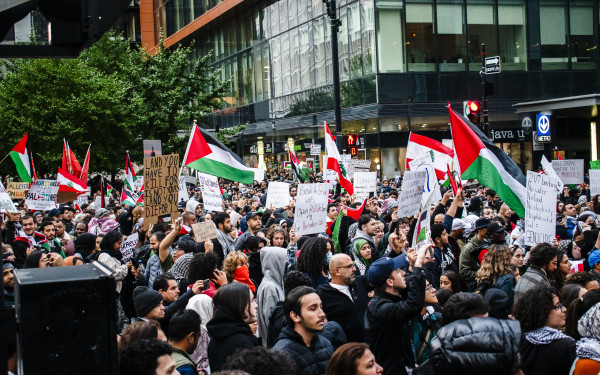
Advocates urge new Quebec government to end cooperation with Israel
The Votons Palestine campaign outlined four key demands ahead of the provincial election
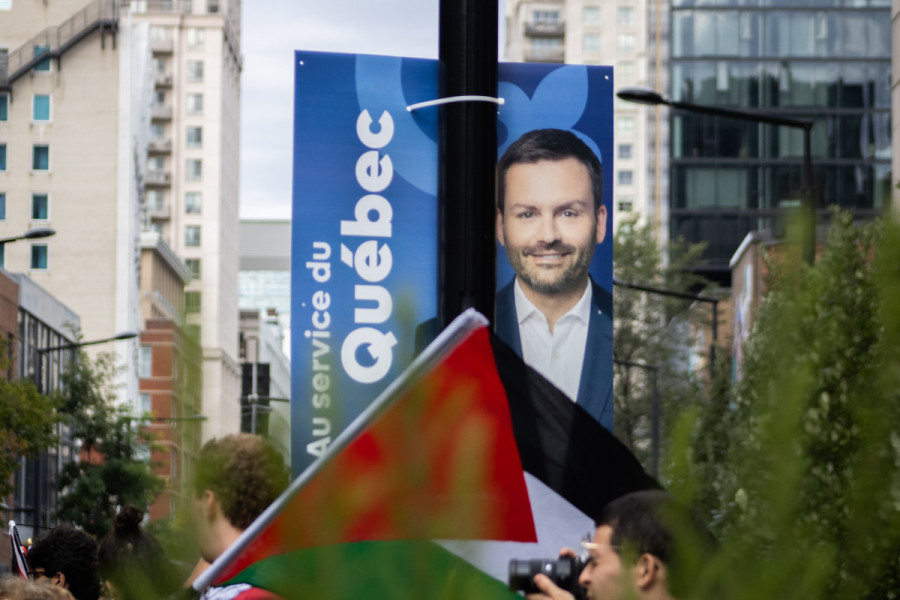
With the Parti Québécois (PQ) winning the provincial election, advocates are demanding the new Quebec government cut ties with Israel and provide Palestinians from Gaza with equal healthcare coverage.
Leading up to the election, a coalition of six civil society organizations launched the Votons Palestine campaign, demanding that candidates commit to four key demands.
The demands of the campaign include closing Quebec’s office in Tel Aviv, divesting from companies complicit in violating international law through the Caisse de dépôt et placement du Québec (CDPQ), ending the flow of military equipment to Israel and extending healthcare coverage to residents arriving in Quebec from Gaza.
The non-partisan campaign was endorsed by 80 candidates and 250 civil society organizations.
In an e-mail to The Link, Quebec Solidaire press officer Sandrine Bourque highlighted the party’s endorsement of the campaign’s demands in a social media post dated Sept. 18.
“We are the only [major] political party in the 2026 election to have fulfilled all the commitments requested by Votons Palestine,” Bourque stated.
However, not every Quebec Solidaire candidate signed the pledge.
Alex Tyrrell, the leader of the Green Party of Quebec, also endorsed the campaign’s demands in a social media post on Sept. 21.
A member of Votons Palestine said the campaign followed similar efforts during last year’s federal and municipal election in Montreal, but with a specific focus on provincial actions.
“Our goal was to popularize the level of complicity of the provincial government in the crimes committed by Israel,” the representative, who remained anonymous to protect their identity, said.
The Coalition Avenir Québec (CAQ) announced it would open a Quebec office in Tel Aviv in August 2023. However, the opening was delayed from the initially planned date in October of that year to early 2024.
According to its website, the office is intended to represent the province in Israel vis-à-vis governmental, institutional, economic, cultural and academic partners.
Tens of thousands of individuals have called on the government to close the office through petitions dated from February 2024 and December 2025.
During the election campaign, the PQ called for the suspension of the office’s activities, while Quebec Solidaire demanded that the government close the office entirely.
“Why are you building relations with a state that has a history of ethnic cleansing and uprooting of Palestinians?” the Votons Palestine member demanded.
Cooperation between the two governments isn’t new, however.
Former Quebec premier Philippe Couillard visited Israel in 2017, and Quebec signed a research-and-development, as well as a cybersecurity accord.
A representative of Students for Palestine’s Honour and Resistance (SPHR) Concordia said the cooperation between the two governments is “shameful but not surprising” given Quebec’s colonial legacy and Israel’s continued practice of apartheid.
“Quebec should embrace divesting from Israel and closing this office to not perpetuate the same colonial crimes that we decry now publicly,” the representative, who was granted anonymity by The Link for safety reasons, said.
“We are the only [major] political party in the 2026 election to have fulfilled all the commitments requested by Votons Palestine,” — Sandrine Bourque, Quebec Solidaire press officer
In 2025, United Nations Special Rapporteur on the situation of human rights in the Palestinian territories Francesca Albanese found that the CDPQ had nearly $9.6 billion invested in companies responsible for sustaining occupation, apartheid and genocide in Palestine.
Raymond Legault, a spokesperson for the coalition, said divesting from these companies would align with the pension fund’s own human rights policy and comply with United Nations guidelines on responsible business practices.
“The CDPQ is under obligation to act upon knowledge that some of the companies it is investing in are complicit in violations of human rights, war crimes and crimes against humanity in Gaza and the West Bank,” Legault said.
In June, Charles Emond, the president and chief executive officer of the second-largest pension fund in Canada, the CDPQ, published a letter in response to the coalition’s report.
“Our geographic exposure to Israel currently stands at 0.04 per cent of our total portfolio, or less than $250 million. What remains are investments held by a handful of our external managers,” Emond wrote.
Legault said the coalition’s demands are not limited to Israeli companies and more broadly target multinational companies complicit in human rights violations, while emphasizing that the CDPQ should align with its previous stances, such as when it divested from Russian companies in 2022.
While the CDPQ is independent from the provincial government, Quebec Solidaire has previously called on the pension fund to divest from companies responsible for violations of international law.
The Votons Palestine campaign also demanded that the government ensure weapons made in or transported through the province are not sent to Israel.
A report published by the Arms Embargo Now coalition in November 2025 detailed shipments of explosives and flammable materials from General Dynamics facilities in Valleyfield and Repentigny to American ammunition plants that manufacture bombs and shells used on civilians in Gaza.
The same publication also highlighted that shipments of TNT manufactured in Poland were routed through the Port of Saguenay and subsequently sent to Israel.
The fourth demand of the campaign was to extend provincial healthcare coverage to Palestinians from Gaza who come to Canada through the temporary residency program. They are covered under the Interim Federal Health Program for three months upon arrival in Canada.
Provinces and territories are responsible for extending healthcare coverage after that period. Quebec, however, has refused to do so, arguing that residents don’t meet the necessary criteria to receive coverage under the province’s public health insurance board, the Régie de l'assurance maladie du Québec (RAMQ).
In May 2025, more than 70 healthcare and civil society groups released an open letter criticizing the decision and noting that Ukrainian refugees are eligible for RAMQ, a policy further extended until 2028.
“How come we have all that money to commit these atrocities that make us complicit in genocide, and then when Palestinians come, we refuse healthcare coverage?” the Votons Palestine member said.
The SPHR representative said that changing Quebec’s relationship with Israel is long overdue.
“It would abide by the demands of thousands of Montrealers who have been protesting against this genocide for the last three years,” the representative said.
The PQ did not respond to The Link’s requests for comment.
This article originally appeared in Volume 47, Issue 5, published November 10, 2026.