
The concerning rise of sports betting
Canada’s lack of framework for gambling advertisements is a blind spot in regulation

At any major sporting event, the losers of a game aren’t only on the court. They’re in the stands, in line waiting to use the bar bathroom or in their living room with the television turned on.
The profits of modern sports entertainment have gone beyond ticket, merchandise and concession sales. They now have monetized fan expectations.
Platforms like bet365 and DraftKings have meticulously positioned themselves as a natural extension of sports entertainment. In the process, they’ve also seduced a new generation of sports fanatics and deconstructed the taboo around gambling.
However, this hasn’t decreased its stakes for our society and the health of those who partake, especially when it’s become more accessible than ever with dozens of online casinos and sportsbooks available for mobile download.
According to a 2025 Mental Health Research Canada study, 9 per cent of Canadian adults are classified as people with problem gambling. Individuals with problem gambling are four times as likely to experience suicidal ideation.
This makes it clear that the risks tied to gambling, like addiction and financial strain, are beyond the scope of the fine print’s advice to simply “gamble responsibly.”
According to Adrianos Tom, a research assistant at Concordia University’s Research Chair on Gambling, the new space betting occupies in sports entertainment is similar to alcohol consumption.
“It’s used as an enhancer to make something exciting more exciting,” Tom said. ”In my opinion, it's both a social standard, like it's become the norm to have a beer while you watch a game."
The accelerating popularity of this industry is thanks to the revision of laws that once heavily restricted sports betting in Canada and the United States.
In 2018, the U.S. Supreme Court struck down the Professional and Amateur Sports Protection Act, which allowed sportsbooks to operate outside of the state of Nevada. In 2021, the Canadian government legalized single-event betting, allowing digital sportsbooks like DraftKings and bet365 to capture a new audience and revolutionize how fans place bets.
This February, ESPN reported that Americans alone legally wagered an estimated US$1.76 billion on Super Bowl LX. According to Canadian Gaming Business, people wagered C$98.3 billion through Ontario’s iGaming platforms last year.
The house always wins
The arrival of single-game bets has widened the scope of bets users can place. Fans can now bet on the coin toss, the colour of sideline Gatorade, the speed of the first goal and beyond. All of which encourages impulsive behaviour from fans as they get more “immersed” in a game.
These digital platforms use deceptive marketing like offering “boosts” on in-game odds to encourage users to make new bets that they’ll likely lose.
“It takes advantage of people's illusions of statistics,” Tom said about the marketing strategy. “The more predictions you make the greater the chances that you're going to lose.”
Last September, iGaming’s monthly report showed that Ontarians lost $329.3 million dollars on wagers while DraftKings reported $1.1 billion dollars in revenue during the third quarter of 2025.
In Canada, sportsbook advertising is in a grey area. Currently, it’s up to the provinces to decide what’s allowed and while Ontario is the only province allowing private companies to operate, their ads are still seen all over the country.
The Act Respecting a National Framework on Sports Betting Advertising which aims to restrict advertising that may harm minors or people at risk of gambling harm completed its second reading at the House of Commons in Feb 2026.
In 2025, market research company Leger reported that about half of the Canadian bettors they surveyed said they would be more likely to increase their bets when they were exposed to live odds on a screen.
Max Friedl, a basketball fan, has also noticed the pressure from the platforms to chase losses.
“You're like, oh, I lost two, so I'll bet [more], I'll win one, I'll place twice as much and win, and then I'll be back winning,” he said.
On its website, DraftKings says it offers “an immersive sports entertainment experience.” Bet365’s “Never Ordinary” advertisement campaign argues that anything can be bet on, and even “unstimulating” sports can maximize their entertainment value with monetary strain from fans.
“It’s used as an enhancer to make something exciting more exciting. In my opinion, it’s both a social standard, like it’s become the norm to have a beer while you watch a game.” — Adrianos Tom, research assistant, Concordia University Research Chair on Gambling
Dr. Liam Young, program head of Carleton University’s communication and media studies department, has observed that the trajectory of sports gambling is eerily similar to that of financial markets.
“Traders view financial markets as a series of units that they aggregate in different ways,” Young said. “You're kind of breaking a larger entity apart into little units, and then you're combining and moving those things around to try to generate value, and that's exactly what's happening with sports now.”
Young called this process "datafication," in which a game is disconnected from the sport and its athletes are viewed as assets, rather than holistically.
This subtle dehumanization of players can embolden bettors to be obsessive or aggressive towards athletes when their performance doesn’t align with their parlays.
Cameron Corhen, a college basketball player, told NPR in 2025 that he had been a victim of social media harassment from bettors.
“After the games, you'll check your DMs and people are wishing harmful things on family members,” Corhen said.
The same year, the National Collegiate Athletic Association found that 10 per cent of its male Division I athletes received social media abuse linked to sports betting in the last year.
The rise
Industry giant DraftKings began as a fantasy sports platform allowing fans to draft their ideal teams by choosing players with the best or most practical statistics. Their experience in communicating those statistics to users allows them to transfer that knowledge into odds and separate a game into consumable parts.
Platforms hope to heighten engagement from fans by showing them various statistics and odds.
“[It's] inviting them to take that expertise and take that knowledge and take that emotional investment and monetize it," Young said. “That's at least a substantial part of the story."
Conversations and debates about betting can also generate excitement. This explains why many in-game broadcasters even discuss their own bets on the air.
“There's an incentive to use it to analyze and to create space for people to talk about it, and that feeds into the kind of mainstreaming of it,” Young said.
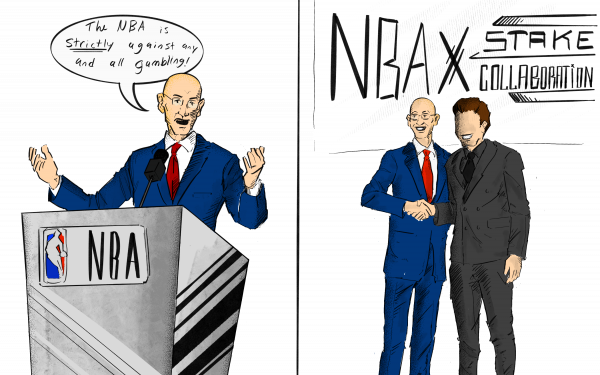
Official partnerships, like the one recently announced between bet365 and UFC, demonstrate that broadcasters, leagues and gambling platforms are all aligned in a mutually beneficial relationship.
“Television broadcasters want us to keep our attention on the game,” Young said. “So a gambling app that encourages you to make a bet and then keep watching the game to see the result of that bet is good for the broadcasters, and it's good for the leagues.”
In a way, the vertical integration of betting has transformed sports entertainment into a major
success story of the attention economy.
But this begs the question: when did sports stop being enough?
If you or someone you know is struggling with gambling, you can contact Aide Jeu, a free, bilingual and confidential telephone consultation service at 514-527-0140.
This article originally appeared in Volume 46, Issue 11, published March 17, 2026.



4_600_375_90_s_c1.jpg)