
STM officers in sheep’s clothing
Metro fare inspections blur the line between public service and policing
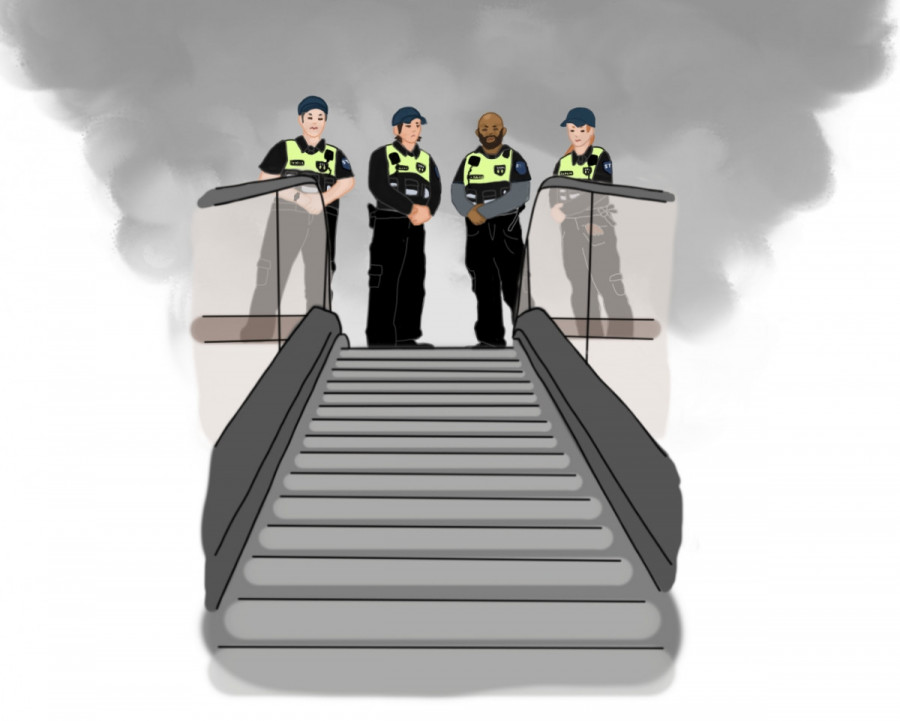
Over the last month, I have twice encountered flocks of STM fare enforcement officers in their natural habitat.
They wait by exits of station platforms in large, loitering groups, stopping each exiting Metro passenger to verify their ticket or OPUS card with clunky, archaic (yet expensive-looking) scanning devices.
In the first instance, I was getting off the Green Line at Saint-Laurent station and wasn’t sure what they were doing. I absentmindedly tried to permeate the loose wall of uniformed officers and go on my merry way home. Then, several STM officers coalesced to form a barrier in my way and demanded that they look at my OPUS card. The whole process seemed a bit absurd, but I complied and only then went on my merry way home.
The second time, I encountered this strange ritual at Place-des-Arts station while boarding the Green Line, and was pleasantly ignored.
What struck me in both instances was the scale and chaotic nature of their operation. The sheer number of STM officers involved in these operations was borderline ridiculous, and they seemed to rely on numbers to enforce fare verification rather than any sort of organized method or protocol.
To be clear, I did not personally find their conduct offensive, disrespectful or unprofessional. I do not resent them for doing their jobs. However, the premise of the activity seemed sort of absurd.
According to the Montreal Gazette, the deployment of fare enforcement officers is part of a renewed effort to crack down on fare evasion while ensuring “fairness and consistency” for its paying customers. In the Gazette’s coverage of the issue, it is suggested that the decision may have been precipitated by financial pressures experienced by the STM in 2025.
The issue of the STM’s fare enforcement strategy raises important questions about the disbursement of financial resources to public services (or lack thereof) and the role of public services writ large.
What role does public transit serve, and what does fare enforcement actually achieve?
If we think about these two questions in silos, the tension between the motives of public service and policing is clear. Imposing a policy that assumes fare evasion is engendered by contempt for public service undermines the very spirit of public service itself.
For many, fare evasion is a last resort; an act of desperation undertaken out of necessity. Treating it as a policing issue ignores these realities at best, and compounds them at worst.
Transparency is a key issue here. The strategy is framed as financially necessary, yet the STM provides little operational transparency.
Their 2026 budget reports up to $56 million in project savings this year, and suggests that savings targets expected to be reached in five years will instead be achieved in three. This is a very different tune from what STM representatives sang upon the rollout of the fare enforcement program.
I suppose the part of this whole charade that leaves a bad taste in my mouth is that, without transparency, none of this seems sincere. I do not object to the issuing of exorbitant fines as much as I resent the convoluted justification behind this program.
If fare enforcement is about financial necessity, the STM should report how much money is directly saved by the program. If it’s about deterrence, they should demonstrate how fare enforcement increases compliance. I also find it curious that the proposed solution to this “fairness” deficit in public transit is randomized policing operations.
Is fare enforcement about balancing the books, providing “fairness and consistency” for paying customers, or something else? Whatever the answer, just tell the truth. I’m sure anyone who feels it necessary to risk a $500 fine for skipping a $3.75 fare can handle it.
This article originally appeared in Volume 46, Issue 12, published March 31, 2026.