
Montreal’s heat is political
Climate change isn’t abstract when summers grow unbearable
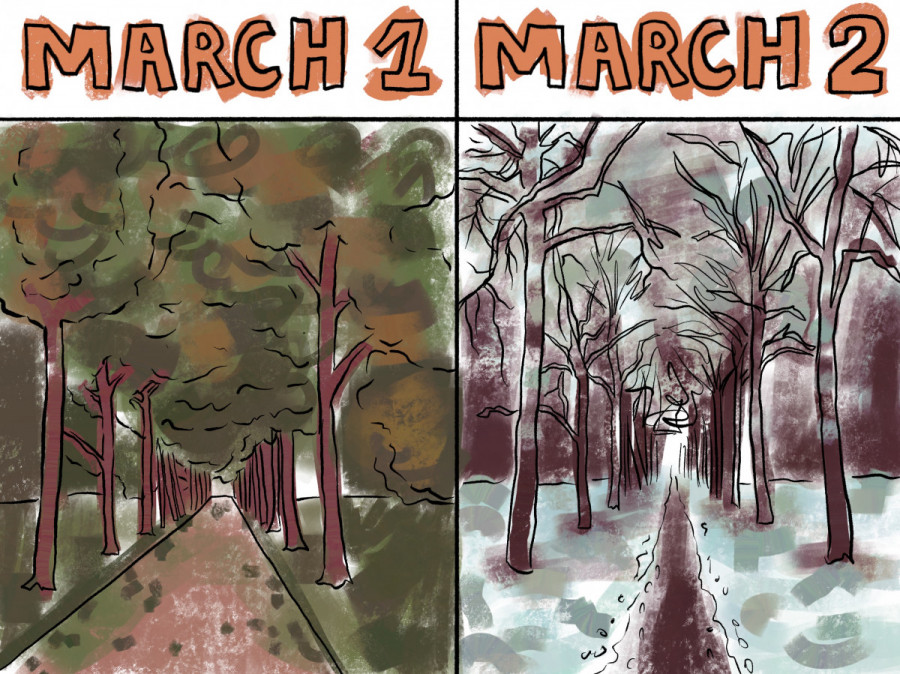
Montrealers are more frequently becoming the victims of climate change.
When I spent my first summer in downtown Montreal, I was unprepared for the heat. Having grown up on leafy suburban streets, I was used to shady sidewalks and quiet refuges from the sun. Little could have prepared me for the concrete oven of Ville-Marie.
Even after sunset, the pavement radiated warmth back into the air. Once-joyful walks from my apartment turned into hellish hikes as heat bounced off buildings and asphalt. I spent countless nights sweating through sheets, turning to ice packs and mediocre fans to counteract the endless heatwaves.
But my discomfort was the least of my worries.
What concerned me most were the people around me: my elderly neighbours, the young mother waiting alone at an unsheltered bus stop and the unhoused man on the corner of my street. I worried about what would happen to them when the temperatures soared.
Extreme heat does not fall evenly across a city. Those with air conditioning can close their windows and wait it out. Those living in poorly insulated apartments, waiting outside for public transit or sleeping on the street cannot. Lower-income neighbourhoods are often further impacted as a result of fewer heat-absorbing green spaces. Heatwaves expose the inequalities already embedded in urban life.
These anxieties surrounding climate change are not exclusive to me, nor are they limited to Montreal. A 2023 CanadaHelps national survey found that 75 per cent of Canadians are worried about climate change.
But this fear is no longer abstract; it is felt in rising temperatures, longer heatwaves and summers that feel increasingly difficult to endure.
On a municipal level, the city of Montreal has several ambitious environmental plans in place. Montréal 2030 puts forward a framework for guiding the city into a future of ecological resilience. Additionally, alongside other major cities like New York, Paris and Toronto, Montreal aims to be carbon-neutral by 2050.
On a provincial level, Quebec has joined the fight against climate change, with its 2030 Plan for a Green Economy that aims to reduce greenhouse gas emissions.
But plans and targets are easy to announce and much harder to deliver.
For decades, governments have signed agreements and introduced ambitious climate strategies, with the first international environmental accord dating back to the highly successful 1987 Montreal Protocol. Yet Canada is not on track to meet its existing climate targets.
Climate change has been pushed around as a tool for decades, losing relevance whenever the next hot political pawn presents itself. It’s easy to symbolically sign onto an agreement or draw up an extravagant plan, but it’s the next steps that truly matter.
Climate change is always discussed in distant timelines. But for Montrealers, it has already started shaping daily life.
When the next heatwave arrives, let it remind you that governments must be pushed to turn promises into action. Because climate change is no longer a distant problem. And every summer is a warning.



_600_375_90_s_c1.jpg)