Montreal’s $40 million investment in police cameras raises privacy concerns
Experts and advocates say body cams are a surveillance tool that benefits police, not the public
In Montreal’s 2026 budget, Mayor Soraya Martinez Ferrada’s administration pledged to spend $40 million on police body-worn cameras and additional security cameras over the next 10 years if the Quebec government approves the use of the technology.
But some researchers, activists and politicians argue that body cameras are costly, invasive and often fail to address systemic issues.
Craig Sauvé, a former Montreal city councillor and the leader of the political party Transition Montréal (TM), told The Link that TM opposes the technology and does not see it as a “sustainable solution” to police brutality.
Sauvé expressed concerns about the technology's limited effectiveness in jurisdictions where it has been implemented and says he would instead like to see the Bureau des enquêtes indépendantes (BEI) do a better job of holding officers accountable for brutality.
“What we really have to be working on is improving the socioeconomic status of our citizens,” Sauvé said, adding that improving Montreal’s social safety nets would reduce crime and the need for heavy policing.
Ted Rutland is a Concordia University professor, human geographer and policing researcher. Rutland said that after more than 15 years of body camera usage, research has not demonstrated improved police accountability or reductions in police violence and racism despite widespread and costly implementations of the technology in some jurisdictions.
Rutland also noted that in the past decade, many police killings of civilians have been filmed on smartphones without the officers involved facing any consequences.
“We have to deal with the fact that the video evidence is not holding police accountable,” Rutland said. He pointed to the fact that the BEI recently chose not to charge any of the officers involved in the 2025 killing of Abisay Cruz despite smartphone video evidence of the killing.
“But [smartphone recordings] help to give a more accurate representation of what the police actually do,” Rutland added.
Rutland criticized disproportionate police killings of BIPOC people and people with mental illness in Canada, and the lack of consequences faced by SPVM officers who kill civilians.
A member of the Defund the Police coalition, who was granted the pseudonym Hugo Gareau for safety reasons, said the origin of body cameras as a “tool for transparency” can be traced back to the early 2010s.
“Body cameras were actually originally marketed as a tool that would make the police more effective at repressing people, at surveilling people and at convicting people,” Gareau said.
Gareau pointed to early marketing by Axon—then known as Taser—that positioned body cameras as a way for police to protect themselves from lawsuits.
The company only began promoting the technology as a way to promote police reform after the police killing of Michael Brown in Ferguson, Missouri, in 2014.
In Rutland’s opinion, body cameras were not introduced to protect civilians or hold police accountable, but to gather evidence and surveil citizens.
“The evidence that they’re collecting through the body cameras—which is 99 per cent just interactions with citizens that they’re targeting—can be used in court, either to extract a plea deal or to convict someone,” Rutland said.
Rutland is skeptical of the Montreal Police Brotherhood’s support for body camera implementation.
He suspects that the organization has ulterior motives, pointing to past statements where the Brotherhood has expressed a desire to combat the narrative created by social media footage of police violence.
Gareau expressed similar concerns.
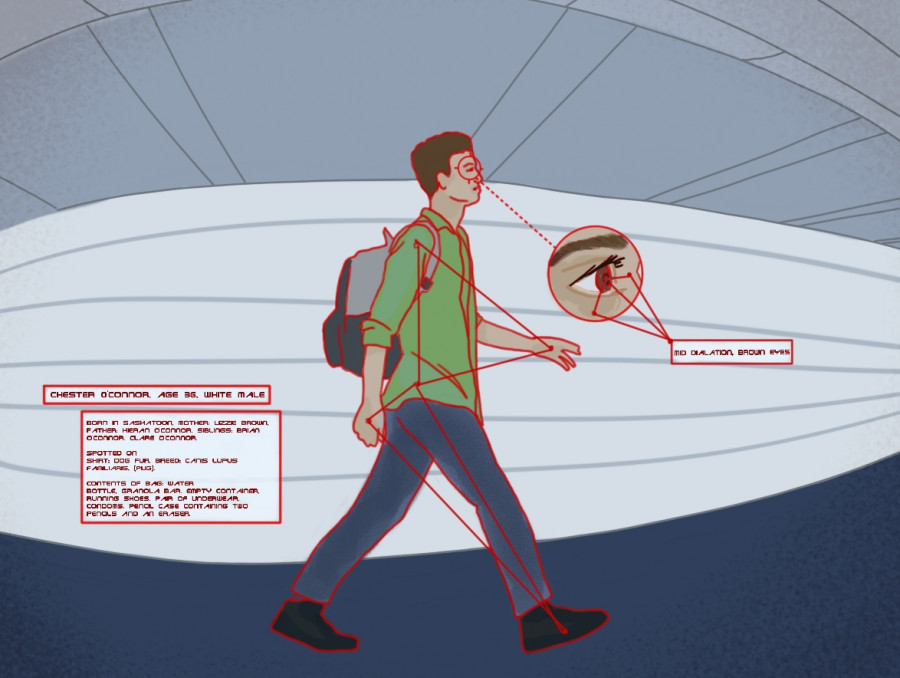
“By [equipping all police with] body cameras, we are basically deploying 4,000 new security cameras that are moving around across the city,” Gareau said. "It's an unimaginable expansion of the surveillance network."
The SPVM reports on its website the management and use of 46 urban security cameras across Montreal. This excludes Metro cameras and traffic cameras, which are managed by other bodies.
Gareau also expressed concern that the police video database created by widespread recordings could be used to surveil protesters and that the SPVM’s new artificial intelligence video surveillance software may be utilized to track activists.
They added that they believe that if footage is released to the public, it could be selectively released to make the police look good while violating civilians’ privacy.
“Oftentimes, the police encounter people in the worst moment of their lives,” Gareau said. “To have that recorded and disseminated is a huge violation and devastating for people.”
For Rutland, the solution to police violence is not body cameras or diversity training for police officers. It is to reduce the role of the police and instead use unarmed, nonviolent response teams for scenarios like mental health crises.
“Many cities are introducing a fourth response team,” said Rutland. “They respond to 911 calls that have nothing to do with crime or violence, which is the vast majority of mental health calls.”
Sauvé said he would support the implementation of a fourth response team, adding that TM proposed spending $20 million to develop a similar team in Montreal in the 2025 municipal election.
Rutland believes that governments should focus on investing in reducing violence and crime instead of further investing in the police, who primarily respond to violence after it has already occurred.
Gareau also emphasized that body cameras cost millions of dollars a year and said that they believe those funds should be reallocated to community organizations.
Sauvé said that he would rather see the funds—which come from Montreal’s capital investment, or infrastructure budget—used for infrastructure, such as for building community centres and libraries that will “improve the quality of life for our citizens.”
“Repression is not working,” Sauvé added, noting that increases in police spending have not been proven to reduce crime rates.
Sauvé said he believes the focus should be on “evidence-based policy,” and that criminology researchers have demonstrated that improving civilians’ socioeconomic conditions, education and overall opportunities is the solution to reducing crime.
He added that the SPVM regularly exceeds their allocated budget (by around $55 million in 2024 and $60 million in 2025) and argued that the city should instead invest that money in supporting its civilians, particularly those at risk of ending up in the criminal justice system.
“Let’s put this money where it’s going to have real effects [in] improving quality of life and bringing down crime,” Sauvé said.
This article originally appeared in Volume 46, Issue 11, published March 17, 2026.



__600_375_s_c1.png)