Hundreds march against U.S.-Israeli military action in Iran and Lebanon
Over 1,500 Lebanese and Iranian civilians estimated to have been killed since start of U.S.-Israeli military violence
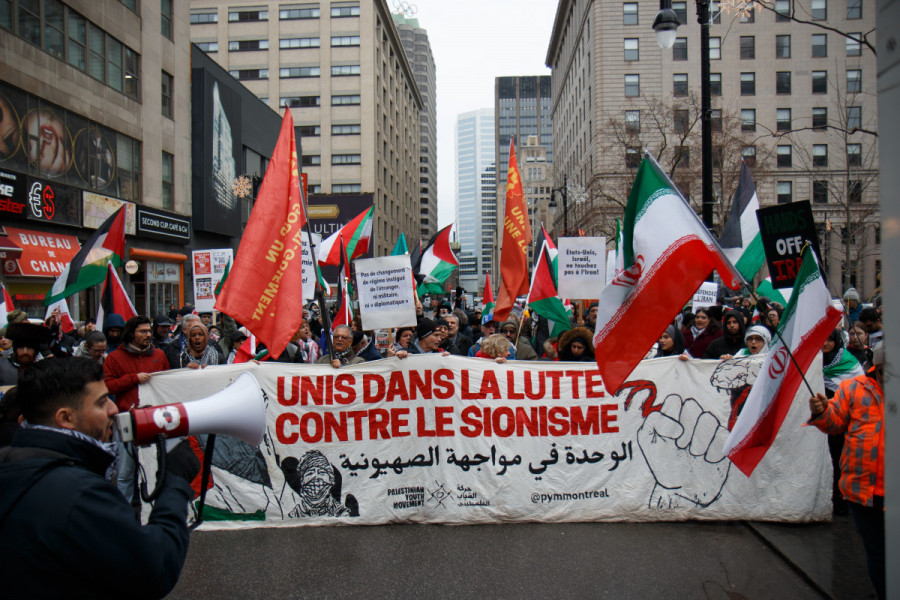
Around 250 people marched through downtown Montreal on March 7 to protest recent U.S. and Israeli military violence in Iran and Lebanon.
The Palestinian Youth Movement (PYM) and the Iranian Canadian Congress (ICC) organized the demonstration. Attendees began gathering in Phillips Square shortly before 3 p.m.
ICC president Mona Ghassemi told The Link that the ICC is “pro-peace and pro-diplomacy” and opposes war and sanctions.
“It’s very important for our community to say no to war,” Ghassemi said.
Danielle Rae, a McGill University political science master's graduate whose thesis focused on the Southwest Asia and North Africa region, said she attended the protest to call for the Canadian government to withdraw its support for “the imperialist war machine,” and to stop the wars against Lebanon, Palestine and Iran.
“Our government is supporting this, and we need to stop,” Rae said. “We need to close the loopholes to Israel, and we need to have an arms embargo with the USA as well.”
In the days leading up to the protest, a Feb. 28 airstrike on an Iranian girls’ elementary school killed over 165 people, of whom a majority were children.
“The school was hit in a ‘double-tap’ attack, with a second bomb following the first, designed to kill survivors and any rescuers arriving on the scene,” Ghassemi said in a speech to the crowd. “UNESCO called it ‘a grave violation of humanitarian law.’”
Ghassemi also weighed in on the killing of Iranian supreme leader Ali Khamenei by American and Israeli airstrikes on March 1.
“Assassinating the leader of any country, no matter your opinions of the politics of that country, is an illegal act. It’s an act of war,” Ghassemi said.
They also noted that these attacks took place amid U.S.-Iranian negotiations surrounding Iran’s nuclear program. Ghassemi condemned Prime Minister Mark Carney’s statement released immediately prior to the strikes.
“[Prime Minister Carney] called for Iran to fully dismantle its civilian nuclear program, which is an inalienable right according to Article IV of the nuclear non-proliferation treaty,” Ghassemi said.
As of March 9, the Iranian government estimates that 1,255 people have been killed by U.S.-Israeli attacks, including 200 children and 11 healthcare workers.
In Lebanon, at least 517,000 people have been displaced, and 394 people—including 83 children and 9 rescue workers—have been killed as of March 8.
Members of the Neturei Karta (NK), an anti-Zionist group of Haredi Jewish people, were notably present despite the protest taking place during Shabbos, the weekly Jewish day of rest.
“As faithful Jews, we raise our voice and declare clearly that these acts of war, oppression and aggression do not represent our people, our faith, our tradition, or the teachings of the holy Torah,” a protest organizer said, reading from an NK written statement. “We pray for an end to the wars against Iran and Lebanon, and for an end to the entire occupation of Palestine.”
Rae said she sees a connection between Israel’s actions in Palestine and their strikes against Iran.
“To Israel, it is one war,” Rae said. “Iran is pretty much their only remaining geopolitical rival. This war in Iran is a way of using the USA as a mercenary army to try to complete the genocide, which they were forced to slow down by international pressure.”
Rae further criticized both the Iranian and American governments, condemning Iran’s “deeply authoritarian dictatorship,” which she said mirrors that of the U.S.
Rae added that she believes the U.S.'s calls for a ‘free Iran’ are hypocritical given American involvement in the 1953 Iranian coup, where the CIA helped overthrow prime minister Mohammad Mosaddegh—who was attempting to secularize and democratize Iran—and reinstalled Shah Mohammad Reza Pahlavi.
“America doesn’t want free states; they want subservient ones,” Rae said. “America, founded on a revolution against a king, always seems to ally with monarchs because they are the easiest to bribe.”
Montrealer Ashtin Stano also attended the protest.
“I’m tired of [corporations] funding genocide, people not speaking out about war crimes, and [the deaths] of school children,” Stano said. “They’re justifying it with pure violence and rhetoric that goes against all forms of human nature and goodwill. It’s still a war crime.”
Stano believes that the attacks distract from recent releases of the Epstein files, which include allegations that figures such as U.S. President Donald Trump have committed crimes such as child sexual abuse.
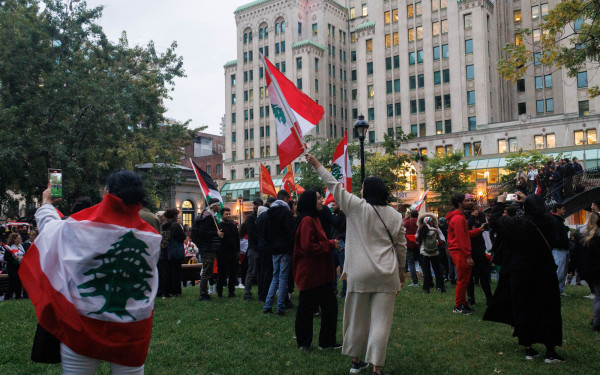
A small contingent of pro-monarchist counter protesters was also present in the square during the demonstration, carrying monarchist Iranian, Israeli and U.S. flags.
After a brief verbal confrontation between five pro-monarchist counter protesters and several demonstrators, police moved the counter protesters to the other side of the square. They began dancing to music that celebrated the assassination of Khamenei, and their numbers soon grew to around 10 people.
Pro-monarchist counter-protesters repeatedly attempted to cross over to the anti-imperialist protest and accost demonstrators, but were escorted back to the other side of the square by law enforcement each time.
The demonstrators began marching down Ste. Catherine St. at 4 p.m.
A similar counterdemonstration of about 40 pro-monarchist counter-protesters gathered nearby around 4:15 p.m., and a heated verbal confrontation between the two groups occurred. The counterdemonstration began marching on the sidewalk, with police officers on bicycles continuously forming a barrier between the two.
Rae, who identifies as transgender, participated in the march while wearing a trans pride flag and a keffiyeh and carrying a Palestinian flag.
“Pride is anti-imperialist, or [else] it is meaningless,” she said.
Ghassemi said that Iran should see societal changes created by the will of the Iranian people rather than a foreign regime change, and argued that Iranian women’s rights require societal change to improve.
“[Secularization] cannot be forced. It needs to come about change through the society as well, not just hitting the government,” Ghassemi explained. “The government impacts the society. Society impacts the government.”
The protest dispersed at around 6 p.m. outside the Israeli consulate.



_600_375_90_s_c1.jpg)