
Empty words on Indigenous land
What began as a gesture of respect has become routine, disconnecting us from true reconciliation
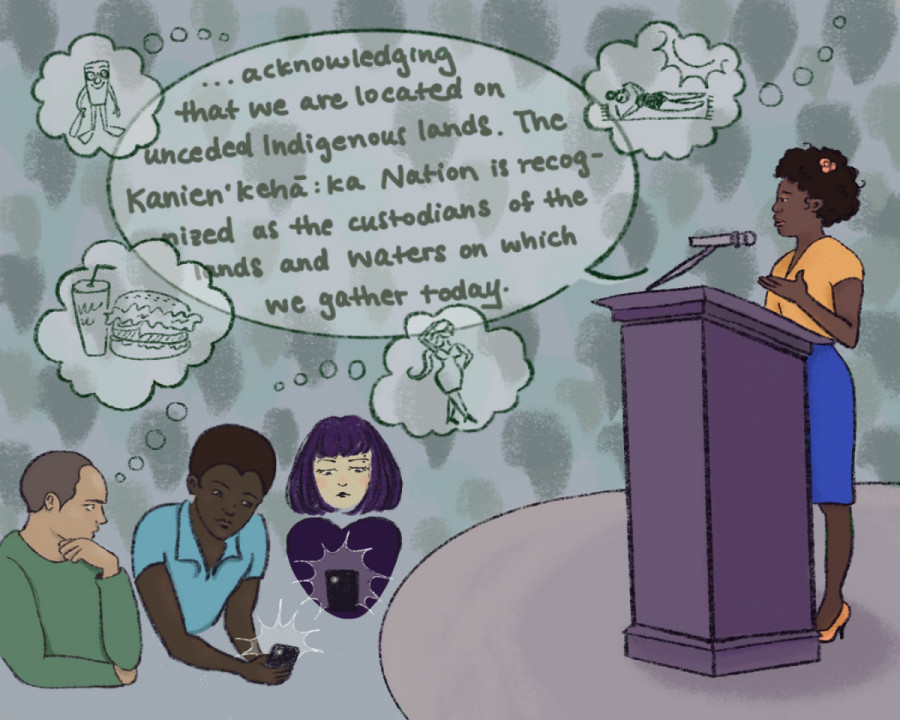
Land acknowledgments are everywhere now. You can find them on university syllabi, public transit announcements, local government websites, and, heck, I've even seen one at the opening of a Taylor Swift concert.
They’ve become as routine as a legal disclaimer, and about as meaningful.
I’ve sat through countless events where a land acknowledgment was read so quickly that it was barely registered by anyone in the room, as if the words carried no weight whatsoever.
In theory, they’re meant to honour Indigenous nations. In reality, they’re often over before they even start. The person reading it looks awkward and stumbles through pronunciations they never bothered to learn, and the audience—well, they’re already scrolling on their phones.
What began as a meaningful form of reconciliation has now become as routine as brushing your teeth in the morning.
These formal statements typically start with something along the lines of, “We are gathered here today on the land of the Kanien'kehá:ka Nation,” and at their core, are meant to acknowledge a history of atrocity and dispossession.
Yet these acknowledgments risk oversimplifying the deeply complex history between Canada and the Indigenous Peoples of Turtle Island. Recognizing only the land we’re standing on collapses centuries of colonization and abuse into a single sentence.
These statements have become purely symbolic with no concrete action behind them. They’re comparable to your friend saying, “Before I start this car, I am acknowledging that I stole it from my local car dealership,” and then just driving off.
Do you realize how stupid that sounds?
I don’t speak for all Indigenous Peoples, but I am speaking for many when I say that a land acknowledgment without direct change is about as useful to our nations as the Canadian penny: symbolic, but ultimately worthless.
A lack of direct change isn’t the only problem.
The fad of land acknowledgments has become more of a public relations tactic, or a trend, if you will. Organizations adopt them to signal cultural awareness, but when the statement ends there, the whole spiel sounds more performative than sincere.
Meanwhile, Indigenous communities continue to face disparities in housing, healthcare, education and land rights. Half of my friends and family from the rez can’t even drink the water from their tap. It's an issue that I doubt crosses anyone’s mind while they’re waiting for the acknowledgment to wrap up.
If institutions truly want land acknowledgments to matter, the words have to be paired with initiative.
Now, this doesn’t mean that Indigenous Peoples are expecting all 2.47 billion acres of land in Canada to suddenly be given back. But something as small as mentioning ongoing treaty and land disputes during these acknowledgments helps make the speech feel a little more genuine, and less like you’re being held at gunpoint to say it.
The routine of recognition alone isn’t reconciliation. Of course, a land acknowledgment can be a great starting point, but when it ends there, it becomes just another box ticked before the real agenda begins.
Real change requires far more than a microphone and a pre-written speech.
This article originally appeared in Volume 46, Issue 12, published March 31, 2026.





_600_375_90_s_c1.jpg)