
A physical game on a virtual field
Virtual reality is becoming a new training ground for athletes
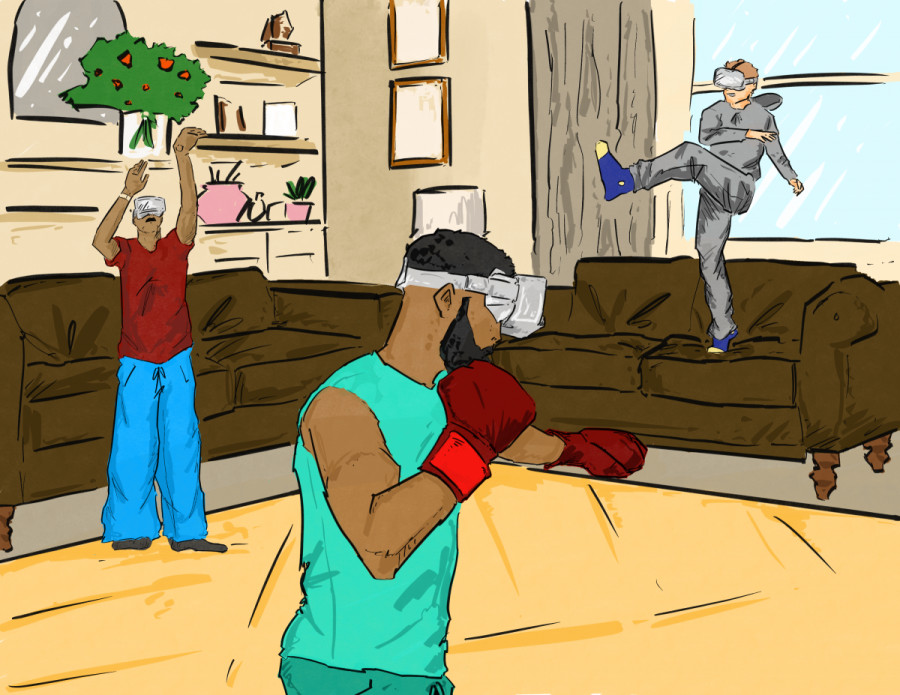
Flip the switch, strap on the headset—and step into the stadium.
Virtual reality (VR) technology uses a head-mounted display to immerse users in a virtual, 3D simulation. Its development has led to breakthroughs in video game action, treatment of psychological disorders and now the world of sports.
While still early in its development, VR has already begun to shape athletic development. VR allows athletes to train on their own personal field, simulate game scenarios to improve real-time decision-making and enhance rehabilitation with engaging visuals that help them stick to a recovery plan.
Nour Hatira is a PhD student studying computer science at Concordia University. She discussed the advantages of VR technology not just in its ability to help athletes train, but to give them a comfortable place to do so.
“Some people can be stressed when they are in the gym or when other people can see them performing a task,” Hatira said. “Using VR offers the same realism. And you can do it alone in any other place. You don't have to be surrounded by people.”
The accessibility of VR technology has allowed it to find a place in the world of athletics. Whether in a lab, on a field or even in a basement, athletes can safely and effectively improve their skills.
A study published by Hatira in 2024 compared the use of VR, augmented reality (AR) and 2D touchscreen technology to train the hand-eye coordination of professional volleyball players. Participants displayed improvement in VR activities from the start of the study to the end, exhibiting VR as an effective tool in the development of athletic skills.
Anil Ufuk Batmaz, a professor of computer science and software engineering at Concordia with research interests in VR and AR, helped Hatira publish her paper and has published several of his own on similar topics. He explained how the lack of physical contact in a virtual setting minimizes the risk of accidents during VR training sessions.
“When the ball comes towards you, it doesn't hit you in a virtual environment,” Batmaz said. “So that reduces the injuries. It actually helps the players to practice more and whenever they want and when they want. So this is the huge benefit.”
Professional athletes have already hopped on the VR wave.
Washington Commanders quarterback Jayden Daniels credits his use of virtual training in helping him win the Heisman Trophy in 2023 and the NFL Offensive Rookie of the Year award in 2024.
Tennis star Alexander Zverev uses VR technology with his brother to train automations for use at game speed. And VR simulations helped Canada’s Paralympic curlers train for the 2026 Games.
But VR can have an effect in an area all athletes are familiar with: rehab.
Steven Warsh is a licensed athletic therapist and the founder of RECOVR Sports, a Montreal-based agency that uses VR technology to help rehab physical injuries. Warsh focused on VR’s ability to provide athletes with a more immersive and captivating way to train and recuperate.
“I'm tired of hearing people say that they hate doing the exercises,” Warsh said. “I’m trying to find ways to make it more engaging, more fun, whether it's weight loss or you're rehabbing from an ankle sprain or a wrist injury. That's the goal.”
Hatira echoes the sentiment of gamification, explaining that a more engaging environment allows for increased rehabilitation sessions.
“I had my friend come over, and he was literally like, ‘I would never put this down. This is so much better than playing Madden, I’m actually QB1.’ The quality of what you’re actually seeing makes it more immersive, it makes it more real.” — Steven Warsh, licensed athletic therapist and founder of RECOVR Sports
“For VR, we can make the training environment more gamified, a more game-like environment,” Hatira said. “It would create more engaging training. People are actually more interested to play, to do the training in VR.”
Warsh pointed to graphics quality as the major point of improvement for VR over the past two years, calling past experiences “cartoony” and “ugly.” Now, he can spend three hours in a game and stay fully immersed in the experience, with games like NFL Pro Era keeping users focused on the action.
“I had my friend come over, and he was literally like, ‘I would never put this down. This is so much better than playing Madden, I'm actually QB1,’” Warsh said. “The quality of what you're actually seeing makes it more immersive, it makes it more real."
Of course, VR training isn’t without its limits. Its clunky headsets inhibit user movement, and the technology still lags behind more familiar technology already ingrained within athletes’ training regimens.
While participants in Hatira’s study did improve their results in VR simulations, they performed best overall using 2D tools.
“In that study, we found that the 2D screen is better in the performance metrics compared to VR and AR because of the depth perception,” Hatira said. “In VR, you can see the target in front of you. You can just press it, and you think that you are pressing it, but it's still far away.”
Batmaz isn’t shy to admit the current limitations of the headset, which range from its inability to function underwater to slipping when an athlete sweats.
But there are uses for its data-gathering abilities, as evidenced by Meta’s collaboration with sport and lifestyle brand Oakley. The two companies developed AI glasses that can record and gather data from an athlete in action.
“Say that you do the training, and when you record this information, you can give feedback, for example, for biking,” Batmaz said. “We can provide this, so that there is a technology that evolves, that is going to change.”
And VR action was never meant to replace physical movement entirely. Real-time, full-speed reps remain the best way for athletes to train for game day—that will never change. But as a strategic tool for development, VR can prove to be a powerful ally.
Hatira advocates for a holistic approach in any sport that doesn’t take place fully virtually. Athletes like the volleyball players in her study, for example, can learn transferable skills from both physical and virtual training.
“In the case, for example, for volleyball players, that training was meant to improve their eye-hand coordination,” Hatira explained. “For example, if we wanted to improve their volleyball performance, they should have been using both the VR training and the actual training.”
As sports become more technologically advanced, Warsh sees the shift coming and is ready to take advantage of the latest gadget making its way into an established industry.
“The old generation doesn't really resonate as much with technology and is scared of it. I think that people often think it's going to replace jobs like AI,” Warsh said. “But honestly, this is a tool in the toolbox. As athletic therapists, we always say we have a toolbox, and we take the tool out, and we use what we have."
This article originally appeared in Volume 46, Issue 11, published March 17, 2026.



1_600_375_90_s_c1.jpg)
4_600_375_90_s_c1.jpg)