Student art collectives moving away from universities
How student art groups are handling having to find new venues
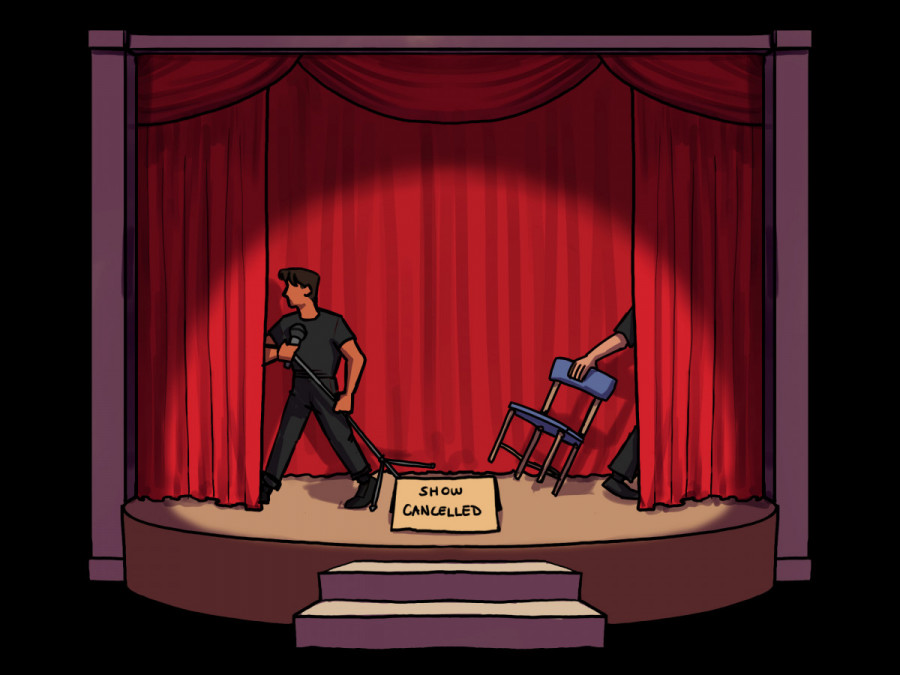
Montreal is home to many student-led artistic movements that offer a strong sense of community within the universities and the city.
Students who attempt to create these safe spaces for self-expression face many struggles. They must navigate administrative decisions, such as building closures, and rely on the community they have built to keep the clubs running.
Concordia University’s Union Santa Fe (USF) and McGill University’s Peel St. Cinema shared their experience relocating their societies as they were forced to move away from the universities where they were founded.
Union Santa Fe, an open mic founded in 2024, used to operate out of the Visual Arts (VA) Building. That is, until 2026, when Concordia decided to repurpose the building.
“The university is continuously assessing a variety of real estate scenarios to ensure that we can continue to meet our academic and operational needs as they evolve and that we are able to manage our facilities in a sustainable and cost-effective way,” Concordia spokesperson Julie Fortier shared.
Co-founder Matt Fudge’s original vision for USF was to give students a place to perform poetry.
“We wanted to give people a place for people to perform poetry, people who didn’t consider themselves poets, who didn’t have any career or vested interest in poetry but still wanted to perform and escape the artistic echo chamber, that’s what we wanted to do with USF.” Fudge said.
Fudge stated the club was initially based at Concordia because that was the space that was available, but he also wanted to connect with those outside the Concordia community.
“We were interested in anyone who was interested in us,” Fudge said.
He described the relocation process as “rocky.” The collective spent months meeting in people’s apartments, which Fudge described as “not ideal” for a community organization.
“[The USF] suffered in terms of accessibility, going to random folks’ apartments,” Fudge said. “The VA was more central.”
Fudge highlighted the importance of community in the collective's perseverance amid the displacement.
“All we have is a sense of community, so many people opened their homes to us. I met so many moms this summer,” Fudge said.
Maya Chené, a long-time USF visitor, described her concern for the collective's future after it was kicked out of the VA building.
“Being in people’s apartments makes it intimidating and less accessible as people live far,” Chené said.
Despite these fears, the community kept showing up.
“I wondered if people would bother coming, but they did; it was beautiful,” Chené shared.
She attributes USF’s perseverance to the strong sense of community within the collective.
“I met my roommates at USF, and so many [other] people,” Chené said. “There is already community at Concordia, but to have a smaller community within Concordia made me feel like I had people who I didn’t need to know one-on-one to feel like I was a part of them.”
She spoke positively about her experience hosting USF out of her home.
“It was really beautiful to have everyone in my house; it felt a lot more intimate,” Chené said.
She also highlighted that USF still had a presence on campus, even though it ended its affiliation with Concordia.
“We moved away from Concordia because Concordia moved away from us,” Fudge said.
This sentiment was echoed by Chené.
“It’s a part of us even outside of school. [The] school has made it clear that we are not associated with them; we made the best of that,” Chené said.
Since distancing itself from Concordia, USF has found it easier to attract members from outside of the school.
“Not only do people from Concordia go to USF; [it’s] student-oriented, but you can really just bring anyone,” said Chené.
USF recently found a permanent location at Cafe Musette, a non-profit on Parc Ave. The event is hosted every other week, with members still hosting out of their homes in the weeks in between.
Peel St. Cinema, one of McGill’s oldest student societies, also faced a similar situation this year.
Matthew Haas, one of the students currently running the society, offered his perspective on its future.
The cinema’s titular Peel St. location was recently put under construction after asbestos was found, making it unusable indefinitely during the removal process.
According to Haas, the club did not have much contact with the admin team, with most communication going through the McGill faculty.
Haas found out the building was under construction through his professor, who also used the space. Ultimately, the relocation has been a community effort rather than something championed by McGill.
After Peel St. posted an announcement on its Instagram account about the indefinite closure, several people, from McGill faculty to local bars, reached out and offered to host screenings. Haas shared that Peel St. has fostered a sense of community among film lovers and McGill students alike.
Haas plans to continue running screenings twice a week during the fall. They also plan to host one screening per week on campus, highlighting the society's importance to McGill film enthusiasts, as the university does not have a formal film major program.
They also plan to host one off-campus screening to appeal to the larger Montreal film-lover community.
“Spaces like Peel are necessary in creating a third space for film. We hope to be a place of warmth in between the academic context and individual entertainment, where folks can commune, appreciate, and think about film, all together.” Haas remarked.
Peel St. was restored to its original location in October.
The sense of community these student groups foster speaks to their importance in the local art scene.