Social media is changing consumer habits
With TikTok’s fast algorithm, new trends are appearing quicker than ever
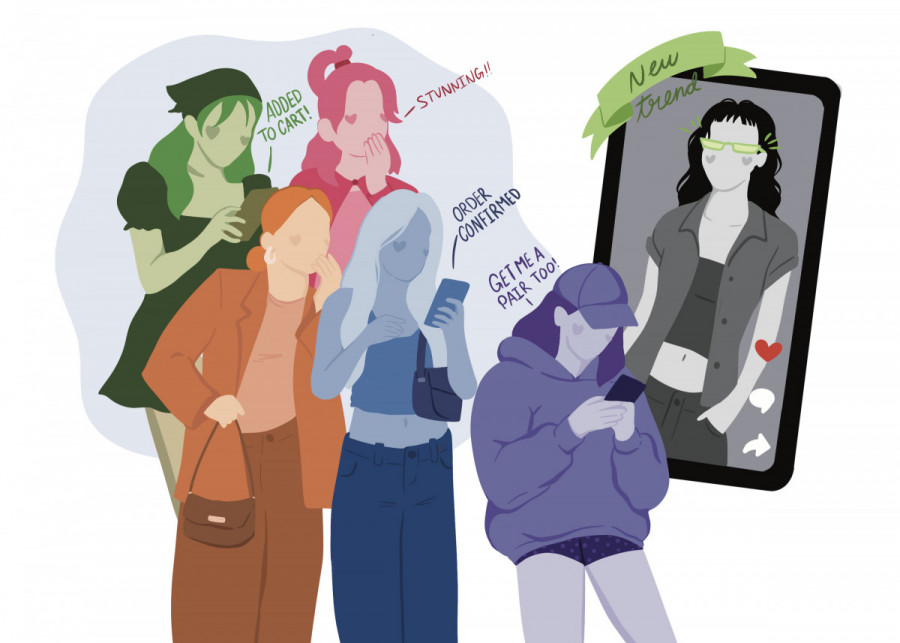
Every day, TikTok exposes Gen Z and the impressionable Gen Alpha to increasingly rapid fashion cycles.
The lifespan of these fast-cycling trends has grown in recent years, largely due to social media algorithms. Teenagers now live in a society where trends last as little as a few weeks. New microtrends raise the question of whether we will exhaust fashion trends and become victims of a monolithic fashion culture.
During the COVID-19 pandemic, TikTok downloads increased by 58 per cent globally. With this exponential growth, more people suddenly had a platform for creating new fashion trends. Trends came from TikTok, rather than being created by people in the fashion industry. Runway looks used to determine what trends would become mainstream, but society now turns to social media and influencers to find the next big thing.
With this shift, fashion “must-haves” are being summoned faster than people can get their hands on them. As a result, retailers must meet the increased consumer demand. As a sales associate at Brandy Melville, I have witnessed this phenomenon firsthand as we receive new stock every weekday. Each week brings a variety of styles, but it is not enough to keep up with ever-changing consumer habits.
There is also the “Regina George effect," where influencers like Hailey Bieber can easily—and sometimes accidentally—create new trends. Currently, TikTok has an estimated 207 million content creators, with over 85,000 having more than 1 million followers. Because TikTok’s content is so easy to digest, these influencers can reach a wide range of “For You” pages with little effort, causing trends to spread faster.
In spring, teal and coral flooded social media feeds. By late May, Brandy Melville released the viral teal and coral Prissila pants for the first time. The pants sold out before most people had a chance to buy them.
Customers with large online followings accelerated the virality of teal and coral by sharing it with their followers. This prompted fast-fashion retailers like Brandy to release more clothing in these colours. However, by late August, they had lost their lustre. Now, items in these colours can last weeks before selling out. It seems consumers have moved on to the next trend.
Microtrends have been a defining part of the 2020s so far. This time last year, people had Labubs hanging from their bags and polka dots on everything. For a while, I saw these trends everywhere, but they have long since fizzled out. As one trend fades, social media quickly promotes the next big thing. Yet, these rapid trend cycles raise concerns about how they will affect consumers.
According to Statistics Canada, retail sales rose 4.5 per cent from June 2025 to June 2026. This increase is partly due to the variety of options in the retail market. Furthermore, Gen Z is twice as likely to go shopping for apparel once a month as the average adult American.
In the last decade, online shopping has become more accessible. Now society has unlimited access to shopping at their fingertips. So when a new trend arises, a single TikTok link can take you to the next viral garment. But that does not always mean you will find exactly what you are hoping for.
It is not easy to keep up with every fad; in fact, it gets quite expensive. Shopping frequently just to keep up is equally time-consuming (whether it’s online or in person). This critique is not to say you should not follow trends, but rather that shoppers should be more intentional when it comes to fashion.
It is important to find a balance between micro trends and personal style. I love my teal Prissila pants, but I also love a lot of the clothes I have had since high school. You would be surprised at how you can make your old clothes seem trendy.
Changing how you style your clothes and growing your wardrobe keep us from a monolithic fashion culture.
This article originally appeared in Volume 47, Issue 3, published October 6, 2026.