
Montreal AI construction hub under scrutiny
The city will implement a new digital twin model to aid in urban planning management
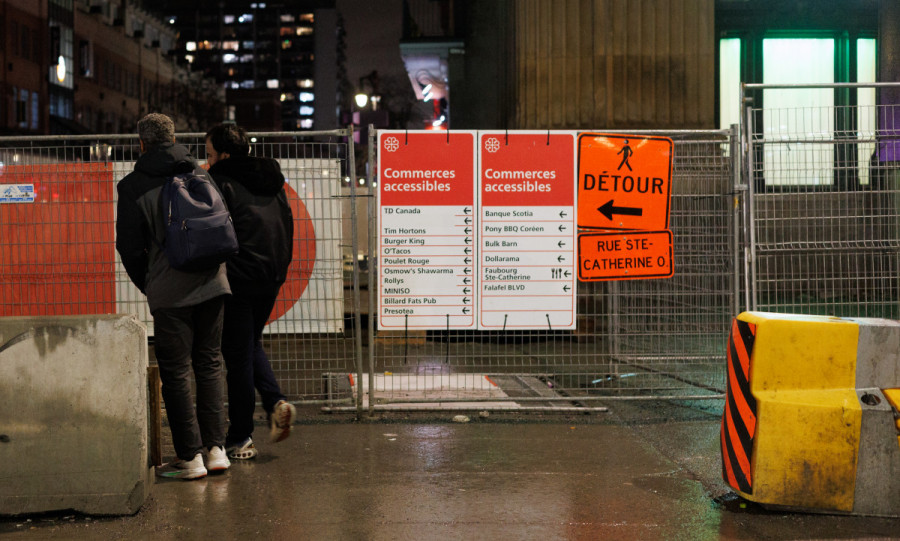
The city of Montreal recently announced the construction of an artificial intelligence hub downtown, saying it will be used to find solutions to construction site management.
Through this hub, the city plans to hire researchers to work on planning and improving safety and accessibility around construction sites, as well as simulating construction scenarios using AI.
The mechanism to implement these solutions is known as the “digital twin” system, which is used to create a virtual duplicate of real-world objects.
Concordia University engineering professor Mazdak Nik-Bakht said he believes that digital twin models can help manage construction projects.
“The digital twin can create a light inventory of knowing what is under construction along with [the project’s] schedule,” Nik-Bakht said. “[Such as] where you have to break the ground for what purpose and what impact it can have over that neighbourhood.”
He added that digital twin models can help with scenario simulation and analysis.
“You can basically simulate as many foreseeable futures when major construction comes,” he said. “We can optimize in terms of the urban management to make sure that no region is overgrown or undergrown in terms of the impact of construction.”
Some experts, however, are skeptical that AI will be effective in urban planning.
Joseph Vybihal, a computer science professor at McGill University, said the city may be turning to AI because it just doesn’t know how to solve complex problems.
Vybihal said AI can help with organizing information and identifying patterns, but warned that the city should not rely too heavily on its recommendations.
“I think they are using AI now because they don’t know how to fix things,” Vybihal said.
Meanwhile, Renee Sieber, a professor of geographic information technologies at McGill University, said many of the proposed solutions under this digital twin system rely mainly on predictive analytics, which are tools that use existing data to anticipate patterns such as traffic congestion or construction timelines.
While this technology can help cities analyze information and potentially coordinate projects more efficiently, Sieber said it does not address the deeper causes of construction delays.
She said that AI has become a very attractive term because it promises to solve many urban problems, but that cities are complex and messy.
“Technology alone won’t fix those challenges,” Sieber said.
The city also announced that technology company executives would form an advisory committee to oversee the use of AI.
Nik-Bakht said that while technology companies may lead the project initially, it would only be effective if construction companies are involved as well.
“I think if I [were] the one who's running this project, from day zero, I'd make it very clear that my most important stakeholder is the construction entity,” Nik-Bakht said.
Sieber added that public discussions about AI often create unrealistic expectations, and that addressing urban planning problems in the city depends on government action, not technical solutions.
“One of the big challenges is the rhetoric around AI,” Sieber said. “Construction in Montreal isn’t really a computational problem. It is a political problem.”
This article originally appeared in Volume 46, Issue 11, published March 17, 2026.