AI is shifting the entry-level job landscape
AI has been a driver for change in the entry-level job market, forcing industries to adapt
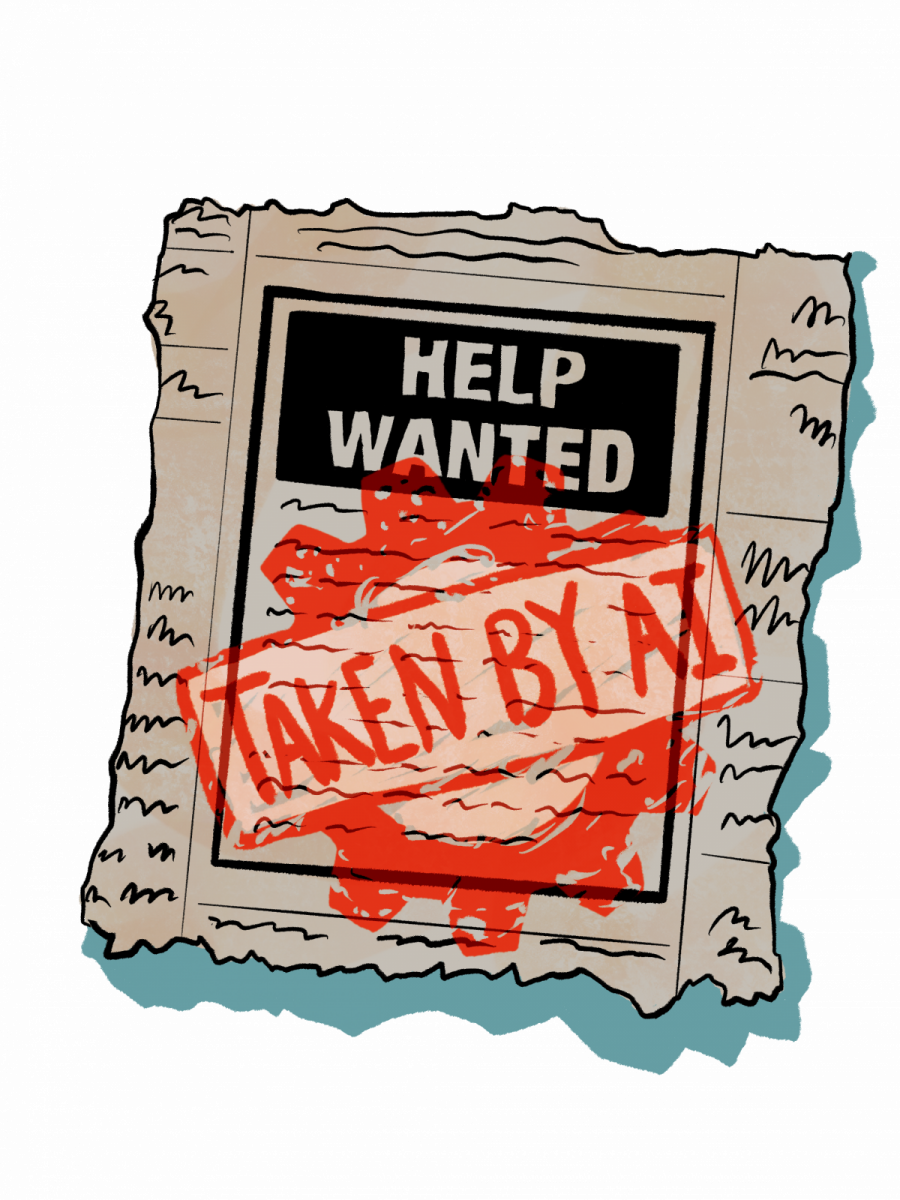
In August 2025, Canadian bank CIBC reported that 15 to 24-year-olds are struggling to find work in Canada.
Canada's youth unemployment rate is slowly rising, with an over five per cent increase between 2022 and 2025, and is considered to be “worse than average” relative to other age groups, the report said.
While the report does not provide a direct cause, it suggests that technological advancements are replacing some entry-level positions, especially those with high exposure and low complementarity with AI, meaning it would be hard for the two to co-exist in one workspace. This is cited as a potential cause for the worldwide trend of rising youth unemployment rates.
According to Statistics Canada, high-exposure, low-complementarity jobs are those "that may be highly exposed to AI-related job transformation and whose tasks could be replaceable by AI in the future."
Negar Kazemipour graduated from Concordia University in 2023 with a Master’s degree in computer science. She was one of the lucky ones, landing an internship and a full-time job during her degree.
“I did not wait to graduate [to get a job,] because it was only a matter of six months between the time I applied and the time that it was starting to be really hard to get interviews,” she said.
To get her job, Kazemipour messaged directors and researchers directly, looking for work, focusing on human connection to secure her place. Some of her peers were not so lucky; some graduated two years ago, and they are still trying to find work, according to Kazemipour.
“Ever since I got hired, almost three years ago now, I have been the newest member of my team,” she added. “No one else got hired after me at the entry level.”
“The bottom rung of the ladder is broken.” — Christine York, translation professor
According to Kazemipour, the computer science industry has implemented AI for tasks such as database management, simple algorithm creation or folder finding. These are jobs that were usually given to interns and entry-level employees to ramp up their skills.
Since the implementation of AI, Kazemipour said she hasn't felt any operational shortfalls at her company.
“Unfortunately, I don’t think the company is missing anything,” she said.
Encode Canada leads the way in youth advocacy for justice and human rights in relation to AI. According to the organization’s co-director, Aimee Li, technology disrupting the job market is not something new. But she said AI is unique in its disruption.
“AI offers a more unique angle,” Li said. “It is not only automating manual jobs like data entry, but it is also automating critical thinking.”
This automation of critical thinking is what Li and others refer to as “cognitive offloading.”
According to Li, since AI’s information is based on past data, the danger of offloading idea generation and decision-making to it is that it removes authenticity and innovation from the process.
“At the end of the day, AI is just a very sophisticated regression model that uses past data to predict the most likely outcome,” Li said. “It is unable to progress further than what we have already.”
She believes that, by replacing their interns and freshly-graduated employees with AI, companies are severing themselves from new ideas.
“Everybody has a unique perspective to contribute,” Li said.
The introduction of AI also creates an inverse-pyramid within companies, according to Simon Blanchette, a management lecturer at Concordia University and McGill University, whose research often specializes in AI. Blanchette explains that senior-level employees are often running the company whilst AI does the work interns would do.
“I feel it is a shortsighted perspective, because you are pretty much killing your future pipeline of talent,” Blanchette said.
He added that many companies use AI as a cost-cutting strategy: small businesses use it as a way to scale their company for cheap, whilst large corporations use it to stay lean.
“You’re dooming yourself to never training talent in-house, and always relying on hiring or approaching already experienced talent,” Blanchette said.
Economic factors, such as inflation and geopolitical tensions, need to be considered when discussing the entry-level job market, as they also contribute to companies being more risk-averse in their hiring practices, warns Blanchette.
“It is kind of a perfect storm; it is a difficult job market at the moment,” he said.
Some industries have more experience than others in dealing with AI’s disruption.
“AI is just a very sophisticated regression model that uses past data to predict the most likely outcome. It is unable to progress further than what we have already.” — Aimee Li, Encode Canada
According to Christine York, translation professor at Concordia’s French studies department, the translation industry has been dealing with AI chipping away at their entry-level jobs since 2016, with the arrival of AI translation models like Google Translate taking up low-level translation work.
The industry was forced to adapt early on, and still faces difficulty to this day, she said.
“The bottom rung of the ladder is broken,” York said.
The professor says AI took away their low-level market almost a decade ago, and the advent of new large language learning models is also chipping away at the middle-market.
The middle-market in translation takes the form of in-house business documentation, memos and emails that used to require translators, but now can be bypassed by a ChatGPT entry. Though York explains that there is a detriment to that.
“People are realizing now that there is a cost to relying on machine-translation,” York said.
According to the professor, any document with a long shelf life—such as those published in scientific or government contexts—carries too much risk to rely on AI for translation.
The industry has adapted to AI by integrating it into its process, explained York. Translators often use software called the translation memory, which collects a database of the translator's work. In future translation work, the software will bring previous instances of sentences back, increasing efficiency.
AI has taken the role of a tool, similar to translation memory, where instead of competing with the translator, the translator uses it to become more efficient at what they do. Combining the databases from ChatGPT, the translation memory, and the translator's experience increases their efficiency.
“Yes, there is disruption from AI,” York said. “There is also this shifting of what services are being offered by translators and the translation industry.”
York also works as the academic director of Concordia’s co-op program in translation. Internships and entry-level jobs have been difficult to find, she said, but she has found a certain stability in the opportunities on offer recently.
“[The department has] worked very hard the last few years trying to deal with this sudden disruption,” she said, adding that they were educating employers and clients on the necessity of translators. “It was a difficult period, but it is starting to fall into place again.”
Hope remains. Blanchette believes that human contact remains the best way to get your foot in the door of the job market, even if only to make sure that your resumé is read by a human being.
AI literacy is also important. Skills like prompt engineering are now marketable to employers who are implementing AI in their companies.
Li agrees. She believes AI can make our lives easier, and that trying to escape it is unproductive.
“The most realistic way to approach AI governance is through examining the technologies themselves, and the potential harm that they can do to the world,” she said.
Kazemipour encourages students not to lose hope. People are getting hired, she says, even if the gap between graduating and getting hired is a little bit bigger.
"Take your time, develop projects and put them on GitHub,” she said. “You have to push yourself to be higher than entry-level experience.”
This article originally appeared in Volume 46, Issue 8, published January 27, 2026.