Hundreds rally in Longueuil against police brutality
Protestors denounced the killing of 15-year-old Nooran Rezayi by Longueuil police in September 2025
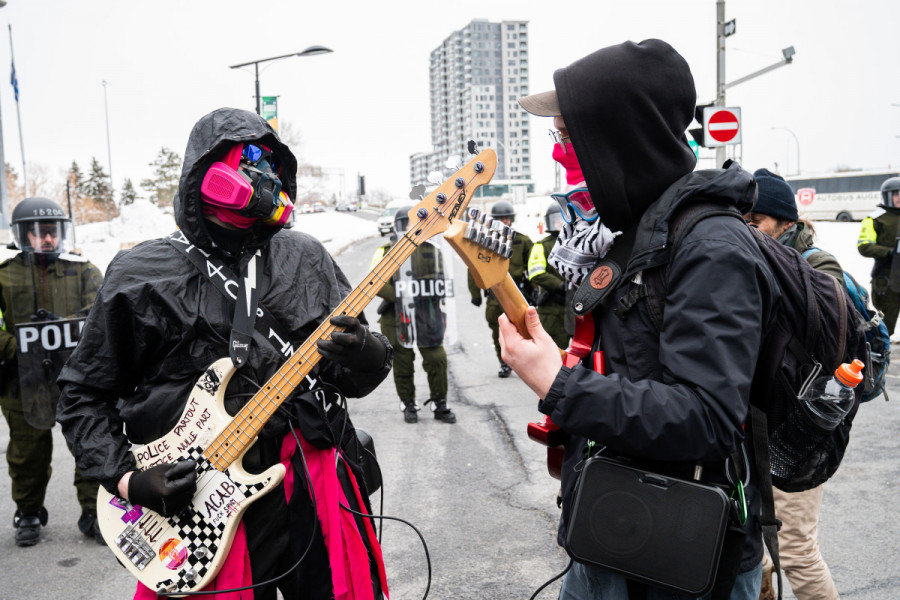
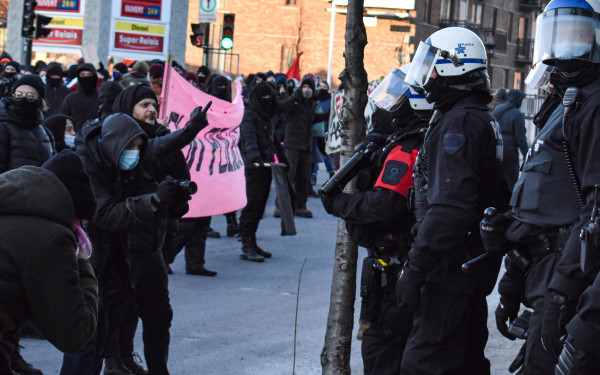
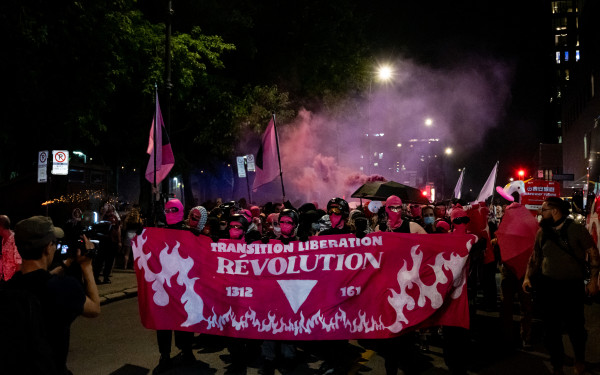
Around 300 protesters rallied outside the Bureau des enquêtes indépendantes (BEI) office in Longueuil on March 15 in honour of the 30th annual International Day Against Police Brutality.
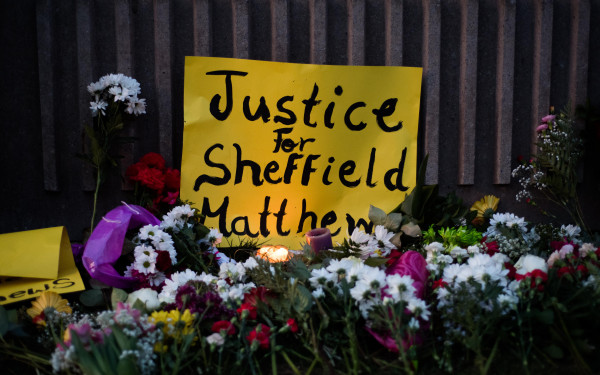
The location was chosen in response to the Service de police de l'agglomération de Longueuil (SPAL)'s killing of 15-year-old Nooran Rezayi in Longueuil in September 2025.
Rezayi was fatally shot right before 3 p.m on Sept. 21, 10 seconds after the police—responding to a 911 call about a group of armed individuals—parked their vehicle. Rezayi’s family says he was unarmed, carrying only a schoolbag, and the BEI investigation confirmed that no firearms were found.
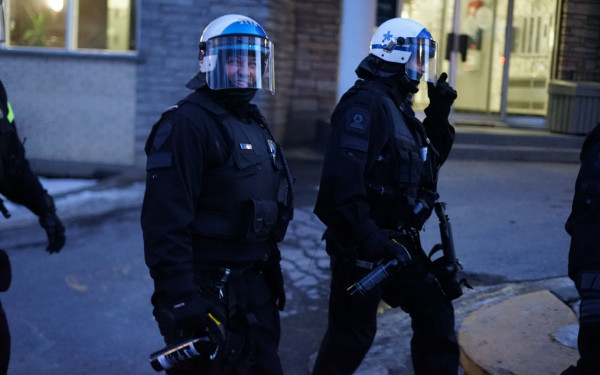
A large number of Sûreté du Québec (SQ) provincial and SPAL municipal police were present at the demonstration, including riot police and an SQ sniper on a nearby rooftop. No police intervention occurred at this year’s protest.
In contrast, 2025’s March 15 protest saw the SPVM deploy tear gas on the crowd and arrest six protesters. Additionally, officers repeatedly assaulted The Link’s photo editor, Andraé Lerone Lewis.
This year, demonstrators sang along to protest songs, danced in conga lines and played hopscotch. Attendees also drew on the streets with chalk, with one attendee writing the names of several recent victims of police brutality in Montreal.
Attendee Felix Brisson, who was granted a pseudonym for safety reasons, said they appreciated the “unexpected” lack of conflict.
“I’m really glad that there was this air of joy and festivity and dancing instead of fear and stress [and] anxiety,” Brisson said.
Attendees—wielding an electric guitar, a bass guitar, amplifiers, a melodica and drums— performed anti-brutality protest songs.
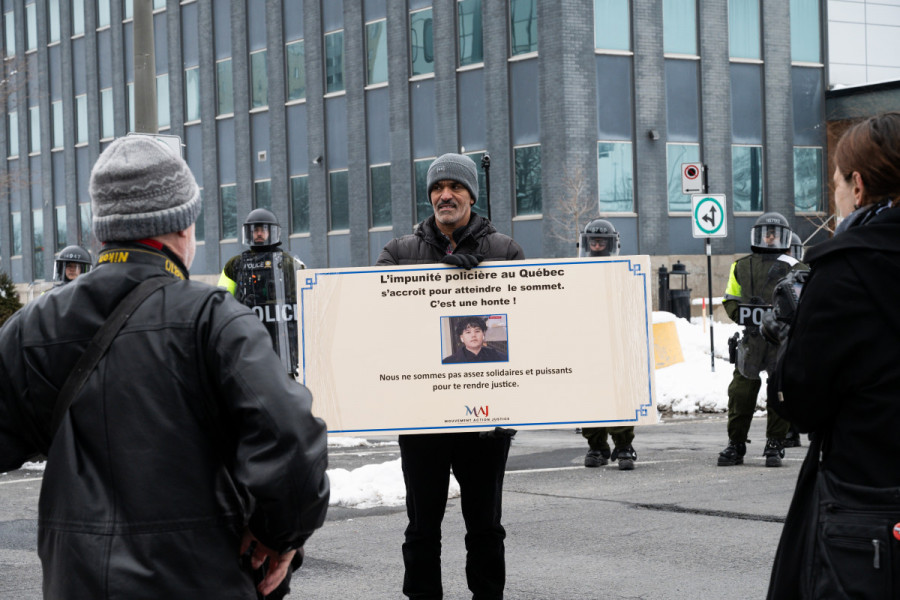
Hadj Zitouni, the director general of Mouvement Action Justice, brought a sign to the protest mourning Rezayi’s death and criticizing “police impunity in Quebec.”
“We have to speak out [and] demand reforms,” Zitouni said. “We’re coming here and trying to say together, in solidarity, that enough is enough.”
Lucy Parsons, a member of the Organisation Révolutionnaire Anarchiste (ORA) who was granted a pseudonym for safety reasons, said that the crowd’s resilience to police violence over the years stood out to her.
“Despite the constant attempts by police and the state to demoralize movements like this through intimidation and repression, people are still coming together,” Parsons said. “[It] reminds us that we’re not alone, and that there are many others who believe another world is possible.”
Parsons said that she attended the protest because she refuses to accept the normalization of police killings and wants to show solidarity with the victims of police violence.
“When a child’s life is taken like that, it forces people to confront the reality of what policing actually looks like in our society,” Parsons said. “We’ve seen so many cases where someone dies during a police intervention and the institutions that are supposed to investigate end up shielding the officers involved.”
Parsons added that, when someone is killed by police, the family is often faced with a long and tiresome struggle to achieve justice for their loved one.
“That process can take years, and it’s incredibly painful,” Parsons said. “The families of people like Nooran Rezayi are left carrying that burden.”
The BEI has submitted a report on the shooting to the Directeur des poursuites criminelles et pénales (DPCP), but no action has been taken at the time of this article’s publication. The BEI has also been criticized by advocates in recent years for issues with lack of transparency and effectiveness and its status as a specialized police force.
Attendee Alex Mailloux, who was also granted a pseudonym for safety reasons, echoed these criticisms, noting that many of the individuals involved in the BEI are former police officers.
“Police protecting other police officers, even when they do bad things, seems to reach up to the BEI,” Mailloux said. Out of 483 investigations by the BEI, only three have resulted in legal proceedings against the officers involved.
“When a child’s life is taken like that, it forces people to confront the reality of what policing actually looks like in our society. We’ve seen so many cases where someone dies during a police intervention and the institutions that are supposed to investigate end up shielding the officers involved.” — Lucy Parsons, ORA
Additionally, the BEI recently announced that it would be closing its investigation without the DPCP laying any charges against the officers involved in the March 30, 2025 killing of Abisay Cruz.
Mailloux said that they have been attending protests in Montreal for many years, and that they have recently witnessed an escalation of police violence towards protesters.
“We used to be pushed and shoved and pepper-sprayed, but now I know dozens of people with very severe concussions, broken bones and [injuries] that will stay with them for the rest of their lives,” Mailloux said.
Parsons said she believes that the solution to police brutality is to build a society that doesn’t rely on policing in the first place, and instead utilizes mutual aid, collective care and community defence.
“In North America, policing grew out of things like slave patrols, the enforcement of colonial control over Indigenous peoples and the protection of private property for the wealthy,” Parsons said.
Parsons pointed to the extreme police presence deployed at this year’s protest as an example of how, in her view, the state prioritizes the defence of its institutions over its citizens.
“Communities, especially poor and racialized communities, often experience policing not as protection but as harassment and surveillance,” Parsons said, citing the importance of police abolition and of learning about alternative systems for community protection.
As an example, fourth response teams for mental health services have been successfully implemented in some U.S. cities to respond to 911 calls for non-violent emergency calls.
Despite the lack of police intervention, altercations occurred between a handful of demonstrators and two livestreamers—Paul Shamrock of Quebec X Media and DeWolf of DCE Media—who repeatedly attempted to film the crowd against their wishes.
DeWolf had a tattoo resembling a "rounded cross" on his neck, which he told The Link was inspired by the skateboard company Independent Truck Company.
The crowd and streamers continuously shouted at each other, repeatedly shoved each other, and exchanged chunks of snow and ice until the protest dispersed at 5:15 p.m.