Coming Out of the Gay Village, a history of one of Montreal’s most prominent neighbourhoods
The exhibition documents the history of the Village in Montreal from the years 1974-1990
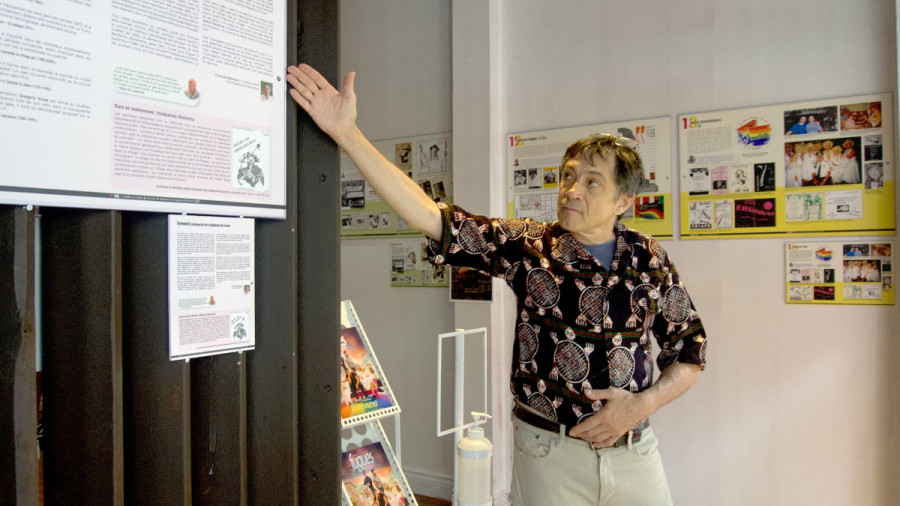
The Coming Out of Montreal’s Gay Village exhibition presented by Les Archives gaies du Québec (AGQ) in collaboration with Fierté Montréal launched on July 31.
The exhibition features AGQ material as well as material gathered by curator François Bellemare during the course of his research, including video testimonials from various community members.
The AGQ offers paid guided tours for groups and the opportunity to buy the exhibition catalogue.
The showcase follows the years between 1974 and 1990 when the gay community moved from the West of Montreal to the East, documenting the historical details of police repression and queer activism of the era.
According to Bellemare, as queer people began being more open, police started to receive more complaints.
“They were feeding each other, the two movements," Bellemare said. "The more repression, the more mobilization.”
After the 1977 Truxx gay bar police raid, the Montreal queer community came out in a big way to demand that the laws be changed.
This history, and much more, is featured in the exhibition. Bellemare was able to gather never-before-printed photographs of protests and posters to add to the AGQ’s collection.
The exhibition was first presented this past fall at the AGQ, where it came to the attention of Fierté Montréal.
The organization offered Bellemare a more centralized location in the Village to put on the exhibition during Montreal’s Pride. This allows the general public to access things they may not have known about before.
“There’s more mingling with the younger generation, and I’m telling the older generation, things change, and you cannot stop that from happening. So what if they want to move? Let them move. Let them know that we built a safe space for them, for them to use our techniques to build their own.” — Gregg Rowe, co-founder of AIDS Community Care Montreal (ACCM)
“It takes the archives out of their world, out of their shelf,” said Bellemare.
Bellemare focused on bringing these archives to a wider audience, including working with a translator to make the exhibit accessible to anglophones.
Susan Lemprière was the translator for the exhibition catalogue. She worked closely with Bellemare to add context to the images that would otherwise have been lost to anglophone audiences.
“There’s a lot of posters and ads that have a lot of plays on words," Lemprière said. "Some of them are very raunchy, some of them are very funny, and I wanted to convey some of that in the image captions."
Given the exhibition’s focus on the gay community in Quebec specifically, Lemprière also included additional information to better situate readers unfamiliar with Quebec's political context of that era.
Bellemare also spoke a little bit about the police's changing attitude surrounding the queer community. Today, Fierté Montréal collaborates with police on security measures.
“The gay memory and the lesbian memory is still inhibited by the long story of repression,” said Bellemare.
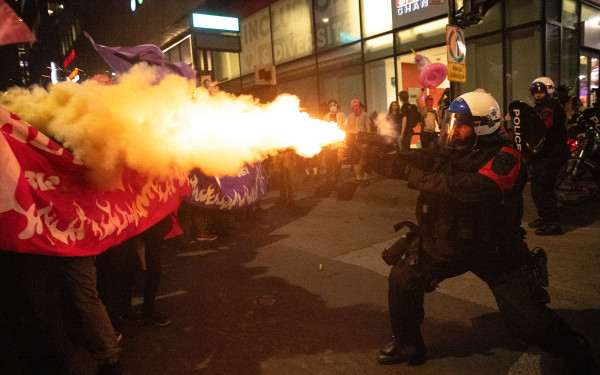
Last year, the alternative pride event Rad Pride was met with police violence and tear gas. Police alleged that pyrotechnics and other objects were thrown at them.
The exhibition also features four events in collaboration with various groups, such as Priape and Aide au Trans du Québec. One of these is the launch of an English version of the exhibition catalogue in collaboration with AIDS Community Care Montreal (ACCM), co-founded by Gregg Rowe.
Rowe’s testimony was included in the video portion of the exhibition.
The ACCM helped the community get established in the 1980s, according to Rowe.
“We were fighting the government and the police and society,” he said. “That’s how the Village got built.”
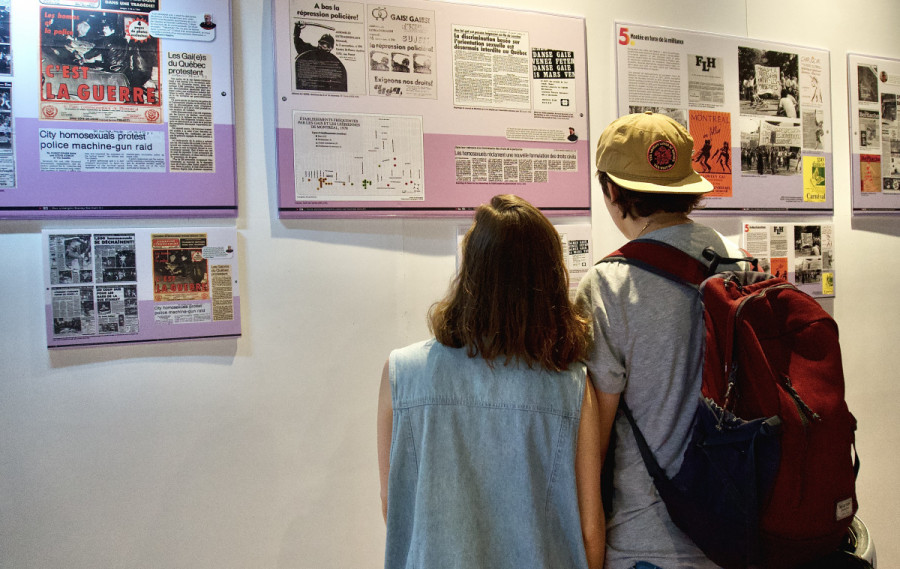
The migration from the West to the East took place because of political pressure. The government wanted to clean up the city for the 1976 Olympics, specifically focusing on the historically anglophone West End where tourists would mostly congregate.
“I can, sort of from experience, say that it was tough for the anglophones to move over there,” Rowe said. “We were crossing the barrier into a francophone community.”
He said that by 1990 the two linguistic cultures managed to come together as one.
“I think that’s what the whole presentation really reflects, is what happened at that time period to our culture,” Rowe said. “Politicians could have gotten away with it, but we didn’t allow that.”
The ACCM provides community outreach, education and prevention.
Rowe said that he is glad AGQ is presenting this exhibit as a way to help bridge the generational gap in the gay community that came about because of the AIDS crisis. He said it is important that they tell their stories.
“We survived, we survived more than HIV and AIDS, we survived the police brutality, we built a community,” he said.
He is now watching young queer people move away from the Village and build more integrated communities of their own.
“There’s more mingling with the younger generation, and I’m telling the older generation, things change, and you cannot stop that from happening," Rowe said. "So what if they want to move? Let them move. Let them know that we built a safe space for them, for them to use our techniques to build their own.”
Coming Out of Montreal’s Gay Village will run until Aug. 9 at 1314 East Saint-Catherine Street.
A previous version of this article stated that the ACCM helped the community get established in the 1970s and 1980s. This is incorrect—the Montreal AIDS Resource Centre (MARC/ARMS) started in 1983 and became the ACCM in 1988.The Link regrets this error.