SPVM increase in chemical irritant usage sparks outcry
Protestors and bystanders share concerns over police’s escalating use of tear gas in recent years
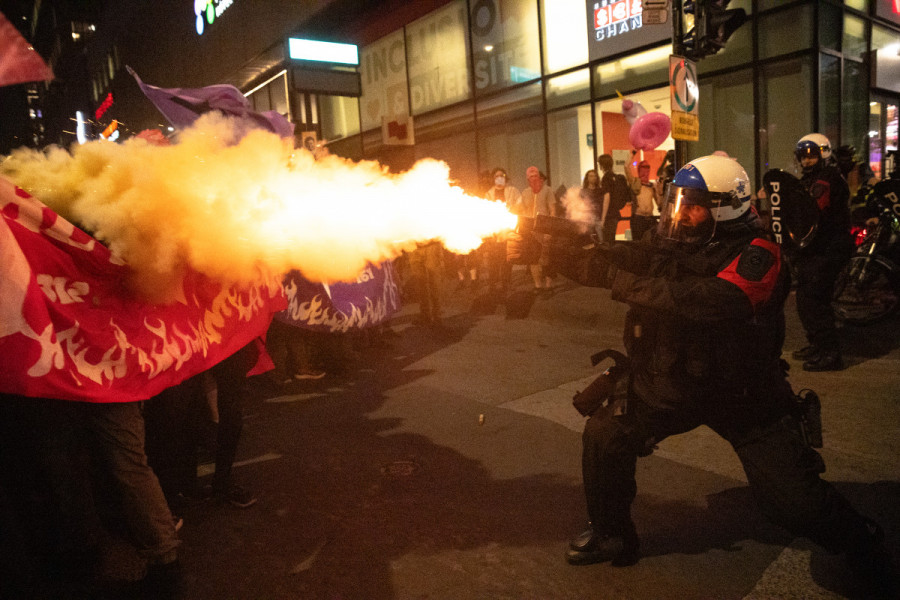
Andy Brunet, a Montreal-based photojournalist, recalls being tear gassed by police during a protest on Oct. 7, 2024.
The experience, they said, was deeply traumatizing and made it difficult for them to continue working.
"It's difficult to open your eyes because everything burns," Brunet said. "It's like they're doing it on purpose, to try and scare you so you don't come back to cover protests.”
This wasn’t the last time police used tear gas on protestors, with documents obtained through an access to information (ATI) request revealing that the SPVM used “chemical irritants” 97 times in 2024, compared to 41 times in 2023, a 137 per cent increase.
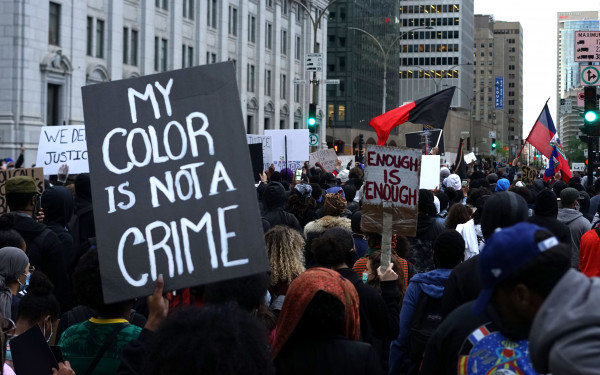
Within this rise, many protesters characterise the SPVM’s tactics as oriented towards escalation, with dispersal via tear gas being the end goal.
Christopher Bahnan, a Concordia University student who has joined protests calling for Concordia to disclose and divest their holdings in companies involved in the genocide in Palestine over the past few years, said that, in their experience, police rarely attempt de-escalation.
“There's no efforts or policies towards de-escalation that they use,” Bahnan said. “And when they do, it is always accompanied by a cavalcade of cops on bikes who will storm and assault the students as they try to move away.”
Emerson Rheault, another Concordia student and activist, shared a similar sentiment.
“They often use tear gas without warning or knowing that it's going to be very hard [for protesters] to run away and get to safety,” Rheault said. “It just feels like I’m trapped.”
Bahnan recounted an experience where the SPVM deployed tear gas in a confined space with no direct escape route, during an anti-NATO protest in November 2024. Demonstrators were tear-gassed in a semi-enclosed underpass on Viger Ave. E. next to the Palais des congrès de Montréal.
At the same protest, police shot a round of tear gas through a car window, setting it on fire. Although several media outlets and the SPVM itself originally claimed protesters caused the fire, TVA journalist Hadi Hassin later revealed that the depleted round had set the vehicle ablaze.
Most recently, Amnistie internationale Canada Francophone announced that they’re assessing if the SPVM violated the international legal right to protest with its heavy deployment of chemical irritants at a protest against ICE-affiliated security firm GardaWorld on Feb. 13.
Police protocol at demonstrations
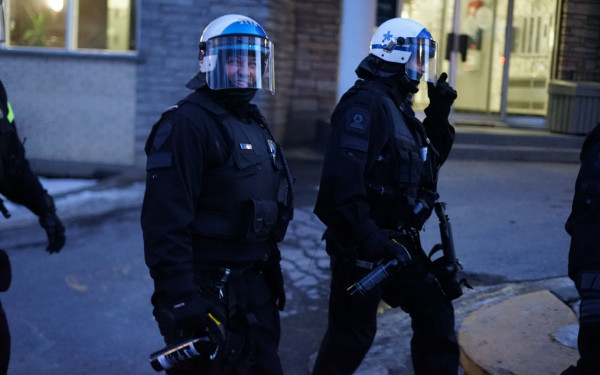
According to Paul Chablo, a 30-year SPVM veteran and chairman of the Police Technology program at John Abbott College, the SPVM has procedures to determine the amount and type of force to bring to each event.
“[They’re informed by] what happened in other cities with similar protests, and what happened in other years,” Chablo said. “Undercover officers infiltrate these organizations and collect information.”
He argued that demonstrators have the responsibility to accept harm risks when police appear aggressive.
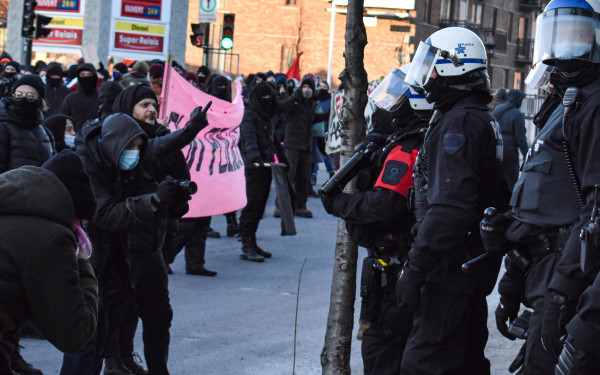
“By the time you get to the riot squad coming with shields and sticks and helmets are you going to stand there with your friends, and get in their way? Nobody in their right sense would,” said Chablo.
He cited examples like rowdy concerts or demonstrations against police brutality as situations where police are likely to bring extra force. The more the person resists, Chablo said, the more the police “can use force.”
Still, he claimed that there are hard limits on the way officers will use tear gas.
“The police will not—they never will—use any type of [chemical] agent on any children or families,” Chablo added.
Witness accounts reveal contradictions
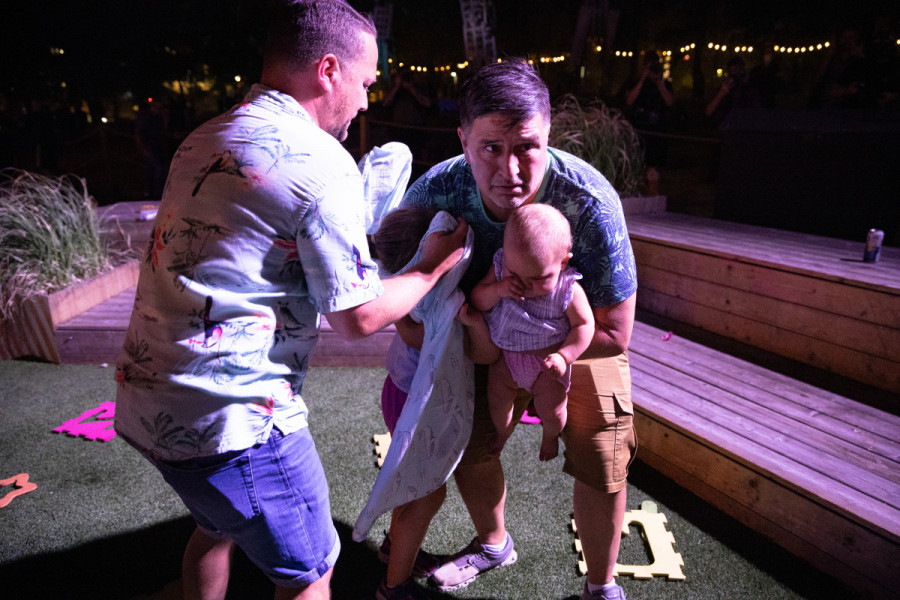
On Aug. 9, 2025, SPVM riot police pushed protesters participating in a Rad Pride demonstration towards Émilie-Gamelin Place, where a family-oriented Latin dance event was taking place.
Jean-Philippe Forget was attending the dance event with his husband, 10-month-old and five-year-old child when the SPVM fired a tear gas canister that “landed right on my baby, like two inches from her face,” he testified in an interview with the CBC.
He further added that the gas covered his family, causing intense pain in his eyes and arms. His children began crying, and the family fled alongside the rest of the protesters.
Forget said that his five-year-old is still very traumatized and “has been afraid of going into crowds and refusing to sleep alone ever since.”
With Forget’s family and numerous other attendees being exposed to the gas, an SPVM spokesperson told The Gazette that “strategic decisions were made taking into account public safety issues.”
A call for transparency from the SPVM
Rine Vieth, a PhD socio-legal researcher with Laval University, has been engaged in an ATI dispute with the SPVM in an attempt to acquire its contracts with tear gas suppliers.
After sending an ATI request to the SPVM on April 5, 2025, Vieth was left without an answer for two months before receiving a response on June 10, 2025 stating that the SPVM’s non-answer should be "considered a refusal.” The refusal email came weeks after the 30-days response period mandated by national ATI regulations.
Following an appeal to the Commission d'accès à l'information, Vieth was eventually sent some documents in August which claimed that the SPVM “hasn’t used lachrymatory gas for several years” and that it “cannot provide any documents related to contracts, spending, and similar subjects related to chemical irritants” because it would violate regulations on withholding information that could reveal crime-fighting processes.
“Their reason was that they don’t want to turn it over to me because criminals could prepare if they knew what weapons the SPVM had,” Vieth said. “And my point there was to say, ‘Look, what if I give you a list of everything I’ve seen the SPVM publicly have?’"
Vieth added that the SPVM has held press conferences about the use of chemical irritants in the past.
"What are criminals preparing for if it’s been in the CBC?” Vieth said.
Debates on the ethics of tear gas usage
Vincent Wong is a law professor who co-authored a 2020 report on tear gas use for the University of Toronto.
The report identified several short and long-term health consequences associated with exposure to tear gas, including nausea, vomiting and permanent vision and breathing problems. Prolonged exposure can also lead to chemical burns in the throat and lungs, as well as respiratory failure.
Documented cases of harm resulting from people being shot directly by the canister include skull fractures, penetrating head and chest wounds and deep burns from canister heat.
Wong believes it important to push against the perception that tear gas is harmless and safe for use.
“This perception is extremely problematic and has to do with the marketing of tear gas [by] colonial policymakers,” said Wong.
“No amount of training or reform can render tear gas use by police reliably safe or justifiable from an international human rights law perspective.” — Vincent Wong, law professor
Wong quoted a 2023 international medical review by Physicians for Human Rights, which identified at least 100,000 people who have been injured by tear gas since 2016, and at least 14 people who have died.
In contrast, Chablo said that if people want to stay safe around riot police, “all they have to do is not to stay there.”
“Ninety-eight per cent understand this," Chablo said. "Now we get this 2 per cent that just want to be stupid, and they try, and they don't win."
Chablo said that responsible organizers should identify “agitators” to the police before the protest begins and remove them from their group, adding that protesters shouldn’t join demonstrations if they see “a bunch of troublemakers.”
Wong argued that this framework collapses the right to peaceful expression and assembly.
“[It] inherently authorizes dangerous force and that any resulting harm is foreseeable and therefore the victim’s fault,” Wong said. “This erases scrutiny of whether the force was necessary, proportionate or even lawful in the first place.”
Wong furthered that there is reason to believe that tear gas is never necessary at demonstrations.
“No amount of training or reform can render tear gas use by police reliably safe or justifiable from an international human rights law perspective,” he said. “Tear gas and other crowd control chemical agents are inherently indiscriminate, affecting offending actors, peaceful protesters and vulnerable bystanders alike, and often produce state-sanction terror in order to specifically undermine freedom of assembly.”
A previous version of this article stated that Andy Brunet was tear gassed by police during a protest on Oct. 7, 2023. This is incorrect, the incident took place in 2024. The Link regrets this error.
This article originally appeared in Volume 46, Issue 10, published February 24, 2026.