Unregulated but essential?
Concordia’s AI push is outpacing any policy on how it should be used
“AI has moved from experimental to essential,” Concordia University's promotional page for its AI Foundations course reads.
When I started my degree at Concordia two years ago, AI was still new to university life.
Back then, ChatGPT faltered on introductory math questions, but it has since been trained and improved on millions of queries, though its reasoning sometimes still fails.
The exponential growth in AI popularity has now led to some research supervisors offering to pay for graduate students’ AI subscription plans by invoicing it as part of the research bursary. By agreeing to foot the bill, these supervisors seem to be echoing Concordia's own promotional line: AI is now essential.
Justifications vary: some fear falling behind technologically, while others find AI faster than existing software for complex computations, since debugging code can take longer than the math itself.
However, isn’t it the institution’s responsibility to protect its labour force?
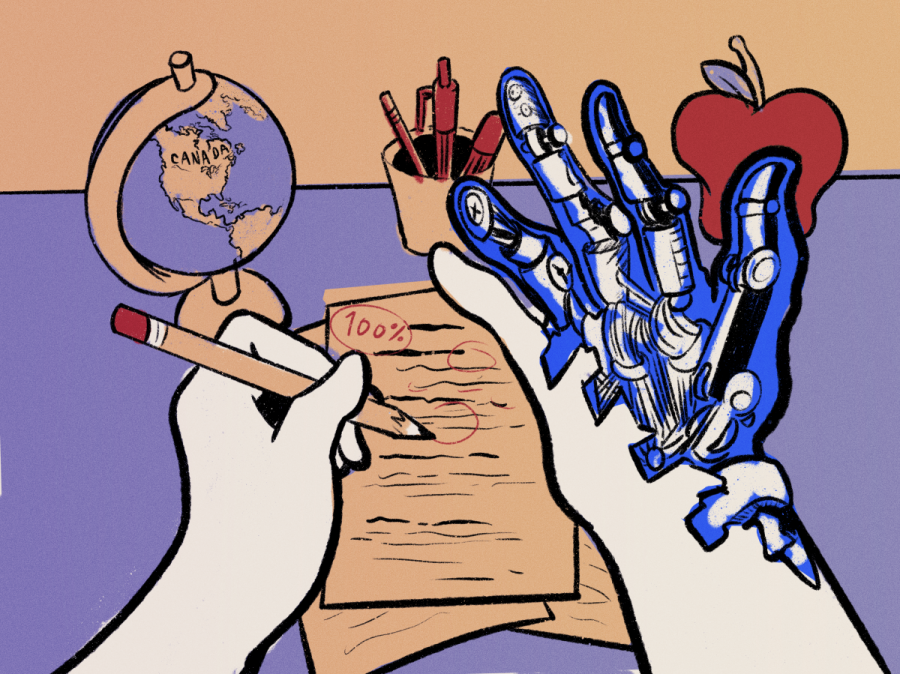
Job security is a legitimate fear. As a teaching assistant, grading has become more complicated; it can be mind-numbing to assess students’ assignments, not knowing if I just corrected the same advanced calculator’s computations rewritten on separate papers. A few years ago, students were hired to translate excerpts of original texts as part of a research assistantship. When a thesis supervisor asks an AI model to translate a whole book, under the illusion of “efficiency,” an experienced translator (and their attention to nuance and context) is foregone for an immediate result at the cost of $200/month. What's more, post-editing (having a human translator review the AI's output, standard practice in professional machine translation) isn't even factored in.
This exact kind of job loss is playing out with Concordia's own Genio Notes: the AI transcription tool, rolled out over the summer of 2025, has already unsettled the 72 student employees who provide note-taking as an accessibility service, despite the university's insistence that there's "no plan to replace human notetakers."
“The Certificate in Generative AI for the workplace introduces you to AI’s range of capabilities and shows you how to use them to spark new ideas, save time, and produce higher-quality work,” Concordia said on its website.
That “time-saving” quality of AI can be a placebo effect. In a meeting with a supervisor who wanted to show me how AI can be used to construct certain diagrams, he had to correct the AI and ask it to redo the same question multiple times.
As a renowned researcher, he pinpointed the inaccuracies, but students might readily accept a symbolic response as fact, leading to more mistakes or delays down the line.
It's unclear which topics and ethical issues Concordia intends to explore in its coursework on AI, and it's surprising that instructors, graduate students and undergraduate students are not being informed as the changes unfold.
As part of the university’s privacy policy, Concordia should be proactive about warning students, workers and faculty against “feeding” AI models any lecture materials, sources, books and so on, to prevent copyright infringement—a concern Concordia faculty have already raised about Genio Notes training on recorded lectures.
Regulating what students upload may be next to impossible, but protecting against data theft and plagiarism has to be the priority. Until guidelines and training for faculty and students are in place, professors and staff are just as capable of feeding data sheets or even private emails into that same AI pool. So far, the only AI-related rule Concordia has issued is a ban on using the DeepSeek chatbot on university-owned devices (Feb.13, 2025).
Instead, as of Aug. 17, 2026, they have published a guideline on the library website for students to seek out regarding the responsible use of Generative AI (“Gen AI”).
In its mad dash to get with the times and position itself as a pillar of AI, Concordia left behind the students it governs as an educational institution. And without concrete regulations and support, it’s on us to catch up.
This article originally appeared in Volume 47, Issue 1, published September 8, 2026.




_600_375_90_s_c1.jpeg)