Iranian student grievances, academic advisor accountability discussed at CSU elections debate
The debate also saw discussion of student representation in higher administration
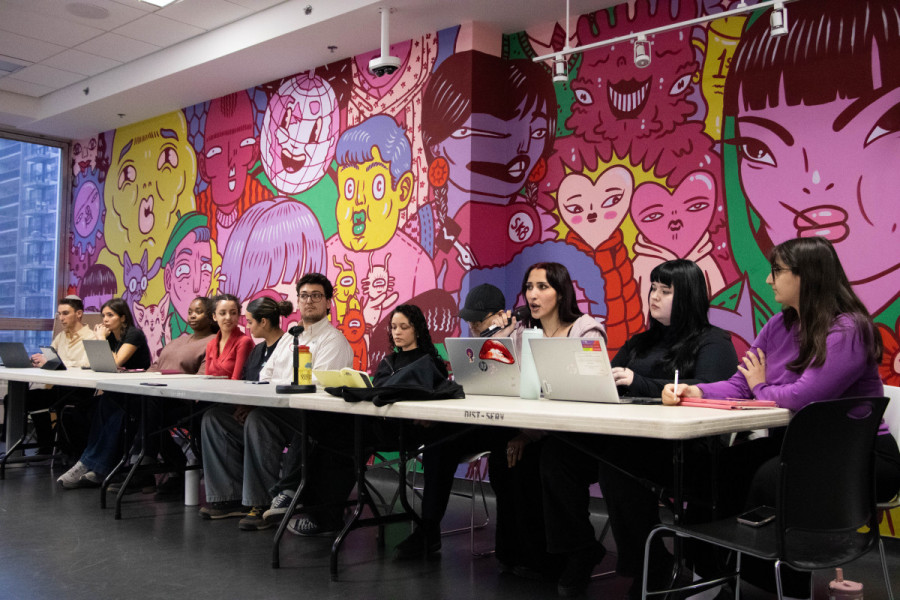
Eleven candidates participated in the Concordia Student Union (CSU)'s 2026 first general elections debate on March 10 at Concordia University.
The CSU held the debates in the Henry F. Hall building in front of an audience of 12. Originally scheduled for 6 p.m., the event did not kick off until 6:15 p.m. and lasted until 7:30 p.m.
The main concerns of the evening were Iranian student aid and protection, academic advisor accountability and student representation on the university’s Board of Governors.
Present at the debate were the Step Up slate—save one member, Emma Doyle—along with candidates Drew Sylver, running for arts and science council; Leen Al Hijjawi, running for academic and advocacy coordinator; Zoe Erika-Okoye, running for sustainability coordinator; and Sofia Leiva, running for arts and science council.
A total of 54 candidates are running for CSU positions this March: 41 for council seats, three for senate and 10 for executive positions.
The debate had some scheduling issues, according to CSU chief electoral officer Callum Ellis-Mennie, due to council meeting conflicts and last-minute advertising. The Loyola debate, originally scheduled for March 9, has been postponed.
The general elections are currently in their campaign period, which will last until March 16. The polling period will take place from March 17 to March 19.
Protecting Iranian students
Independent studies student and audience member Diba Sedighi claimed at the end of the debate that a women’s studies professor harassed her via text message because of Sedighi’s support for Iranian liberation. Sedighi claimed she submitted complaints to the administration, but received no resolution.
The Link has not been able to independently verify these claims by publication time.
Sylver, a former CSU councillor, said the council should launch a petition and campaign to address this harassment.
Ryan Assaker, current CSU finance coordinator running for general coordinator with the Step Up slate, said Sedighi is not alone.
“Iranian students have come to me as well and have talked about specifically, not only this teacher, but a couple of other teachers that have been doing the exact same thing,” Assaker said.
Sedighi claimed Iranian students feel isolated with the way they have been treated at Concordia.
Academic advisor accountability
Isabelle Ranger, running for academic and advocacy coordinator for the Step Up slate, stated that the accountability and poor training of departmental advisors and advising services need to be addressed, especially given limited class availability due to administrative budget cuts.
“Everyone’s had a bad experience with an academic advisor,” Ranger claimed. “That’s only going to get worse with these existing issues with misleading information from an academic advisor that is preventing people from progressing in their degree and graduating, and in a lot of cases, that can be really detrimental to a student.”
Audience member and Concordia biology alumnus who graduated last spring, Khashayar Hoseinzad, said he studied on the wrong school path for three years due to the ill-advice of academic advisors.
“Their pointers for what we should do are literally useless for us,” Hoseinzad said of their experience with advisors at the university. “They don’t have enough knowledge at all about how things must be done.”
Ranger said she has seen a lot of data on these shortfalls during her time as the CSU Advocacy Centre’s lead student advocate, and credits it as a universal problem across the university.
Student representation on the Board of Governors
Assaker aims to expand student representation on university decision-making bodies, such as the Board of Governors, Concordia's highest oversight body responsible for the university’s financial decisions.
“I think there is a very strong case to make that students should have a bigger piece of the pie,” Assaker said. “[Student] voices are loud, should be loud and should be represented on [the Board of Governors].”
The CSU represents an estimated 35,000 undergraduate students and has only one seat on the Board of Governors. In 2012, undergraduate representation fell from 10 per cent to the current 4 per cent of voting members when the Board of Governors reduced their seats from 40 to 25.
Assaker also mentioned that he would like to create coalitions with professors to fight common grievances held by both the student body and faculty against the university, such as the recent non-renewal of limited-term appointments teaching contracts.
“There needs to be an understanding that this is not a one-sided thing, and students can collaborate with teachers and department heads to be able to enact concrete change within the university,” Assaker said. “If you go talk to teachers, you’ll see that they mirror a lot of frustrations the students have.”