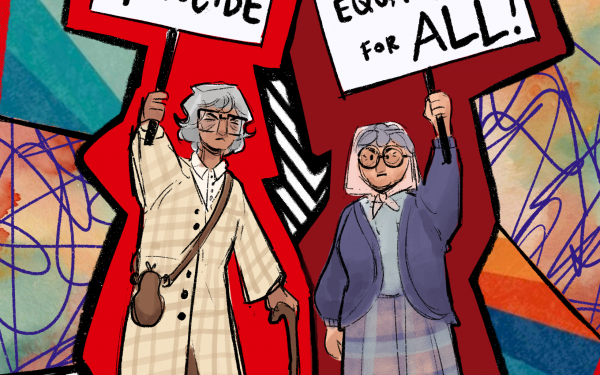
Thousands in Montreal march for global women’s rights
Protesters gathered in solidarity with various human rights movements
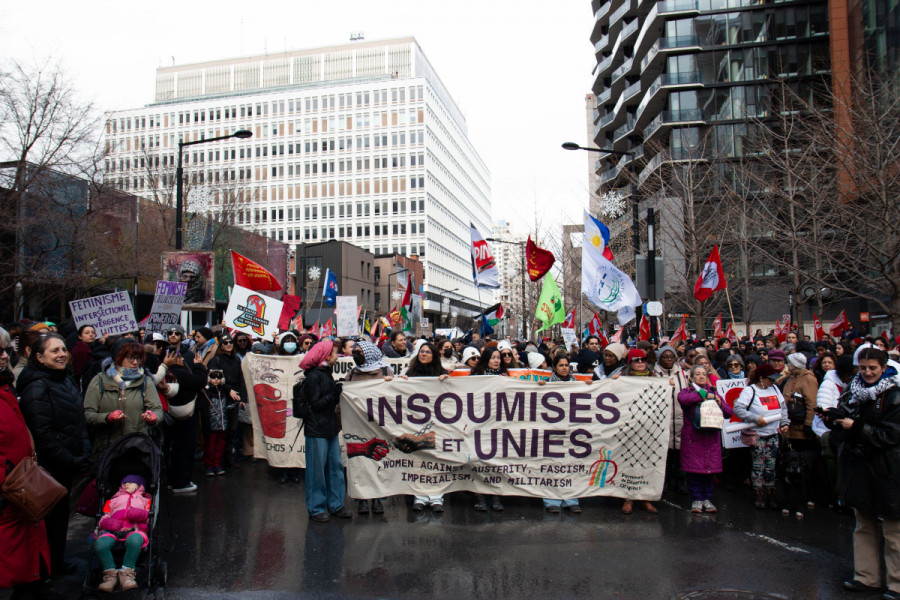
On March 8, thousands gathered in the streets of downtown Montreal for the 25th annual International Women’s Day march, organized by the anti-imperialist community group Femmes de diverses origines.
The event celebrated the 115th anniversary of the 1917 Petrograd strikes, where female textile workers in Saint Petersburg, Russia, incited a citywide protest against World War I and Russia’s inability to feed its citizens. Their demands for “bread and peace” defined a day that would eventually be recognized as International Women’s Day.
Protesters began gathering at Place Norman-Bethune around 12:30 p.m., although the mass of participants grew large enough that it stretched down de Maisonneuve Blvd.
Kay Lockyer, who helped organize the march with Femmes de diverses origines, commended the large turnout.
“It's been 25 years that we've been doing this,” Lockyer said. “It's amazing that we're able to bring to the mainstream feminist movements anti-imperialism, anti-colonialism, anti-capitalism, all the anti-isms.”
Before the march began, organizers invited speakers from different participating groups to address the crowd. One of the groups was Anakbayan Montreal, a national democratic Filipino youth group fighting for the right to land, jobs and fair wages, education, and social services.
Anakbayan Montreal member Alexi Fuentes called out the Filipino government for its oppression of its people.
She brought up Chantal Anicoche, a Filipino-American woman who was abducted by the Armed Forces of the Philippines after returning to the country to learn more about the persecution and aid with relief work. Anicoche was released after heavy pressure from activist groups.
“We must all stand alongside the most marginalized women because none of us are free until all of us are free,” Fuentes said.
Solidarity remained a key theme throughout the march, which got underway around 1:45 p.m.
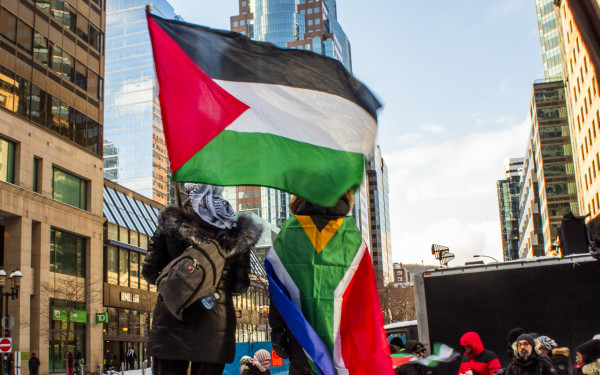
Protesters moved east down de Maisonneuve Blvd., waving Iranian, Congolese, Lebanese and Palestinian flags and chanting in support of women’s rights, workers’ rights and an end to international conflict.
Julien Daigneault is a member of Socialist Alternative, an organization that campaigns for environmental, economic and social justice movements. He emphasized the importance of standing with other marginalized groups in unified opposition, using the ongoing genocide in Gaza as an example.
“At this very moment, we are in the context of war, and war disproportionately affects women,” Daigneault said. “For instance, in Gaza, 70 per cent of the dead are children and women. So we have nothing to gain from being part of this militarism that we see everywhere.”
A report issued by the UN Independent International Commission of Inquiry on the Occupied Palestinian Territory found that Israel has extensively used gender-based violence to attack and dehumanize the Palestinian people throughout the ongoing genocide in Gaza.
Along with the sexual assault of women, men and children, Israel has also destroyed sexual and reproductive healthcare facilities, including maternity wards and in-vitro fertility clinics.
The protest continued down de Maisonneuve Blvd. until it reached Wood Ave. and turned to face 1 Westmount Square, the location of the Consulate General of Israel in Montreal.
While police presence remained active throughout the march, no crowd control forces were deployed amongst the protesters. At the consulate, however, riot police guarded the doors.
Protesters denounced the Israeli occupation of Gaza and chanted, “Not in our name,” in reference to Israel’s pinkwashing campaign to demonize Palestinian treatment of women and LGBTQIA2S+ individuals.
They also burned a two-faced effigy of U.S. President Donald Trump and Israeli Prime Minister Benjamin Netanyahu and lit smoke bombs in black, green and red.
The U.S. carries a long-running history of gender-based violence in foreign conflicts. This includes the 1968 My Lai Massacre during the Vietnam War and extensive sexual assault committed both by and within the U.S. military throughout its campaigns in the Southwest Asia and North Africa region in the early 2000s.
Most recently in Iran, U.S. airstrikes destroyed the Shajareh Tayyebeh all-girls elementary school, killing 175 people, including women and children.
After stopping at the Consulate General of Israel, the protest continued down Ste. Catherine St., stopping again at the intersection of Atwater Ave. There, marchers burned another effigy, this one of former Quebec Premier François Legault, who drew intense criticism for his management of abortion rights and targeted attacks on Quebec’s Muslim community.
Alexanne Lessard, who joined the protest in support of the movement, praised the solidarity among the various advocacy groups.
“Even if we have some kind of difference, even if we're not always the same, we don't pick on each other, but we unite around humanity,” Lessard said. “Because what's the other choice? Wait and die?”
The march reached Pierce St. around 3:30 p.m., where it was halted by ongoing construction. Despite this, many protesters lingered, dancing in the street and continuing chants.
A small altercation arose near the end when several protesters attempted to snatch an Israeli flag from a woman who had waved it at the march from the sidewalk. The woman was knocked to the ground, but officers intervened and separated her from the protesters.
The protest finally dispersed around 4:00 p.m. in the presence of police officers on bicycles and several police vehicles.



_600_375_90_s_c1.jpg)