
A constitution without consent
Power rarely introduces itself as power.
When the CAQ government tabled Bill 1, the Quebec Constitution Act, in 2025, former premier Francois Legault framed it as a way to protect what he describes as Quebec’s common values.
Those values include the protection of the French language, state secularism, equality between men and women and the right to abortion. The bill also affirms Quebec’s use of the notwithstanding clause, allowing the government to override certain Charter rights without having to justify its decision.
But a constitution is not meant to protect the government; it is meant to protect the public from the government. A constitution should draw the line between authority and accountability. Bill 1 moves that line in the state’s favour.
Bill 1 would create a formal Constitution of Quebec. It would declare the province an autonomous national state and position its constitution as the “law of laws” within its borders. It would revise the Quebec Charter of Human Rights and Freedoms and recalibrate the balance between collective rights and individual protections. It would restrict certain publicly funded organizations from using public funds to challenge laws deemed fundamental to Quebec’s identity.
Human rights organizations have cautioned that the bill diminishes Quebec’s Charter protections, imposes new limits on fundamental rights and risks eroding the rule of law. More than 300 organizations have publicly condemned the bill, calling it a threat to democratic safeguards and access to justice.
Supporters call this autonomy. But autonomy without accountability shields those in power from scrutiny.
When governments restrict who can challenge laws and limit the avenues through which legislation is made, they reduce oversight. And oversight is not obstruction; it is democracy. Courts exist to review state action, while civil society exists to question it. Minority protections exist because majorities cannot always be trusted to protect everyone equally.
These mechanisms are safeguards, not inconveniences. Bill 1 narrows those safeguards.
By limiting publicly funded groups' ability to challenge certain laws in court and asserting that Quebec’s constitution takes precedence, the bill could make it harder for minority communities and institutions to contest government decisions.
When access to courts tightens, the majority does not feel it first. Instead, the pressure clamps down on linguistic minorities defending institutions. It puts a stranglehold on communities that rely on constitutional protections when political processes fail them. The process surrounding the bill deepens those concerns.
A constitution should be shaped by the people who must live under it. It should emerge from broad consultation, open debate and collective ownership. Yet Bill 1 was tabled without prior public drafting or participatory consultation, with hearings announced only after the fact. For legislation that reshapes constitutional architecture, that sequence matters.
If a constitution is meant to check power, it should not be advanced through a process that concentrates it.
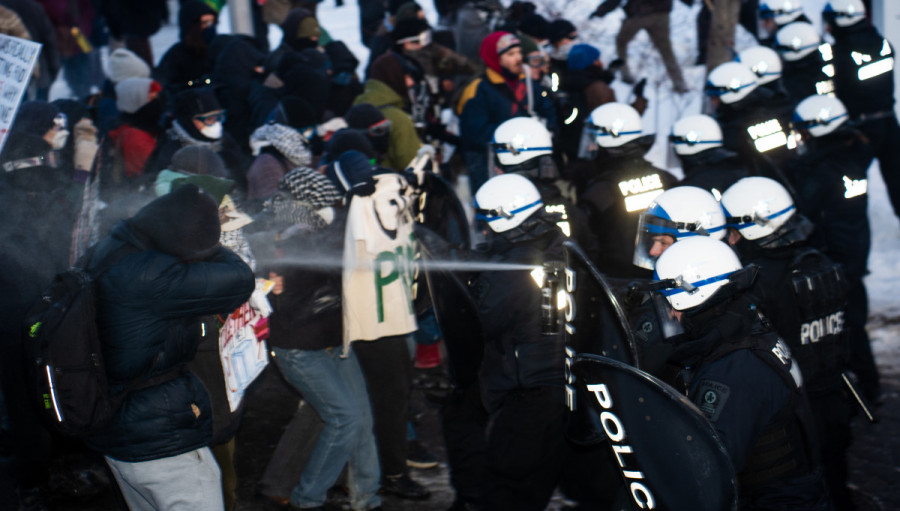
Last week, hundreds gathered in the Saint-Laurent borough to protest Quebec-based security contractor GardaWorld’s ties to U.S. Immigration and Customs Enforcement, known as ICE. The demonstration was dispersed with pepper spray and tear gas, and human rights observers, like Amnistie internationale Canada Francophone, have raised concerns about whether the right to peaceful assembly was respected.
The statute and the street are different arenas, but they expose the same question: how easily can power be challenged?
One arena concerns the right to judicial review. The other concerns the right to protest. Both are mechanisms through which the public holds the state accountable. Power does not become legitimate simply because it is written into law. It becomes legitimate when it accepts limits.
The Link believes those limits matter.
We believe rights must be enforceable, not symbolic. We believe minority protections cannot depend on who holds a majority in the National Assembly, and courts must remain accessible to those challenging the state. Constitutional change should be built with the public, not presented to them as a finished product.
A constitution should expand democratic participation, not narrow it. It should strengthen accountability, not shield authority. It should make it easier to defend rights, not harder.
Yet Bill 1 concentrates power while narrowing the tools used to challenge it, reshaping constitutional authority without meaningful public participation.
Constitutions exist to limit power. And when that limit weakens, it is not power that becomes vulnerable.
It is the public.
This article originally appeared in Volume 46, Issue 10, published February 24, 2026.





_(1)_600_375_s_c1.png)