
Social (Cult)ure: Mediocrity (Taylor’s Version)
The devotion of Swifties can shield Taylor Swift from honest critique
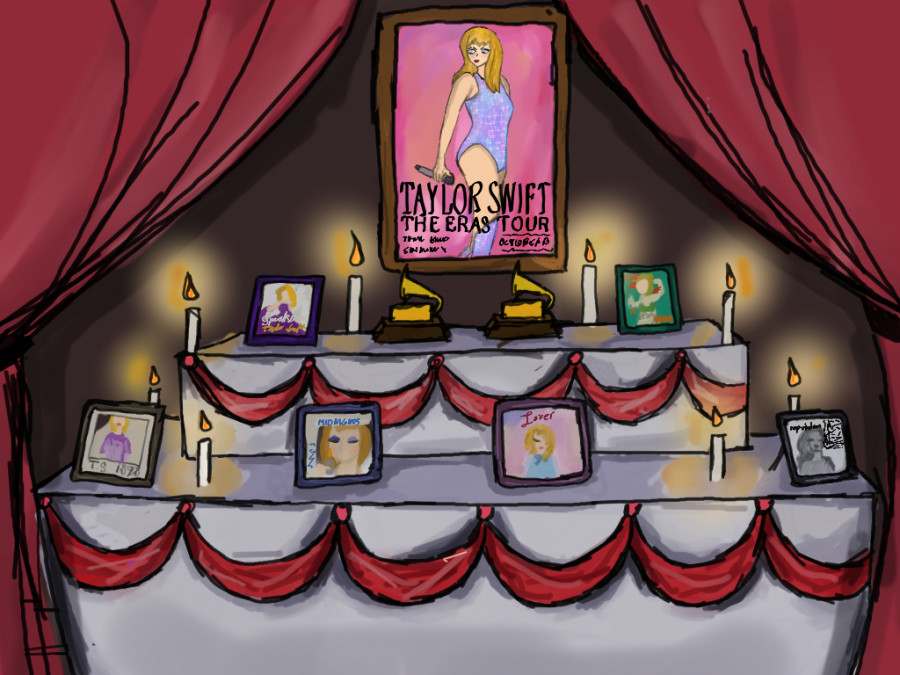
Taylor Swift has never been more powerful. She has also rarely felt less challenged.
After decades of reinvention, record-breaking tours and billionaire status, Swift occupies a level of cultural dominance that few artists ever reach. But with that dominance comes a new problem: when no one can meaningfully critique you, what sharpens the art?
At this scale of success, fandom begins to function less as an audience and more as infrastructure. Swift’s power is not sustained by sales alone but by a digital culture that increasingly treats criticism as disloyalty rather than discussion.
When Swift began her musical career in 2006, she presented herself as an ordinary and relatable teenage girl-next-door. Two decades later, in 2026, her billionaire status has made that persona impossible to sustain.
But wealth alone cannot explain the recent decline in her work. She has already demonstrated that artistic distance from her audience is not fatal.
She fully embraced her pop princess status on her 1989 album in 2014, creating a critically acclaimed record that accurately reflected her already unrelatable celebrity rather than apologizing for it. Her artistic range became even clearer in 2020, when folklore featured songs like “betty,” written from the perspective of a fictional 17-year-old boy.
But critics and much of the public widely regarded 2025’s The Life of a Showgirl as a significant artistic low.
It was released following the record-breaking Eras Tour, which has been acknowledged as both a celebration and a peak of Swift’s illustrious career. This elevated Swift to a degree of success where, for the first time in her career, the “haters” that she had fixated on artistically for decades were relatively silent concerning her art.
The record itself exposed the consequences of that silence.
Critics pointed to a noticeable decline in lyrical precision, arguing that the sharp writing that once defined her had been replaced with shallow, even cringeworthy lines. In earlier eras, she treated backlash as fuel. This time, Swift’s response to the backlash was accepting of the mixed reviews, stating that all publicity is good publicity with no commitment to change.
This is different from her previous attitude to criticism. In 2019, after Reputation was snubbed at the Grammys, she declared she needed to “make a better record.” That reflex toward betterment now appears absent.
This album also divided her fans, with some feeling betrayed by the decline in quality, and others continuing to defend Swift.
What began as solidarity has, at times, hardened into orthodoxy. The language of support blurs into the language of defence, and defence blurs into suppression.
Criticism of Taylor Swift rarely stays about the music for long. It turns into a question of loyalty. Fans coordinate streaming pushes, overwhelm negative reviews and treat even mild critiques as something personal.
At that point, it’s hard to know what genuine feedback even looks like. Swift has shown she can grow and recalibrate when she wants to. The difference now is that she doesn’t really have to. There’s always someone ready to smooth it over.
Swift has flown too close to the sun in a metaphor she may have appreciated five years ago, but would not feel the need to use anymore.
With every new level of success reached, Swift ceases to improve the quality of her work, to the detriment of the very fans who defend her.
And yet they continue to cheer on the decline, as long as it’s branded “Taylor’s Version.”





_600_375_90_s_c1.jpg)