Buying with intention at the BUYPOC Market
The event centred Black-owned businesses and creative expression
Held in honour of Black History Month, a student-led market on Feb. 26 at Concordia University featured Black artists displaying their work, from little knick-knacks to nail art and paintings.
The BUYPOC Market, held in collaboration with Black History Semester (BHS), the Fine Arts Student Alliance (FASA), and Second Soul, organized a pop-up market exclusively for Black vendors for the month.
BUYPOC started as a community for small businesses to network, then blossomed into a monthly market at Concordia for BIPOC artists and entrepreneurs.
Syeda Asmat Fahim, BUYPOC’s events and logistics coordinator, describes the initiative as a "beautiful community of growth" and an opportunity to create a safe space for people of colour, to motivate them to display and explore their creativity.
Having been a vendor herself, Fahim found a boost of confidence in her business by showcasing her homemade jewelry.
“Representation and the space you create really matter,” Fahim said.
The event called for 15 Black applicants, for which there was no tabling fee, so all the proceeds and profits went to the vendors.
Running from 11 a.m. to 5 p.m., it offered a steady, welcoming space for the community to gather and support Black-owned businesses. Focused on personal care, handmade crafts, jewelry, artwork and holistic therapy, the market highlighted creativity and entrepreneurship in a relaxed, accessible setting.
Vendors in their personal care sections featured natural hair and skincare products, including lotions, oils, body butters and all-natural treatments for decongestion.
One table showcasing handmade crafts displayed press-on nails, each with its own signature, made by Cassandra Youemto, a freelancer who started her business, Claws By C, a year and a half ago.
“I’m here not only to promote my own business but also to encourage other people who are here today,” Youemto said.
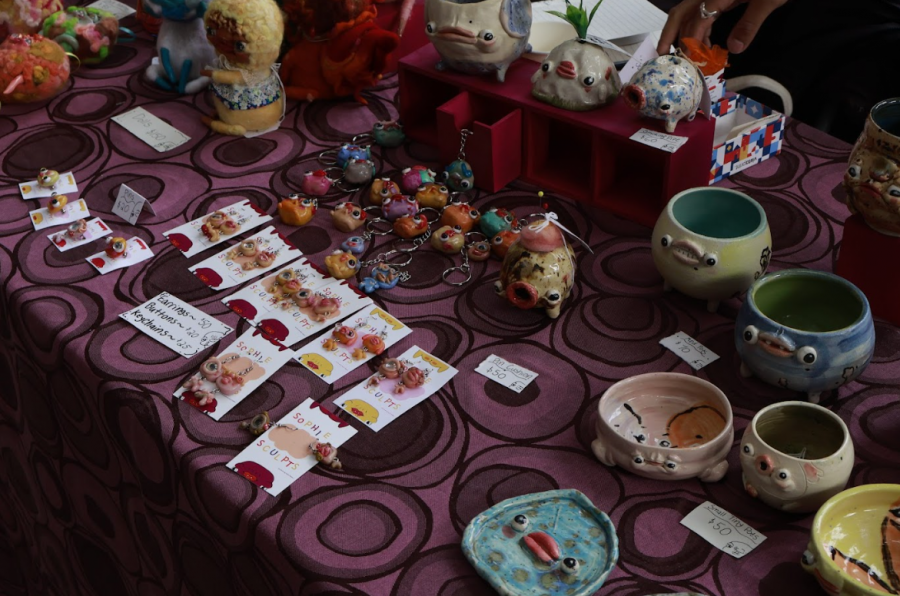
Another vendor curated little ceramic sculptures with different personalities, some in the form of ashtrays and ornaments, with faces knitted into clouds of yarn. Sophia Angbao is a mixed-media artist working in ceramics and textiles, creating whimsical, creepy creatures.
Angbao has participated in many markets, but this BUYPOC event is her first. She expressed the importance of being able to support the Black art industry, particularly in the face of the societal barriers that most Black artists face.
“It’s really nice to feel all the creativity here and the camaraderie,” Angbao said.
A quieter corner was dedicated to holistic therapy, where the practitioner offered tarot readings to clients, fully immersed in her sessions.
The atmosphere encouraged connection rather than rush.
Jewelry designers presented both bold and minimalist pieces, from crystal earrings to beaded accessories and charmed chokers. Several collections incorporated thrifted and locally sourced items, and others blended heritage with contemporary design.
The market was vibrant with a sense of fellowship and appreciation, prompting vendors to adopt eco-friendly and sustainable approaches to their business models.
In bringing together commerce, culture and community, this marketplace served as a reminder that Black History is not confined to textbooks or timelines; it is actively shaped by creators, entrepreneurs and wellness practitioners working today.
BHS coordinators Shaun Polanco-Simmons, Esther Clarke and Titunlola Kuti reiterated that the focus of their student association is not limited to one month. Rather, it stretches throughout the whole semester, celebrating Black communities’ culture, heritage and accomplishments.
“We’re focusing on a broad stroke of months, where again Black people have Black people every day of the year,” Polanco-Simmons said.
It was not simply a seasonal gathering, it was a living expression of history in motion—a reminder that celebrating Black History also means investing in its future.